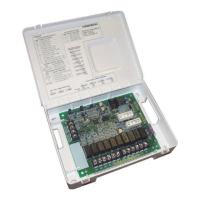
The Lennox Equipment Interface Module (EIM) (22X18) serves as an interface between non-communicating HVAC equipment and Lennox communicating HVAC equipment, enabling seamless integration with Lennox communicating thermostats. It facilitates the control and monitoring of various HVAC system components, including furnaces, air handlers, air conditioners, and heat pumps. The EIM is designed to work with Lennox communicating thermostats using the R, i+, i-, and C terminals.
Function Description:
The EIM's primary function is to translate communication between Lennox communicating thermostats and conventional 24VAC HVAC equipment. This allows users to leverage the advanced features of Lennox communicating thermostats, such as precise temperature control, energy management, and system diagnostics, even with non-communicating indoor and outdoor units. The module supports various configurations, including single-stage outdoor units with single-stage or variable-stage indoor furnaces.
Beyond basic HVAC control, the EIM also supports ventilation and zoning applications. For ventilation, it can integrate with ERV/HRV systems or fresh air dampers, allowing the thermostat to manage fresh air intake based on user settings and outdoor conditions. In zoning applications, the EIM can work with a damper control module to manage airflow to different zones, providing individualized comfort control.
Important Technical Specifications:
- Transformer Rating: The required indoor unit transformer rating (VA) varies depending on the system configuration. For example, a 2-stage HP with 3-stage electric heat and fresh air requires 70 VA, while a 2-stage AC with a 2-stage furnace requires 40 VA. Single-stage fresh air dampers typically need 6 to 12 VA.
- Operating Temperature Range: The EIM is designed to operate in temperatures ranging from 40°F to 176°F (40°C to 80°C).
- Shipping and Storage Temperature Range: For shipping and storage, the module can withstand temperatures from 40°F to 185°F (40°C to 85°C).
- Operating Humidity Range: It can operate in 10% to 90% non-condensing humidity at 104°F.
- Dimensions: The EIM measures 8 inches (203mm) in width, 6 inches (152mm) in height, and 1-5/8 inches (42mm) in depth.
- Fuse: The module is equipped with a 3 AMP fuse for protection.
- Wiring: 18AWG unshielded thermostat cable is generally recommended for all non-communicating connections. For communication lines (i+ and i- terminals), 18-22AWG unshielded or shielded cable may be required, especially in situations with inductive voltage issues.
Usage Features:
The EIM offers several configurable features through its jumpers, DIP switches, and terminal connections:
- Unit Type Jumper Pins: These pins allow the installer to specify the type of indoor unit (ERV/HRV, Lennox Communicating Furnace, Conventional Furnace, or Conventional Air Handler). This setting determines how the EIM interacts with the indoor equipment.
- Heat Stages Jumper Pins: This setting configures the number of heat stages for electric heat (air handler), gas heat (furnace), or compressor stages (heat pump). The factory default is position 2 (two heat stages).
- Heat Pump Capacity Jumper Pins: For non-communicating heat pumps, this jumper is used to configure the heat pump size (e.g., 1.5 TON, 2 TON, 3 TON). The factory default is 3.0 (3-ton).
- Others / Vent DIP Switch: This DIP switch determines the EIM's operational mode. Setting it to OFF (VENT) enables ventilation-only operation (ERV/HRV or fresh air damper), while setting it to ON (OTHERS) is for IFC/AHC/HP operations.
- Sensor Connections: The EIM provides terminals for connecting outdoor air sensors (X2658) and discharge air sensors, allowing the system to monitor ambient and discharge temperatures for optimized operation.
- Dual-Fuel Terminal Connections: Specific terminals are dedicated to dual-fuel configurations, including connections for heat pump reversing valves (O and B terminals) and defrost signal input (W1-DEF).
- Conventional Terminal Connections: Standard terminals (G, Y1, Y2, DS, C, R, H, OB) are available for connecting to conventional HVAC equipment, providing outputs for fan, compressor stages, dehumidification, and heat pump reversing valve.
- LED Indicators: The EIM features two green LEDs: a Status LED and an RSBUS LED. The RSBUS LED flashes when information is being communicated over the RSBus, while the Status LED provides various indications, including steady ON for device start-up, blinking for soft disable state, and different blink patterns for service being provided or alarms present.
Maintenance Features:
- Alert Codes and Troubleshooting: The EIM works in conjunction with the Lennox communicating thermostat to generate and display alert codes, which aid in diagnosing system issues. These alerts are categorized as Service Urgent, Service Soon, and Information Only-Dealer, indicating the severity and required action.
- Soft Disable: If the thermostat detects an unknown control, the EIM can enter a soft disable mode, indicated by a blinking LED status (three seconds OFF, one second ON). This feature helps in identifying and configuring new or unconfigured components.
- Recommissioning: If jumpers are set incorrectly after commissioning, repositioning them requires re-running the commissioning procedure at the Lennox communicating thermostat for the changes to be recognized. Similarly, if the EIM is replaced, recommissioning is necessary.
- Wiring Troubleshooting: The manual provides detailed troubleshooting steps for communication problems (Alert Code 105), including checking wiring connections, ensuring proper grounding, and considering shielded cabling to minimize electrical noise.
- Power Cycling: For certain alert codes, cycling power to the control or the entire system can help clear the issue and allow the system to re-detect components.
- Sensor Resistance Checks: For outdoor and discharge air sensor problems (Alert Codes 180 and 310), checking sensor resistance against charts in the installation instructions is recommended.
The EIM is a crucial component for integrating conventional HVAC systems with Lennox's advanced communicating thermostats, offering enhanced control, diagnostic capabilities, and support for various system configurations and applications.

 Need help?
 General

 To Next Page