EasyManua.ls Logo

Lennox XC15 Series - User Manual

Lennox XC15 Series
20 pages
Print Icon
To Next Page IconTo Next Page
Loading...
01/06 505,095M
*2P0106* *P505095M*
Page 1
E2006 Lennox Industries Inc.
Dallas, Texas, USA
RETAIN THESE INSTRUCTIONS
FOR FUTURE REFERENCE
WARNING
Improper installation, adjustment, alteration, ser-
vice or maintenance can cause property damage,
personal injury or loss of life. Installation and ser-
vice must be performed by a qualified installer or
service agency.
IMPORTANT
This unit must be matched with an indoor coil as
specified in Lennox’ Engineering Handbook.
Coils previously charged with R−22 must be flu-
shed.
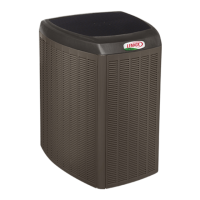
XC15 Outdoor Unit
XC15 outdoor units use R−410A refrigerant. This unit must
be installed with a matching indoor coil and line set as out-
lined in the Lennox Engineering Handbook. XC15 outdoor
units are designed for use in expansion valve (TXV) sys-
tems only. Refer to the Lennox Engineering Handbook for
expansion valve kits which must be ordered separately.
CAUTION
Physical contact with metal edges and corners
while applying excessive force or rapid motion can
result in personal injury. Be aware of, and use
caution when working near these areas during
installation or while servicing this equipment.
Shipping and Packing List
1 − Assembled XC15 outdoor unit
1 − Bushing (for low voltage wiring)
2 − Grommets (for liquid and vapor lines)
Check equipment for shipping damage. If you find any
damage, immediately contact the last carrier.
INSTALLATION
INSTRUCTIONS
XC15 Series Units
CONDENSING UNITS
505,095M
01/06
Table of Contents
XC15 Outdoor Unit 1. . . . . . . . . . . . . . . . . . . . . . . . . . . . . .
Shipping And Packing List 1. . . . . . . . . . . . . . . . . . . . . . . .
Unit Dimensions 2. . . . . . . . . . . . . . . . . . . . . . . . . . . . . . . . .
General Information 1. . . . . . . . . . . . . . . . . . . . . . . . . . . . .
Setting Unit 2. . . . . . . . . . . . . . . . . . . . . . . . . . . . . . . . . . . . .
Removing Panels 3. . . . . . . . . . . . . . . . . . . . . . . . . . . . . . .
Electrical 4. . . . . . . . . . . . . . . . . . . . . . . . . . . . . . . . . . . . . . .
Refrigerant Piping 6. . . . . . . . . . . . . . . . . . . . . . . . . . . . . . .
Flushing Existing Line Set and Indoor Coil 9. . . . . . . . . .
Refrigerant Metering Device 10. . . . . . . . . . . . . . . . . . . . .
Manifold Gauge Set 11. . . . . . . . . . . . . . . . . . . . . . . . . . . .
Service Valves 11. . . . . . . . . . . . . . . . . . . . . . . . . . . . . . . . .
Leak Testing 12. . . . . . . . . . . . . . . . . . . . . . . . . . . . . . . . . . .
Evacuation 12. . . . . . . . . . . . . . . . . . . . . . . . . . . . . . . . . . . .
Start−up 13. . . . . . . . . . . . . . . . . . . . . . . . . . . . . . . . . . . . . . .
Refrigerant Charging 13. . . . . . . . . . . . . . . . . . . . . . . . . . . .
System Operation 16. . . . . . . . . . . . . . . . . . . . . . . . . . . . . .
Maintenance 18. . . . . . . . . . . . . . . . . . . . . . . . . . . . . . . . . . .
Optional Accessories 18. . . . . . . . . . . . . . . . . . . . . . . . . . .
XC15 Start−Up and Performance Check List 19. . . . . . . .
Homeowner’s Information − Maintenance 19. . . . . . . . . .
Thermostat Operation 20. . . . . . . . . . . . . . . . . . . . . . . . . . .
Sound Reduction Cover & Assembly Procedure 20. . . .
General Information
When servicing or repairing HVAC components, ensure
the fasteners are appropriately tightened. Table 1 shows
torque values for fasteners, and for port and valve caps.
Table 1
Torque Requirements
Part Recommended Torque
Service valve cap 8 ft.− lb. 11 NM
Sheet metal screws 16 in.− lb. 2 NM
Machine screws #8 16 in.− lb. 2 NM
Compressor bolts 90 in.− lb. 10 NM
Gauge port seal cap 8 ft.− lb. 11 NM
These instructions are intended as a general guide and do
not supersede national or local codes in any way. Consult
authorities having jurisdiction before installation.
Litho U.S.A.

Question and Answer IconNeed help?

Do you have a question about the Lennox XC15 Series and is the answer not in the manual?

Summary

Setting the Unit

Electrical Wiring

Refrigerant Piping

Brazing Connection Procedure

Flushing Existing Line Set & Indoor Coil

Flushing Procedure

Step-by-step guide for flushing the refrigerant system.

Flushing Connections

Manifold Gauge Set

Leak Testing

Leak Test with Electronic Leak Detector

Procedure for detecting leaks in the refrigerant system.

Evacuation

Start-Up Procedure

Refrigerant Charging

Guide for charging the system with R-410A refrigerant.

Checking Charge

Charge Using Weigh-in Method

Method for charging the unit when outdoor temperature is below 65°F.

Charge Using the Approach Method

Method for charging the unit when outdoor temperature is above 65°F.

XC15 Subcooling Values

Charge Using Subcooling Method

Procedure for charging using subcooling when outdoor temp is below 65°F.

System Operation Monitor LED Troubleshooting Codes

XC15 Start-Up & Performance Check List

Overview

The Lennox XC15 Series Units are outdoor condensing units designed for use in expansion valve (TXV) systems, utilizing R-410A refrigerant. These units must be installed with a matching indoor coil and line set as specified in the Lennox Engineering Handbook. Coils previously charged with R-22 must be flushed before use with the XC15.

Function Description:

The XC15 outdoor unit works in conjunction with an indoor coil to provide air conditioning. It uses R-410A refrigerant, which operates at higher pressures than R-22. The system's operation is monitored by a System Operation Monitor (LSOM) that detects common fault conditions and communicates them through ALERT (yellow) and TRIP (red) LEDs, indicating both mechanical and electrical system problems. The LSOM also has a Power LED (green) to indicate voltage presence. The unit is equipped with a high pressure switch and a low pressure switch for safety and operational control. A filter drier is factory-installed in each unit to maintain refrigerant purity.

Important Technical Specifications:

  • Refrigerant: R-410A
  • System Type: Expansion Valve (TXV) systems only.
  • Electrical: Wiring must conform to current local and national codes (NEC in USA, CEC in Canada). Units are approved for use with copper conductors only. 24V, Class II circuit connections are made in the low voltage junction box.
  • Thermostat Wire Gauge:
    • Less than 100' (30m): 18 AWG
    • More than 100' (30m): 16 AWG
    • Insulation type: color-coded, temperature rating 35°C minimum.
  • Torque Requirements:
    • Service valve cap: 8 ft.-lb. (11 NM)
    • Sheet metal screws: 16 in.-lb. (2 NM)
    • Machine screws #8: 16 in.-lb. (2 NM)
    • Compressor bolts: 90 in.-lb. (10 NM)
    • Gauge port seal cap: 8 ft.-lb. (11 NM)
  • High Pressure Switch: SPST, manual-reset, opens at 590 psi.
  • Low Pressure Switch: SPST, auto-reset, opens at 40 psi, closes at 90 psi.
  • Refrigerant Charge Adjustment: For 3/8 in. (9.5mm) liquid line set diameter, add 3 ounces per 5 feet (85 grams per 1.52 meter) if line length is greater than 15' (4.57m), subtract if less than 15'.
  • Manifold Gauge Set: Must be rated for 0-800 psi (high side) and 30" vacuum to 250 psi (low side), with gauge hoses rated up to 800 psi (4000 psi burst rating).
  • Vacuum Gauge: Thermocouple or thermistor electronic vacuum gauge calibrated in microns, reading from 50 microns to at least 23,000 microns.

Usage Features:

  • Installation Clearances: A service clearance of 30" (762 mm) must be maintained on the access panel side. Clearance to one of the other three sides must be 36" (914 mm), to two sides 12" (304 mm), and to the final side 6" (152 mm). A 24" (610 mm) clearance is required between two units, and 48" (1219 mm) on top. Maximum soffit overhang is 36" (914 mm).
  • Slab Mounting: Top of slab should be high enough to prevent water collection, with a slope tolerance of not more than 2 degrees or 2 inches per 5 feet (51 mm per 1524 mm) away from the building.
  • Roof Mounting: Install at a minimum of 4 inches above the roof surface. Weight must be properly distributed over roof joists and rafters.
  • Refrigerant Piping: Use Lennox L15 (sweat, non-flare) series line sets or field-fabricated refrigerant lines. Proper line set isolation is crucial to prevent vibration and noise transmission to the building structure. Grommets are provided to isolate refrigerant lines from sheet metal edges.
  • Brazing: Use 1 to 2 psig dry nitrogen purge during brazing to prevent oxidation and moisture. Use silver alloy brazing rods (5-6% minimum silver for copper-to-copper, 45% for copper-to-brass or copper-to-steel) rated for R-410A. Wrap valve bodies and copper tube stubs with a wet cloth during brazing to prevent heat damage.
  • Flushing Existing Line Sets/Indoor Coils: If using an existing indoor coil or line set previously charged with R-22, or a coil manufactured before January 1999, it must be flushed. This is critical because Polyol ester (POE) oils used with R-410A are incompatible with mineral oil and can cause system damage and warranty voidance. An oil-less recovery machine and two clean R-22 recovery bottles are required.
  • Leak Testing: After line set connections, check for leaks using an electronic leak detector capable of sensing HFC refrigerant. Pressurize the system with dry nitrogen (150 psig / 1034 kPa) and a trace amount of R-410A.
  • Evacuation: Evacuate the system to an absolute pressure of 23,000 microns (29.01 inches of mercury) to remove noncondensables and water vapor, which can corrode copper piping and compressor parts. A second evacuation to 500 microns (29.9 inches of mercury) within 20 minutes after pump shutdown is required.
  • Start-Up: Ensure crankcase heater (if equipped) is energized 24 hours prior to start-up. Check fan for binding, inspect wiring, verify voltage supply at disconnect (within nameplate range), and set thermostat for cooling demand.
  • Charging:
    • Weigh-in Method (Outdoor Temp < 65°F / 18°C): Recover refrigerant, leak check, evacuate, then weigh in the unit nameplate charge.
    • Approach Method (Outdoor Temp ≥ 65°F / 18°C): Record outdoor ambient and liquid line temperatures. The difference (approach temperature) should match values in Table 4. Adjust charge by adding refrigerant to lower approach temperature or recovering to increase it.
    • Subcooling Method (Outdoor Temp < 65°F / 18°C): Use this method by restricting airflow through the outdoor coil to achieve liquid pressures in the 325-375 psig (2240-2585 kPa) range. Record liquid line temperature and pressure, determine saturation temperature from Table 7, and calculate subcooling. Compare to Table 6 values and adjust charge accordingly.
  • Thermostat Operation: Refer to the user's manual for specific thermostat details. Set temperature setpoints and fan switch (AUTO/INT for humidity control, ON/CONT for continuous circulation). Programmable thermostats offer time-of-day setpoints.
  • LSOM Alert Codes: The LSOM provides flash codes for various system issues (e.g., low refrigerant charge, dirty condenser coil, high head pressure, locked rotor, open circuit). Codes can be reset manually (cycle 24VAC power) or automatically (when conditions return to normal).

Maintenance Features:

  • General: Maintenance should be performed by a qualified installer or service agency. Turn off electrical power at disconnect switch(es) before any service.
  • Outdoor Unit:
    • Clean and inspect the outdoor coil monthly (or as needed), flushing with a water hose after turning off power.
    • Check connecting lines and coils for oil leaks.
    • Check wiring for loose connections.
    • Check for correct voltage and amp-draw (while operating).
    • Ensure no obstructions (leaves, trash, shrubs) restrict airflow.
    • Outdoor fan motor is prelubricated and sealed, requiring no further lubrication.
    • Avoid prolonged exposure to treated water (sprinklers, soakers) to prevent corrosion.
  • Indoor Coil:
    • Clean coil, if necessary.
    • Check connecting lines and coils for oil leaks.
    • Check condensate line and clean, if necessary.
  • Indoor Unit:
    • Clean or change filters monthly (or as needed).
    • Adjust blower speed for cooling, measuring pressure drop over the coil to determine CFM.
    • Check blower for dirt or debris.
    • Check all wiring for loose connections.
    • Check for correct voltage and amp-draw (while operating).
    • Electronic Air Cleaners (if equipped) require specific maintenance instructions from the dealer.
  • Sound Reduction Cover (SR1): The manual provides detailed assembly instructions for the optional sound reduction cover, which helps minimize noise.

Lennox XC15 Series Specifications

General IconGeneral
BrandLennox
ModelXC15 Series
CategoryHeat Pump
LanguageEnglish

Related product manuals