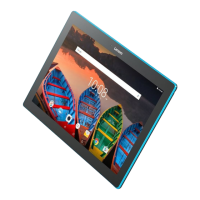
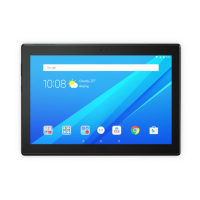
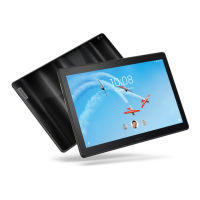
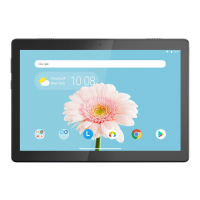
This document serves as a comprehensive user guide for the Lenovo Tab E10, covering various aspects from basic operation to advanced settings and maintenance. It is designed to help users understand and utilize their device effectively, with specific instructions for different models (TB-X104F, TB-X104F1, TB-X104L, TB-X104X).
Function Description
The Lenovo Tab E10 is a versatile tablet designed for everyday use, offering functionalities for communication, entertainment, and productivity. It runs on an Android operating system, providing access to a wide range of applications through Google Play. The device supports various connectivity options, including WLAN and, for specific models (TB-X104L/TB-X104X), LTE, enabling internet access and communication on the go.
Key functions include:
- Web Browsing: Users can browse the internet using the Chrome app, search for keywords, and manage webpages (add new tabs, close tabs, refresh, bookmark).
- Camera: The device features a built-in camera for taking photos and recording videos, with options for panorama mode and switching between front and rear cameras.
- Multi-User Support: The tablet supports multiple user accounts, including Owner, Guest, Standard User, and Child User, allowing for personalized experiences and parental control.
- Split Screen Mode: This feature enables users to run and view two applications simultaneously, enhancing multitasking capabilities.
- Data Synchronization: The device can transfer data such as music, pictures, videos, documents, and Android application package (APK) files between the tablet and a computer via a USB cable.
- Notifications and Quick Settings: A dedicated panel provides notifications for new messages, USB connections, and ongoing activities, while Quick Settings offers quick access to frequently used settings like WLAN.
Usage Features
The Lenovo Tab E10 is designed with user-friendly features to enhance the overall experience.
- Home Screen Customization: Users can personalize their home screen by adding widgets, changing wallpapers, and organizing apps. The home screen includes a Google Search bar and pre-installed useful apps.
- Navigation: The device uses on-screen buttons for navigation: Back, Home, and Recent. The Recent button allows users to view and manage recently used applications, including closing individual apps or all running apps.
- App Management: Users can easily add widgets to the home screen, move apps between screens, and uninstall applications (though some system apps cannot be uninstalled).
- Network Configuration: The tablet supports setting up WLAN networks, mobile networks (for WLAN+LTE models), and VPN networks. It also allows users to set up a personal hotspot to share their internet connection with other devices.
- Language Settings: Users can add and manage multiple languages for the device interface.
- Accessibility Preferences: The device offers accessibility settings to adjust text scaling and webpage zoom for improved readability.
- Screenshot Capture: Users can capture screenshots by simultaneously pressing and holding the Power and Volume down buttons.
- Viewing Media: Photos and videos taken with the camera, as well as screenshots, are stored in the device's internal storage and can be viewed through the Photos app or Files Go.
- Installing APKs: The device allows for the installation of applications from unknown sources, providing flexibility for users to install apps not available on Google Play. This requires enabling "Allow from this source" in the settings.
Maintenance Features
Proper maintenance and adherence to safety guidelines are crucial for the longevity and safe operation of the Lenovo Tab E10. The user guide provides important information regarding handling, charging, and environmental considerations.
- Device Handling: Users are advised to handle the device with care, avoiding drops, bends, punctures, and exposure to foreign objects or heavy pressure, as sensitive internal components and the glass screen can be damaged. In case of screen damage, users should not touch broken glass and contact Lenovo support.
- Environmental Conditions: The device should be kept away from hot and high-voltage environments and used within a temperature range of 0°C (32°F) to 40°C (104°F) to prevent damage. It should also not be exposed to water, rain, extreme humidity, sweat, or other liquids.
- Disassembly and Modification: The device is a sealed unit, and users are warned against disassembling or modifying it, as this will void the warranty. All internal repairs must be performed by Lenovo-authorized personnel.
- Battery Care: The device has a built-in rechargeable lithium-ion battery. Users should not attempt to replace it due to the risk of explosion if an incorrect type is used. Lenovo Support should be contacted for battery replacement.
- Charging Practices: Only standard Lenovo power adapters and USB 2.0 or higher data cables should be used for charging. Users should ensure adequate ventilation around the charging device and unplug it if it has been exposed to liquids, shows physical damage, or needs cleaning.
- High Volume Usage Caution: To protect hearing, users are advised to limit the time spent using headsets or headphones at high volume, avoid turning up the volume to block out noisy surroundings, and turn down the volume if they cannot hear people speaking. If hearing discomfort occurs, users should stop listening and have their hearing checked.
- Safety in Vehicles: When using the device in a motor vehicle or on a bicycle, users must prioritize safety and adhere to local laws and regulations regarding mobile electronic device usage.
- Disposal Guidelines: At the end of its useful life, the device should be disposed of according to local laws and regulations, not crushed, incinerated, immersed in water, or discarded as ordinary waste. Information on recycling programs is provided, including country-specific details for Brazil, Japan, and India.
- Child Safety: The device and its accessories contain small parts that can be a choking hazard and should be kept away from small children. The glass screen can also break if dropped or thrown.
- Data and Software Protection: Users should avoid deleting unknown files or changing the names of files or directories not created by them, as this can cause software malfunction. Awareness of computer viruses, hackers, spyware, and other malicious activities is emphasized, and users are responsible for installing and updating firewalls, antivirus, and anti-spyware software.
- Electromagnetic Interference: Electrical appliances such as fans, radios, high-powered speakers, air-conditioners, and microwave ovens should be kept away from the device, as their strong magnetic fields can damage the screen and data.
- Heat Awareness: Users should be aware that the device may become hot during operation or charging. Prolonged contact with hot sections of the device should be avoided to prevent discomfort or skin burns.
- Troubleshooting: The guide includes basic troubleshooting tips for common issues such as insufficient memory during app installation, unresponsive touch screen, device not powering on or system crashes, inability to access the internet via WLAN, and failure to wake up from sleep mode. These tips often involve freeing up memory, force restarting the device, or restarting network components.

 Need help?
 General

 To Next Page