506305-01Page 4 of 36 Issue 0938
Unconfined Space
An unconfined space is defined as “a space whose volume
is more than 50 cubic feet per 1000 BTU per hour of the
combined input rating of all appliances installed in that
space.” When a furnace is installed in an unconfined space
in a building, it can be assumed that the infiltration will be
sufficient to supply the required air. If the furnace is installed
in a ventilated attic or crawl space, it is assumed that the
infiltration is sufficient to supply the required air. However,
in a building of unusually tight construction, additional outdoor
air should be provided.
• Return air temperature range between 60°F and 80°F
must be maintained.
• Air filters must be installed in the system and must be
maintained during construction.
• Air filters must be replaced upon construction completion.
• The input rate and temperature rise must be set per the
furnace rating plate.
• One hundred percent (100%) outdoor air must be provided
for combustion air requirements during construction.
Temporary ducting may supply outdoor air to the furnace.
Do not connect duct directly to the furnace. Size the
temporary duct following the instructions provided on this
page in the Combustion and Ventilation Air section
regarding confined space with air from outside.
• The furnace heat exchanger, components, duct system,
air filters, and evaporator coils must be thoroughly cleaned
following final construction cleanup.
• All furnace operating conditions (including ignition, input
rate, temperature rise, and venting) must be verified
according to these installation instructions.
If the furnace is to be installed in an attic or other insulated
space, it must be kept free and clear of insulating materials.
Clearances
All servicing and cleaning of the furnace can be performed
from the front. If installed in a closet or utility room, provide
18" clearance in front for service if the door to the room is
not in line with the front of the furnace.
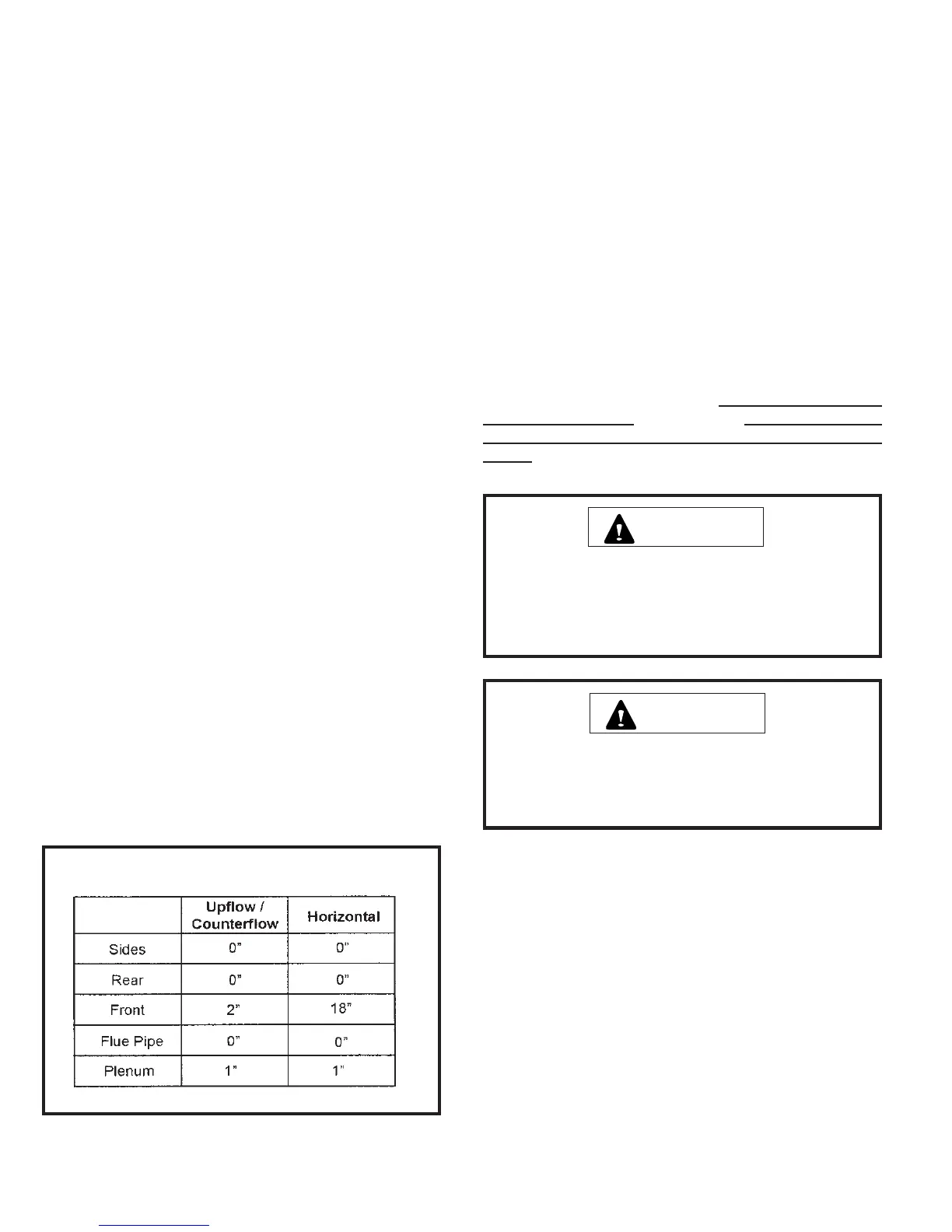
Refer to Table 1 for the minimum clearances to combustibles
required for construction and proper unit operation.
Accessibility clearances must take precedence over fire
protection clearances.
G1D91BU, G1D91BT, G1D93BU and G1D93BT models may
be installed on wood flooring but shall not be installed directly
on carpeting, tile, or any other combustible material.
G1D93BC counterflow models are certified for installation
on combustible flooring provided a special base assembly
is used. (Refer to the Duct Connection – Counterflow
Models section on page 22 for more information on using
the special base assembly.)
When a counterflow unit is installed on a combustible floor,
1" clearance must be provided between the supply duct and
the floor.
Combustion and Ventilation Air
Adequate provisions for combustion air and ventilation of
furnace must be made. Refer to Section 5.3, “Air for
Combustion and Ventilation,” of the National Fuel Gas Code,
ANSI Z223.1/NFPA54 (latest edition), Sections 7.2, 7.3, or
7.4 of CSA B149.1 Natural Gas and Propane Installation
Codes (latest editions), or applicable provisions of the local
building codes.
Insufficient combustion air can cause headaches,
nausea, dizziness, or asphyxiation. When considering
combustion air requirements, enough air must also be
provided to meet the needs of all fuel-burning
appliances and exhaust fans.
WARNING
Air openings in the front of the furnace must be kept
free of obstructions. Any obstruction may cause
improper operation that can result in a fire hazard or
carbon monoxide injury.
WARNING
Table 1
Minimum Clearances to Combustibles


 To Next Page
 Loading...