331
7-2. Steps to take in an emergency
LC500_LC500h_OM_OM11405U_(U)
7
When trouble arises
chains secured to the emergency tow-
ing eyelets. This should only be
attempted on hard surfaced roads for
short distances at under 18 mph (30
km/h).
A driver must be in the vehicle to steer
and operate the brakes. The vehicle’s
wheels, drive train, axles, steering and
brakes must be in good condition.
To have your vehicle towed by another
vehicle, the towing eyelet must be
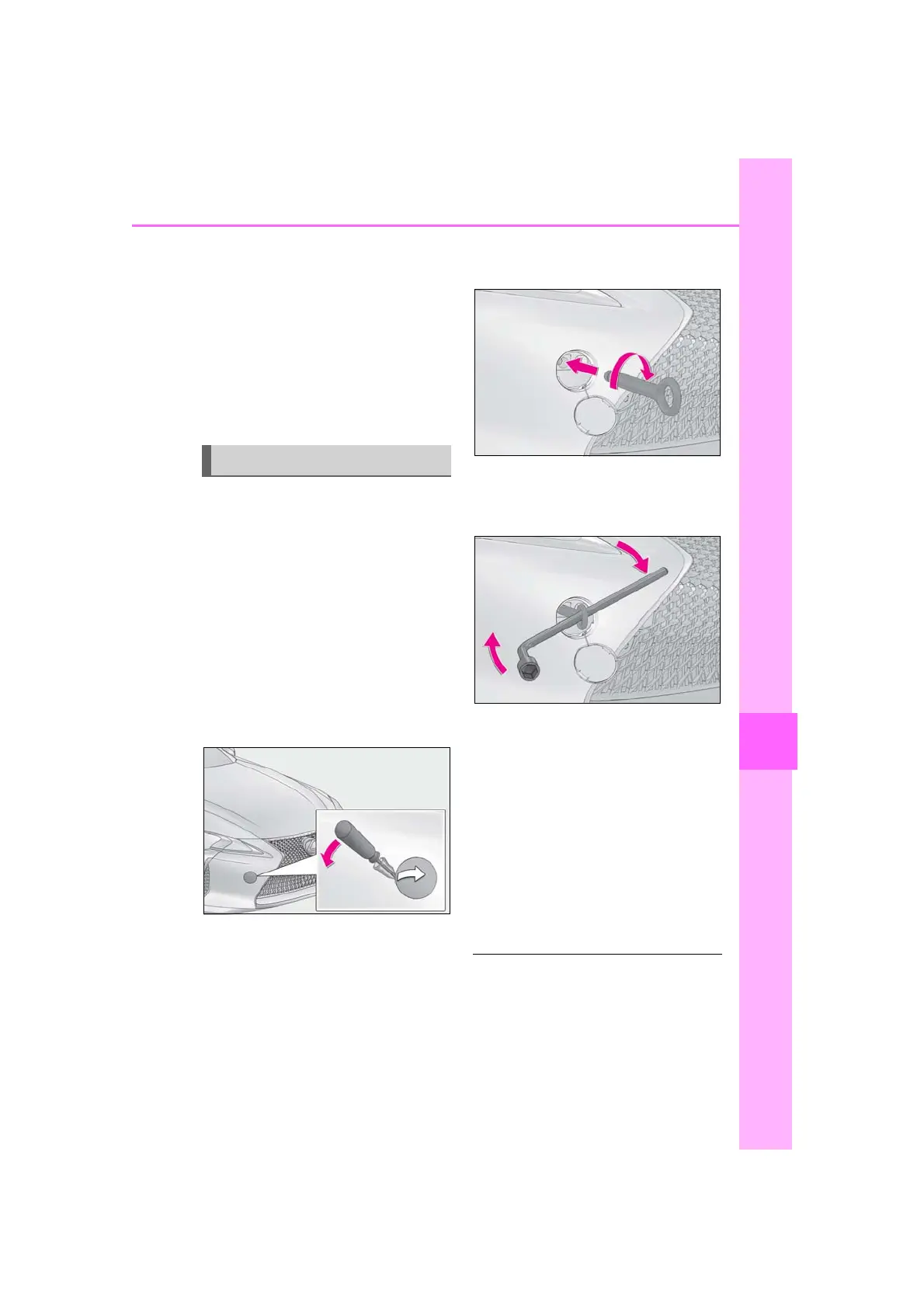
installed to your vehicle. Install the tow-
ing eyelet using the following proce-
dure.
1 Take out the towing eyelet.
(→P.309)
2 Remove the eyelet cover using a
flathead screwdriver.
To protect the bodywork, place a rag
between the screwdriver and the vehicle
body as shown in the illustration.
3 Insert the towing eyelet into the
hole and tighten partially by hand.
4 Tighten down the towing eyelet
securely using a wheel nut wrench
or hard metal bar.
5 Securely attach cables or chains to
the towing eyelet.
Take care not to damage the vehicle body.
6 Enter the vehicle being towed and
start the engine <hybrid system>.
If the engine <hybrid system> does not
start, turn the engine switch <power
switch> to IGNITION ON mode <ON
mode>.
7 Shift the shift position to N and
release the parking brake.
■ While towing
If the engine is not running <hybrid system is
off>, the power assist for the brakes and
steering will not function, making steering
and braking more difficult.
Emergency towing procedure



 To Next Page