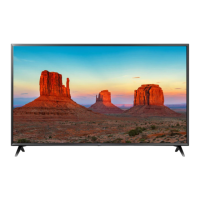
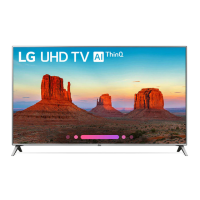
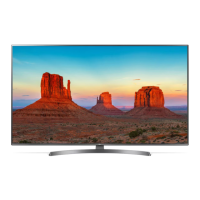
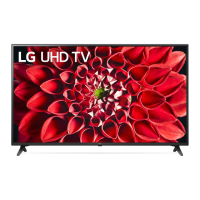
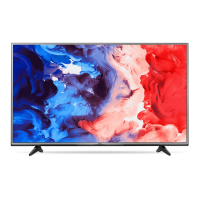
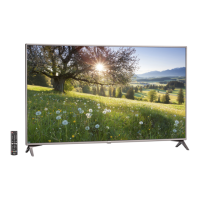
This document is a service manual for an LG LED TV, specifically models 55UK6340PTF, 6400PVC, and 55UK6600PTC, identified by chassis UB83P. It provides comprehensive information for servicing, maintenance, and troubleshooting the device.
Function Description:
The device is an LG LED TV designed for home entertainment. It supports various input sources and display formats, offering a wide range of functionalities for viewing television broadcasts, playing media from external devices, and connecting to networks. The TV incorporates advanced features for picture and sound processing, as well as smart functionalities through software updates.
Important Technical Specifications:
Application Range:
- This specification applies to LED TVs using the UB83P chassis.
Test Requirements:
- Temperature: 25 °C ± 5 °C (77 °F ± 9 °F), CST: 40 °C ± 5 °C.
- Relative Humidity: 65% ± 10%.
- Power Voltage: Standard input voltage (AC 100-240 V~, 50/60 Hz).
- Specifications and Performance: Follows drawings and part number specifications in the Bill of Materials (BOM).
- Operation Time: Receiver must operate for approximately 20 minutes prior to adjustment.
Test Method:
- Performance: Follows LGE TV test method.
- Demanded Other Specification: Safety (CE, IEC), EMC (CE, IEC), Wireless (Wireless HD Specification - Option).
Model General Specification:
- Market: Oceania, Asia, Middle East, Africa.
- Television System:
- Digital TV: DVB-T/T2, DVB-C, DVB-S/S2.
- Analogue TV: PAL B/B, PAL B/G, PAL D/K, PAL-I, SECAM B/G, SECAM D/K, NTSC-M.
- Channel Storage:
- ATV & DVB-T/T2: 3,000EA.
- DVB-S/S2: 6,000EA.
- Receiving System:
- Analog: Upper Heterodyne.
- Digital (DVB-T): COFDM.
- Digital (DVB-T/T2): COFDM.
- Digital (QAM): QAM.
- DVB-T: Guard Interval (1/4, 1/8, 1/16, 1/32), Modulation (QPSK, 16-QAM, 64-QAM with Code Rates 1/2, 2/3, 3/4, 5/6, 7/8).
- DVB-T2: Guard Interval (1/4, 1/8, 1/16, 1/32, 1/128, 19/128, 19/256), Modulation (QPSK, 16-QAM, 64-QAM, 256-QAM with Code Rates 1/2, 2/5, 2/3, 3/4, 5/6).
- DVB-C: Symbolrate (4.0Msymbols/s to 7.2Msymbols/s), Modulation (16QAM, 64-QAM, 128-QAM, 256-QAM).
- DVB-S/S2: Symbolrate (DVB-S2: 2~45Msymbol/s, DVB-S: 2~45Msymbol/s), Viterbi (DVB-S mode: 1/2, 2/3, 3/4, 5/6, 7/8; DVB-S2 mode: 1/2, 2/3, 3/4, 3/5, 4/5, 5/6, 8/9, 9/10).
- 4 System: PAL, SECAM, NTSC, PAL60.
- Video Input RCA: PAL, SECAM, NTSC.
- Component Input: Y/Pb/Pr.
- Head Phone Out: Antenna, AV, Component, HDMI1(6G), HDMI2(3G), HDMI3(3G), USB1, USB2, USB3.
- HDMI Input: HDMI1-DTV, HDMI2-DTV, HDMI3-DTV (PC(HDMI Ver. 1.4), Support HDCP).
- Audio Input: DVI Audio, Component, AV.
- SPDIF Out: SPDIF out.
- USB Input: For My Media (Movie/Photo/Music List) or For SVC.
- Ethernet Connect: 1EA.
- CVBS Input:
- 720x480i (15.73 kHz H-freq, 59.94 Hz V-freq, 13.50 MHz Pixel clock): SDTV, DVD 480i (NTSC-M).
- 720x480i (15.75 kHz H-freq, 60.00 Hz V-freq, 13.51 MHz Pixel clock): SDTV, DVD 480i (NTSC-M).
- 720x576i (15.63 kHz H-freq, 50.00 Hz V-freq, 13.50 MHz Pixel clock): SDTV, DVD 576i (PAL-BDGHI).
- Component Input (Y, CB/PB, CR/PR):
- Supports various resolutions from 720x480i to 1920x1080p with corresponding H-freq, V-freq, and Pixel clock values, covering SDTV and HDTV formats.
- HDMI Input (DTV):
- Supports resolutions from 640x480p to 4096x2160p (UHD) with varying refresh rates (23.97 Hz to 120 Hz) and pixel clocks, including deep color support for UHD.
- HDMI Input (PC):
- Supports resolutions from 640x350 (EGA) to 4096x2160 (UHD) with various refresh rates and pixel clocks, including WUXGA (Reduced Blanking) for Full HD and UHD models.
Usage Features:
- Software Update: The TV supports software updates via USB download or Network Service Update (NSU).
- USB Download: Insert a USB memory stick, and the TV will automatically detect and prompt for an update.
- NSU Download: Access through Menu → All Settings → General → About This TV, then select "CHECK FOR UPDATES" or "DOWNLOAD AND INSTALL."
- Remote Control: The manual details the functions of the service remote control, including power on/off, input selection, picture mode changes, volume control, channel changes, and access to various service menus like "IN-START" for adjustment and diagnostic checks.
- Test Patterns: The service remote allows access to 6 types of test patterns (Off, White, Red, Green, Blue, Black, Gray127) for diagnosing display issues such as defective pixels, residual images, and module errors.
- White Balance Adjustment: Through the "IN-START" menu, technicians can access "White Balance" settings to record and re-enter R, G, B (GAIN, Cut) values for Color Temp (Cool/Medium/Warm) after replacing the Main Board.
- Tuner Signal Strength Check: The TV allows checking RF signal level using the Diagnostics menu on OSD (Advanced → Channels → Channel Tuning → Manual Tuning → Check the Signal). Normal signal strength and quality should be over 50%.
- External Device Connectivity: The TV provides multiple ports (HDMI, Component, AV, USB, Ethernet) for connecting various external devices, including DVD players, set-top boxes, and USB storage.
Maintenance Features:
- Safety Precautions: Emphasizes the use of an isolation transformer, replacement of parts with specified components (especially safety-related parts marked with a triangle in the Exploded View), and performing AC leakage current checks before returning the TV to the customer.
- Servicing Precautions: Detailed guidelines for handling electrical components, including unplugging the AC cord, using appropriate voltage meters, avoiding chemical sprays, cleaning contacts with specified mixtures, and proper soldering techniques for electrostatically sensitive (ES) devices.
- Disassembly Guide: Step-by-step instructions for disassembling the rear cover, stand, main, PSU, SPK, Wifi, IR & Stand Bracket A,B, S-PCB Cover Shield L,R, LCM, Source PCB, Case Top, Guide Panel, Optical Sheet, DPS, LED Fixer, and Reflector Sheet.
- LED Array Disassembly & Assemble Guide: Instructions for disassembling and assembling the LED array, including attaching double tape and connecting the CNT. Specifies the required LED array quantity per inch size (e.g., 3 EA for 43-55 inch, 4 EA for 65 inch).
- Troubleshooting Guide: A comprehensive section covering various error symptoms (High category: Video error, Power error, Audio error, Function error, Noise, Exterior error; Mid category: No video/Normal audio, Picture broken/Freezing, Color error, No power, Wrecked audio/discontinuation/noise, Remote control & Local switch checking, Wifi operating checking, External device recognition error, Circuit noise, mechanical noise, Exterior defect).
- Power Board Diagnostic JIG: Utilizes a Smart JIG Multi Gender (P/N: RAD32507801 or RAD33187801) for diagnosing power board issues. This tool helps check various voltage outputs (24V, 20V, 13.2V/18V) and identifies defective power boards based on LED indicators (OK/NG). The manual provides detailed connection methods for different OLED and LED models (e.g., 15Y OLED, 16Y OLED, 16Y/17Y LED, 17Y LED).
- T-Con PMIC Voltage Measurement: Provides a table of test points and expected voltage specifications (Min/Max) for T-Con PMIC, including VTERM, VCC18, VCOM1/2, P VGL, LS VGL, VGH, VST, VGH EVEN/ODD, PM VCC, HVDD, and VDD EPI.
- Symptom Examples (Image Error, Main, Module, T-Con): Visual examples of common symptoms like color smear, color spread, screen darkness, screen stop, bit noise, dark picture, broken picture, isometric horizontal bars, internal matter, image broken, screen sync signal broken, bend on the screen, vertical smear, over color, vertical bar, and screen lower image broken, along with their probable causes.

 Need help?

 To Next Page
 General