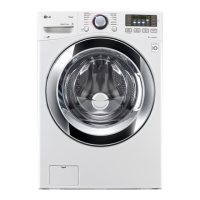
This document provides a comprehensive guide for the installation, operation, maintenance, and troubleshooting of an LG automatic electric washing machine, model WFS0814WHN (F4J*TY(P)(0-9)W/S).
Function Description
The LG automatic electric washing machine is designed for household use to clean various types of laundry. It offers a range of washing programs and options to suit different fabric types, soil levels, and user preferences. The machine incorporates features like SmartThinQ application connectivity and Smart Diagnosis™ for enhanced user experience and troubleshooting.
Important Technical Specifications
- Model: WFS0814WHN (F*J*TY(P)(0-9)*)
- Wash Capacity: 8 kg
- Power Supply: 220 - 240 V~ 50/60 Hz
- Size: 600 mm (W) x 560 mm (D) x 850 mm (H)
- Product Weight: 62 kg
- Permissible Water Pressure: 0.1 - 1.0 MPa (1.0 - 10.0 kgf / cm²)
- Max. Watt: 2100 W
- Annual Water Consumption: 10780 L
- Annual Energy Consumption: 142 KWH
- IP No.(Degree of Protection): IPX4
- Country of Origin: Made In China
The maximum RPM varies by program, with Cotton, Cotton+, Mix, Allergy Care, Dark Wash, Quick 30, and Stain Care reaching 1400 RPM. Easy Care, Baby Steam Care, Silent Wash, Duvet, and Gentle Care have lower maximum RPMs, ranging from 800 to 1000.
Usage Features
Installation:
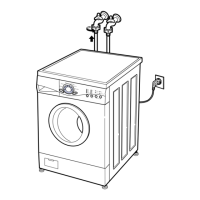
The appliance requires a flat, hard floor with an allowable slope of 1°. It should be placed within 1 meter of a power outlet. Additional clearance of 10 cm at the rear and 2 cm on the right and left sides is recommended. The appliance must be properly grounded. Transit bolts must be removed before operation to prevent vibration and noise. Anti-slip sheets can be used on slippery surfaces, and rubber cups are recommended for wooden floors to reduce vibration. Water supply hoses need to be securely connected, ensuring rubber seals are in place and water pressure is between 0.1 and 1.0 MPa. The drain hose should not be placed higher than 100 cm above the floor.
Operation:
- Sorting Laundry: Check care labels for fabric content and washing instructions. Sort clothes by fabric type, soil level, color, and load size. Avoid washing single large items to prevent unbalanced loads. Check pockets for foreign objects.
- Loading: Open the door and load items into the washing machine.
- Detergent/Softener: Add the proper amount of detergent and fabric softener to the dispenser drawer. Liquid detergent should not be used with Time Delay or Pre Wash. Do not exceed the maximum fill line for fabric softener.
- Power On: Press the Power button.
- Cycle Selection: Choose a desired washing cycle using the cycle button or selector knob. Programs include Cotton, Cotton+, Mix, Easy Care, Duvet, Allergy Care, Sports Wear, Baby Steam Care, Silent Wash, Dark Wash, Quick 30, Gentle Care, and Stain Care.
- Start Cycle: Press the Start/Pause button. The machine will agitate briefly to measure load weight. If not pressed within 15 minutes, settings will be lost.
- End of Cycle: A melody will sound. Remove clothes immediately to reduce wrinkling.
Option Programs:
- Delay End: Set a time delay for the wash cycle to finish.
- Pre Wash: Recommended for heavily soiled laundry.
- Intensive: Effective for normal and heavily soiled laundry.
- Crease Care: Prevents creasing.
- Time Save: Reduces wash time for lightly soiled loads.
- Rinse/Rinse+: Adds one or more rinses.
- Add Item: Allows adding or removing laundry after the program starts, provided water level/temperature is not high.
- Temp.: Selects wash and rinse temperature.
- Spin: Selects spin speed.
- Child Lock: Disables controls to prevent children from changing settings.
- Beep On/Off: Turns the beeper sound on or off.
Smart Functions:
- SmartThinQ Application: Download the LG SmartThinQ app for additional features and guides.
- Tag On Function: Use NFC-equipped smartphones to download new and special cycles. Only one downloaded cycle can be stored at a time.
- Tub Clean Coach: Shows remaining cycles before a Tub Clean is recommended.
- Smart Diagnosis™: Provides useful information for diagnosing and solving issues via the app or customer information center.
Maintenance Features
Care After Wash:
- Wipe the door and door seal to remove moisture.
- Leave the door open to dry the drum interior.
- Wipe the machine body with a dry cloth.
Cleaning the Interior:
- Wipe the door opening and door glass with a towel or soft cloth.
- Remove items from the machine immediately after the cycle.
- Run the Tub Clean program once a month (or more often) to remove detergent buildup.
Cleaning the Water Inlet Filter:
- Turn off supply taps and unscrew the water supply hose.
- Clean the filter with a hard bristle brush.
- Clean the filter if '1E' icon is displayed.
Cleaning the Drain Pump Filter:
- Open the cover cap and pull out the hose.
- Unplug the drain plug and open the filter by turning it to the left.
- Collect drained water in a container.
- Remove any extraneous matter from the pump filter.
Cleaning the Dispenser Drawer:
- Remove the drawer by pulling it out until it stops, pressing the disengage button.
- Remove inserts and rinse them with warm water.
- Clean the drawer opening with a cloth or non-metal brush.
- Wipe moisture and return inserts and drawer.
Tub Clean (Optional):
- Remove all clothing from the machine.
- Add anti-limescale to the main wash compartment (or tablets directly into the drum).
- Close the drawer.
- Power on, press and hold the Tub Clean button for 3 seconds, then press Start/Pause.
- Leave the door open after the program to dry.
Caution on Freezing During Winter:
- Install the product where it will not freeze.
- After washing, remove all remaining water from the pump and drain hose.
- To handle freezing: Pour warm water (50-60 °C) into the drum, close the door, and wait 1-2 hours. If water supply problems occur, thaw the tap and inlet hose connections with a hot water cloth or immerse the inlet hose in warm water.
Troubleshooting:
The manual provides a detailed troubleshooting guide for common issues such as rattling noise, thumping sound, vibrating noise, water leaks, oversudsing, water not entering/draining, machine not starting/spinning, wash cycle time delays, fabric softener overflow, dry problems, and odors. Error messages like '1E', 'UE', 'dE', 'dE1', 'dE2', 'tE', 'FE', 'PE', 'LE', 'AE', and 'dHE' are also explained with corresponding solutions.

 Need help?

 To Next Page
 General