Need help?
Do you have a question about the LG GRF8648SC and is the answer not in the manual?
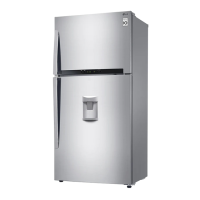
This document serves as an owner's manual for an LG Refrigerator-Freezer, providing comprehensive instructions for its installation, operation, and maintenance. It emphasizes safety precautions, energy-saving tips, and troubleshooting advice to ensure optimal performance and longevity of the appliance.
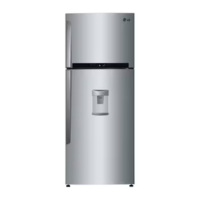
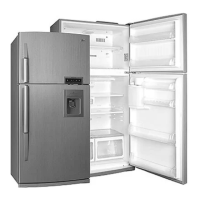
The LG Refrigerator-Freezer is designed to store fresh and frozen foods, maintaining optimal temperatures in both compartments. It features a dual-compartment design with a freezer at the top and a refrigerator at the bottom. The appliance utilizes isobutane refrigerant (R600a), an environmentally friendly natural gas, and employs a frost-free defrost system. It is intended for household and similar applications, including staff kitchen areas, farmhouses, hotels, motels, bed and breakfast environments, and catering services.
Starting and Temperature Setting: Upon initial installation, the refrigerator should be allowed 2-3 hours to stabilize at normal operating temperatures before being filled with food. If operation is interrupted, a 5-minute wait is recommended before restarting. The appliance maintains a constant temperature regardless of room temperature fluctuations. It is advised not to change the temperature settings frequently once set.
Controls: The refrigerator compartment temperature is controlled via a 'Fridge' button, allowing selection from seven setting points, ranging from 0°C to 6°C. Each press of the button adjusts the temperature by 1°C. The freezer compartment temperature is controlled by a dial, where turning the knob right sets a higher number for lower temperatures, and turning it left sets a smaller number for higher temperatures. An "Express Freeze" feature is available to quickly lower the refrigerator temperature to maximum cooling capacity, useful when warm food is introduced. This feature operates automatically or can be manually shut off. A "Lock" function is also included, activated by pressing and holding the Lock button for 3 seconds, which disables other buttons and illuminates the Lock LED, serving as a child lock.
Door Alarm: An audible alarm sounds if the refrigerator or freezer door remains open for 1 minute, repeating every 30 seconds if the door is not closed.
Self-Test (Smart Diagnosis): The refrigerator incorporates a built-in diagnostic capability. In case of a malfunction, it displays an error code to assist repair technicians. During an error code display, other control and display functions are suspended. For smart diagnosis, all refrigerator doors should be closed, the display lock button pressed and held to enter a locked state, and then the fridge temperature button pressed and held for 3 seconds. The telephone should then be placed near the speaker hole at the top right side of the appliance for data transmission to a service center.
Ice Making: The appliance features a "Twisting Ice Serve Type" ice maker. To make ice cubes, the ice tray is filled with water and inserted into its position. To remove ice cubes, the lever of the tray is gently pulled and turned, causing the ice cubes to drop into the ice cube box. The ice maker can be disassembled to create more space in the freezer. Only potable water should be used for ice making, and the water should be filled up to the marked line.
Drawers:
Water Dispenser: The water dispenser requires the water tank to be in position before filling. Water can be poured into the tank by opening the cover cap. The dispenser pad is pressed with a cup to release water, which stops flowing when the cup is removed. Only potable water should be used, and hot water must be cooled before being added to the tank. The water tank can be removed for cleaning or to create more space in the upper basket, using a plug provided with the egg tray to close the hole.
Cleaning: Regular cleaning is crucial to prevent undesirable odors. Spilled food should be wiped up immediately to prevent acidification and staining of plastic surfaces. Metallic scouring pads, brushes, coarse abrasive cleaners, or strong alkaline solutions should never be used on any surface.
Safety Precautions for Cleaning: Always remove the power cord from the wall outlet before cleaning near electrical parts. Excess moisture should be wiped up to prevent water or liquid from entering electrical components and causing electric shock. Flammable or toxic cleaning liquids, surface active agents, car wax, anticorrosives, oils, gasoline, acids, or wax should not be used. Using these carelessly may cause discoloration.
Vacation Time: For average-length vacations, it's best to leave the refrigerator operating. For extended periods, all food should be removed, the power cord disconnected, the interior thoroughly cleaned, and the doors left open to prevent odor formation.
Power Failure: Most power failures are short and will not affect refrigerator temperatures significantly. During longer outages, minimizing door openings and placing dry ice on top of frozen packages is recommended.
Moving the Appliance: Before moving, all loose items inside the refrigerator should be removed and securely fastened. The leveling screws should be turned all the way into the base to prevent damage.
Anti-Condensation Pipe: The outer cabinet wall may become warm, especially after installation, due to the anti-condensation pipe pumping hot refrigerant to prevent "sweating." This is normal and not a cause for alarm.
Light Bulb Replacement: Before replacing a burned-out light bulb, the refrigerator should be unplugged or the power turned off at the circuit breaker or fuse box. Moving the control to the OFF position does not remove power to the light circuit.
Disposal of Old Appliance: The appliance contains recyclable materials (refrigerant, lubricant, parts). These materials should be sent to a recycling waste disposal site. Local authorities should be contacted for information on proper disposal. The packing materials should be removed from the door when disposing of the refrigerator to prevent children from becoming locked inside.
 General
| Type | French Door |
|---|---|
| Smart Diagnosis | Yes |
| Inverter Linear Compressor | Yes |
| Ice Maker | Yes |
| Water Dispenser | Yes |
| Noise Level | 39 dB |
| Color | Stainless Steel |

 To Next Page