Need help?
Do you have a question about the LG JRNU07GTUB4 and is the answer not in the manual?
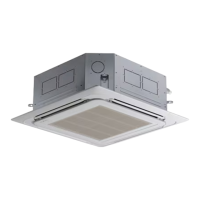
This document is an owner's manual and installation manual for an LG Air Conditioner, specifically a Ceiling Cassette 1-Way type.
The LG Air Conditioner is designed to provide cooling and air conditioning for indoor spaces. It operates by circulating air, cooling it, and then redistributing it into the room. The system includes features for preparing for operation, usage, cleaning, maintenance, service, forced operation, auto restart, and E-Waste guidelines. The installation manual provides detailed instructions for setting up the indoor unit, including wiring connections, drain piping, and decoration panel installation.
The manual lists several models: JRNU07GTUB4, JRNU09GTUB4, JRNU12GTUB4, JRNU18GTTB4, and JRNU24GTTB4. For installation, the manual specifies the nominal cross-sectional area of the conductors based on the rated current of the appliance. For example, for a current ≤ 0.2 A, the tinsel cord is 0.5 mm². For 0.2 < A ≤ 3 A, the tinsel cord is 0.75 mm². The cross-sectional area increases with higher current, up to 10 mm² for > 40 A ≤ 63 A. The total cooling capacity in Btu/h varies by model, with examples like EX) 5 000 Btu/h → '05' 18 000 Btu/h → '18'. The system uses R410A refrigerant. The total amount of replenished refrigerant in the refrigerant facility (kg) and the capacity of the smallest room where the indoor unit is installed (m²) are specified for limiting concentration. Drain piping requires a down-slope (1/50 to 1/100) to prevent reversal flow. The outside diameter of the drain connection on the indoor unit is 32 mm. The piping material is polyvinyl chloride pipe VP-25 and pipe fittings. Heat insulation material should be polyethylene foam with a thickness of more than 8 mm. The indoor unit PCB has DIP switches for various settings, including communication, cycle, group control, dry contact mode, installation, heater linkage, ventilator linkage, vane selection, and region selection. The serial number of Multi V super IV (outdoor units) is effective after October 2013.
The air conditioner is designed for ease of use with clear instructions for operation.
Regular maintenance is crucial for the longevity and efficient operation of the air conditioner.
The manual also includes detailed diagrams for installation, such as how to assemble components, connect wiring, and install decoration panels for both grille and panel types. It provides specific instructions for group control settings, including DIP switch configurations for master and slave units.
 General
| Brand | LG |
|---|---|
| Model | JRNU07GTUB4 |
| Category | Air Conditioner |
| Language | English |

 To Next Page