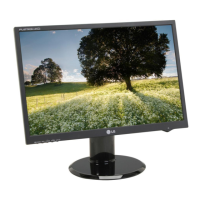
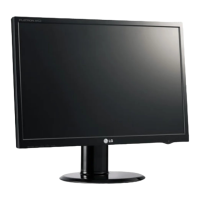
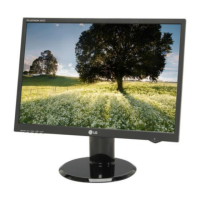
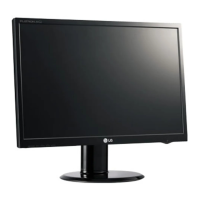
This document is a user's guide for the LG L226WU monitor, providing essential information for its safe installation, operation, and maintenance.
Function Description
The LG L226WU is a display unit designed for use with computers. Its primary function is to provide a visual interface for computer systems, supporting both analog and digital input signals. A key feature of this monitor is its USB connectivity, which allows it to function as a USB hub and supports multi-screen setups, extending or mirroring the display from a primary computer. The monitor is equipped with an On Screen Display (OSD) control system, enabling users to adjust various image parameters and settings for optimal viewing. It also includes an "f-ENGINE" feature for optimizing image conditions based on content type (movie/text) and user preferences.
Usage Features
Connecting the Display:
The monitor can be connected to a computer using DVI, D-sub, or USB cables. Users should ensure the computer and monitor are turned off before making connections. Once connected, pressing the power button will automatically execute the "Self Image Setting Function" in analog mode, which adjusts display settings for optimal input signals. For manual adjustments, the "AUTO/SET" button can be used, or the "Factory reset" option in the OSD menu.
Stand Assembly and Positioning:
The monitor comes with a stand that requires assembly. Users should place the monitor face down on a soft surface, rotate the stand body, and then assemble the stand base. Once assembled, the monitor can be carefully lifted. The stand offers ergonomic adjustments including tilt (-3° to 17°), swivel (356°), and height (maximum 5.51 inches or 140.0mm). A locking pin needs to be removed to adjust the height. It is recommended to keep the forward tilt angle within 5 degrees for ergonomic viewing.
USB Programs and Connectivity:
The L226WU supports USB connectivity, functioning as a USB hub with one upstream port and two downstream ports. The upstream port connects to the computer, while downstream ports can connect to peripherals like mice, memory sticks, or USB hard disks. For multi-screen setups, the monitor can be used to extend or mirror the display. The "LG USB Easy Connection" program, once installed, provides icons in the taskbar for easy access to features like Screen Resolution, Color Quality, Screen Rotation (Pivot function), Extend To, Extend, and Mirror. The Pivot function allows rotating the panel 90° clockwise, which requires lifting the monitor to its highest height to avoid contact with the stand base. When using multiple USB monitors, the "LG USB Easy Connection" program can be set up separately for each. The monitor supports up to five monitors in a directional connection or six in a parallel connection via USB.
Control Panel Functions:
The front panel includes several buttons for controlling the monitor:
- SOURCE Button: Selects the input signal (DVI, D-Sub, or USB).
- MENU Button: Enters or exits the On Screen Display (OSD). Holding it for several seconds can lock or unlock OSD controls.
- - / + Buttons: Used to select or adjust functions within the OSD.
- f-ENGINE (-) Button: Accesses the f-ENGINE menu for image optimization.
- AUTO/SET Button: Enters a selection in the OSD and performs auto image adjustment in analog mode.
- Power Button: Turns the display on or off.
- Power Indicator: Lights blue in On Mode and amber in Sleep Mode (Energy Saving).
On Screen Display (OSD) Control Adjustment:
The OSD system allows users to adjust image size, position, and operating parameters. Adjustments are made by pressing the MENU button, navigating with -/+ buttons, selecting with AUTO/SET, and adjusting levels. The OSD menu includes:
- PICTURE: Brightness, Contrast, Gamma.
- COLOR: Preset (sRGB, 6500K, 9300K), Red, Green, Blue.
- POSITION: Horizontal, Vertical.
- TRACKING: Clock, Phase, Sharpness.
- SETUP: Language, OSD Position, White Balance, Power Indicator, Factory Reset, ARC (Aspect Ratio Control).
- f-ENGINE: Movie/Text, User, Normal.
Maintenance Features
Important Precautions:
The user's guide emphasizes several safety and maintenance precautions:
- Power Cord: Use only the supplied power cord. Ensure it's easily accessible and not overloaded or frayed.
- Opening the Display: Do not open the display as there are no user-serviceable components and dangerous high voltages are present.
- Placement: Do not place the display on sloping surfaces unless secured. Use only manufacturer-recommended stands. Avoid dropping objects on the screen.
- Fire/Hazards: Turn off the display when leaving the room. Keep children from inserting objects into openings. Unplug the display during extended periods of unattended use or during thunder/lightning.
- Installation: Do not block ventilation openings. Avoid placing the display near heat sources or in built-in enclosures without proper ventilation.
- LCD Screen: Do not rub or strike the LCD screen with hard objects. Avoid pressing the screen with fingers for long periods to prevent afterimages.
- Dot Defects: Some red, green, or blue dot defects may appear but do not affect display performance.
- Resolution: Use the recommended resolution for the best image quality.
- Cleaning: Unplug the display before cleaning. Use a slightly damp (not wet) cloth. Do not spray aerosol directly on the screen.
- Repacking: Keep the original carton and packing materials for future transport.
- Disposal: The fluorescent lamp contains mercury. Dispose of the product according to local regulations, not with general household waste.
Troubleshooting:
The guide provides troubleshooting steps for common issues:
- No Image: Check power cord connection, power status (indicator color), brightness/contrast, and ensure the PC is on. If in power saving mode, move mouse or press a key.
- "OUT OF RANGE" Message: Indicates the PC's video signal is outside the display's horizontal or vertical frequency range. Adjust settings in the PC.
- "CHECK SIGNAL CABLE" Message: Indicates the signal cable is not connected. Check and reconnect the cable.
- "OSD LOCKED" Message: Unlock OSD controls by holding the MENU button for several seconds.
- Incorrect Display Image:
- Position Incorrect: Use AUTO/SET or adjust H/V position in OSD.
- Vertical Bars/Stripes: Use AUTO/SET or adjust CLOCK in OSD.
- Horizontal Noise: Use AUTO/SET or adjust PHASE in OSD.
- General Image Issues: Check Control Panel -> Display -> Settings for resolution/frequency changes. Adjust to recommended resolution and set color depth higher than 24 bits.
- Screen Color Mono/Abnormal: Check signal cable connection, video card insertion, and color setting (higher than 24 bits) in Control Panel - Settings.
- Screen Blinks: Check if the screen is set to interlace mode and change to recommended resolution if necessary.
- Display Driver Issues: Install the display driver from the provided CD or LG website. Ensure the video card supports Plug&Play.
Wall Mount Installation:
The monitor supports wall mount plates (purchased separately). Installation involves placing the monitor face down, separating the stand, and then installing the wall mount plate.
Kensington Security Slot:
A Kensington Security Slot is provided for connecting a locking cable, which can be purchased separately, to secure the monitor.


 To Next Page
 General