Need help?
Do you have a question about the LG LD-2120WH and is the answer not in the manual?
Measures to protect children from operating the dishwasher or accessing hazardous materials.
Guidelines for safe use and maintenance of the power cord to prevent electric shock or fire.
Importance of proper grounding for electrical safety and how to ensure it.
Instructions for preparing the cabinet space, including dimensions and cutouts for hoses.
Requirements for electrical connection, including circuit breaker, grounding, and plug accessibility.
Steps to prepare the dishwasher itself, including adjusting legs for height.
Guidance on sliding the dishwasher into the prepared cabinet space.
Methods for connecting the drain hose to sink traps or standpipes to ensure proper drainage.
How to connect the water supply hose to the tap and dishwasher, ensuring no leaks.
Performing a final check, plugging in, and running a test cycle for proper operation.
Adjusting the dishwasher's legs to ensure it is level and the door operates smoothly.
Explains the digital display for program time, remaining time, and error codes.
How to activate/deactivate child lock and beep sounds for user convenience.
Details on selecting wash programs and operating the power button for start/stop.
General guidelines for loading dishes for optimal washing, including scraping food.
Instructions for placing cutlery in the basket for effective cleaning and safety.
Guidance on placing delicate items, cups, and glasses in the upper rack for best results.
How to raise or lower the upper rack to accommodate different crockery sizes.
List of items not recommended for dishwasher cleaning due to material or decoration damage.
Instructions on how and where to add detergent for various wash programs.
Procedure for filling and adjusting the rinse aid dispenser for spotting and drying.
How to fill salt and set the water softener based on local water hardness.
Using fold-down dividers in the lower rack to improve stacking of pots and pans.
Tips for effective drying and information on the EN50242 energy efficiency test.
Optimizes washing based on dish soiling, adjusting time and temperature automatically.
Program for normally soiled everyday loads, balancing performance and efficiency.
For a fast wash of lightly soiled, recently used dishes and cutlery.
How to remove, clean, and replace the mesh, upper STS, and outer filters.
Checking and cleaning the upper spray arm for blockages.
Checking and cleaning the lower spray arm for blockages.
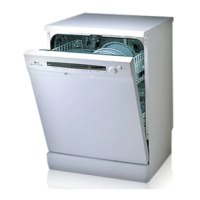
This document is an owner's manual for an LG dishwasher, providing comprehensive instructions for its safe installation, operation, and maintenance. The dishwasher is designed for normal household use and is not intended for industrial or commercial applications.
The manual emphasizes several critical safety precautions. During installation, electrical connections must adhere to the rating label and local regulations, ensuring a properly earthed system without extension cords. If hot water exceeds 65°C, the water heater setting should be adjusted, or the dishwasher connected to cold water. Damaged power cords must be replaced by qualified personnel. The appliance should be positioned to allow easy access to the plug. New hose-sets are required for water mains connection, and old ones should not be reused.
For safe use, only suitable household utensils should be placed in the dishwasher, avoiding non-heat resistant or metal-decorated items. Solvents are strictly prohibited due to explosion and fire risks. Water should not be sprayed on the appliance to prevent electrical failure. Users should avoid pushing down or sitting on the inner door when open, as this can cause deformation. Only dishwasher-specific detergent should be used, as hand-washing detergent can interfere with operation. Dishwasher detergents are highly alkaline and dangerous if swallowed; contact with skin and eyes should be avoided, and children kept away when the door is open. The detergent receptacle should be checked for emptiness after each cycle. The appliance includes a safety function that stops operation during heavy mains disturbances.
Child safety is addressed through a "Child Lock" mode to prevent setting changes. Children should be kept away from detergents and rinse-aids and supervised to ensure they do not play with the appliance. The power cord requires protection from physical abuse, and overloaded outlets, damaged cords, or frayed insulation are dangerous and should be addressed by an authorized servicer. The appliance must be grounded to reduce electric shock risk, with the plug connected to an appropriate, grounded outlet. Improper grounding can lead to electric shock, and any modifications to the plug or outlet should be done by a qualified electrician.
Installation involves several steps. First, the cupboard opening must be prepared, ensuring the dishwasher fits the specified dimensions (600-605mm width, 820-870mm height, 600mm depth). The location should be close to a sink for water and drain connections, ideally within 3 meters for proper drainage. If installed in a corner, a minimum 5cm space from adjacent cabinets or walls is required. If bare chipboard is adjacent to or above the dishwasher, it should be sealed with waterproofing paint or sealant to prevent swelling from steam.
Next, electrical wiring preparation is crucial. For personal safety, the house fuse or circuit breaker should be removed before installation. Extension cords or adapter plugs are not to be used. Electrical and grounding connections must comply with national and local codes, supplying correct voltage and hertz to an individual, properly grounded branch circuit protected by a minimum 13 amp circuit breaker or time delay fuse. Wiring should be 2 wires with ground. The power plug must be accessible, not behind the dishwasher, and within 1.2 meters of its side. The plug must be correctly earthed, and no other appliance should share the same outlet.
Before sliding the dishwasher into the cupboard, the legs should be adjusted to the required height using a spanner, ensuring final height and balancing adjustments are made. The drain hose inside the cabinet must not be kinked or stretched. If the cupboard height is below 850mm, the top table of the dishwasher should be removed by unscrewing two rear screws.
Drain line connection involves two typical methods. If the drain hose end doesn't fit the drain line, a heat and detergent-resistant rubber connector (not supplied) can be used. If connecting to a sink "S" trap or waste disposal unit, the hose must be looped up to the underside of the bench top and secured to prevent siphoning. If connecting to a separate standpipe, an airtight connection is essential. Drain hose extensions should be used carefully, ensuring the hose is not kinked (bends should have a 40mm radius).
For water supply connection, the hose connects to the valve behind the dishwasher and the water tap. The dishwasher can use hot or cold water, but if hot water cannot be maintained below 65°C, it must be connected to cold water. Sealing tape or compound should be used to prevent leaks, and the line must not be kinked or sharply bent.
Finally, for assembly, the supply hose should be securely hand-tightened, and the power supply cord plugged into an earthed outlet. After installation, the dishwasher should be operated through one cycle (Quick cycle recommended) without dishes to check for water leaks and operating conditions. Initial operation might produce noise, in which case the power switch should be turned off and the dishwasher restarted.
After installation, if the door feels sticky or produces a frictional sound when opening or closing, the product's level needs adjustment. If the door slants to the right, unscrew (counter-clockwise) the left rear leg to raise the level. If it slants to the left, unscrew (counter-clockwise) the right rear leg. The goal is to eliminate slant, stickiness, or friction.
The dishwasher features a control panel with several buttons and indicators. The "TIME LEFT" display shows the remaining program time or, before starting, the selected program's running time. It also displays error codes like "DE" (Drainage trouble), "FE" (Overfilling water), "IE" (Water inlet trouble), "EI" (Water leakage trouble), and "HE" (Heater trouble), with a "Cd" code indicating "Cool dry" at the end of a cycle. The "DELAY START" button allows delaying the program start from 1 to 19 hours, increasing by 1 hour with each press. Indicators for "Refill with special salt" and "Refill with rinse aid" illuminate when these consumables are low.
Program selection is done via individual buttons for "Auto," "Eco65°," "Quick40°," and "Pre-wash." The "POWER" button turns the dishwasher on and off, automatically switching off for safety and energy saving, or in case of irregular surge disturbances. The "CHILD LOCK" function, activated by simultaneously pressing "Auto" and "Eco" for a few seconds, locks control buttons to prevent accidental changes and is canceled upon power failure. The "BEEP ON/OFF" function, set by simultaneously pressing "Quick" and "Pre-wash" for a few seconds when the dishwasher is off, controls audible alerts and is also canceled upon power failure.
Loading Your Dishwasher: For optimal washing, dishes should be loaded according to instructions. Large, non-soluble food particles like bones or toothpicks should be scraped off. Crockery should be positioned to allow water contact on all surfaces. Deep-based items should be angled for proper water runoff and drying. Items with burnt-on scraps should be pre-soaked. Large items should not obstruct the detergent dispenser lid.
Using the Cutlery Basket: Cutlery should be mixed within each section of the basket to prevent nesting. Place cutlery with handles down in the cover. The cover can be hinged or clipped away if not needed. Knives should be placed in a separate rack on the upper rack. Sharp items require careful loading and unloading.
Loading the Lower Rack: This rack is ideal for dinner plates, soup bowls, dishes, pots, pans, lids, and grill trays. Plates should be upright and facing the center. Pots, pans, and large dishes should be turned upside down. Ensure spray arm rotation is not obstructed.
Loading the Upper Rack: This rack is for more delicate items, small plates, long cutlery, cups, glasses, and dishwasher-safe plastic items. Plates should be positioned upwards with the plate bottom facing the front. Cups, glasses, and bowls should be upside down. Fold-down cup racks can support extra cups or long-stem glasses. Ensure the spray arm under the upper rack can rotate freely.
Adjusting the Upper Rack (Not on all models): The upper rack can be raised or lowered to accommodate different crockery sizes. Before adjusting, the rack must be empty and slid out. Reinsert the rack into the desired position. Fitting it back into the standard position reduces space between upper and lower racks. After adjustment, verify the spray arm rotates freely. Adjusting an empty rack prevents damage to crockery and injury.
Non-Dishwasher Safe Items: Items like copper or anodized aluminum, hand-painted silver or gold leaf crockery, wood or bone-handled utensils, iron or non-rust proof utensils, and non-dishwasher safe plastic items should not be washed in the dishwasher due to high water temperatures and detergent that may cause damage.
Adding Detergent: Detergent must be added before every program, except Pre-Wash. Follow manufacturer instructions for dosage. Less detergent may be used for moderately dirty dishes. Chambers hold 15g and 25g. The amount varies by program: Auto (20g), Eco (15g), Quick (10g), Pre-wash (no detergent). After adding, close the chamber lid. Detergent dispenses automatically and the lid remains open after operation. Only household dishwasher detergent should be used; hand-washing detergent creates foam that interferes with operation. Dishwasher detergent is a poison and should be kept out of reach of children. Check the compartment after each wash for remaining detergent.
Adding Rinse Aid: To fill, rotate the round cap counter-clockwise and remove. Fill to the maximum level with quality rinse aid, then replace and lock the cap. Rinse aid dispenses automatically during the final rinse cycle. The dosage setting is factory set but can be adjusted if cloudy spots, streaks, or water marks appear (increase setting) or if smears or foam appear (decrease setting). The rinse aid level can be checked via an indicator window (black for sufficient, clear for required) or a light on the control panel. The light indicates near exhaustion. Rinse aid ensures spot and streak-free dishes and improved drying. Too much can cause excess foam and potential water leaks.
Salt Filling: This model includes a water softener. Soft water is essential for satisfactory rinsing, preventing lime stains. If tap water hardness exceeds a certain level, it must be softened by adding special salt to the dishwasher's water softener. The required salt amount is set based on tap water hardness. For first filling, check local water hardness, set the water softener accordingly, remove the lower rack and salt container cap, and fill with coarse or regenerating salt (approx. 1.9 kg) using a funnel. Wipe spilled salt and tightly screw on the cap to prevent suds penetration.
Setting up the Water Softening System: The water softener can be adjusted in 8 steps, from "H0" to "H7," corresponding to water hardness levels. The factory setting is "H4." To change, switch off the dishwasher, then simultaneously press and hold "Delay Start" and "Power." "H" and a figure will appear. Press "Quick" to cycle through settings "H0" to "H7." Once adjusted, press "Pre-wash" to save the setting. The salt refill lamp will turn off if the control is set to "H0" as no salt will be consumed. For settings "H1" to "H7," salt must be added.
Fold Down Dividers (Not on all models): Dividers in the lower rack can be lowered to improve stacking of pots and pans.
Drying: At the end of the program, fully opening the door assists in drying.
Energy Test (EN50242): This test is performed with the appliance loaded according to standard specifications (12 place settings), using the "Eco" comparability course, rinse aid setting 3, and specific detergent amounts (6g on door, 24g in dispenser). The Rack-U must be in the uppermost position.
The program indicator lights and all phase indicators will illuminate. The display shows the running time, then the remaining time, which decreases minute by minute. If the door is opened during operation, a safety device stops the machine. Closing the door resumes the program from where it stopped.
At the end of the washing program: "End" is displayed, a buzz sounds, and then "Cd" code appears, indicating "Cool dry." This fan operation helps diminish remaining moisture. Users can open and unload the dishwasher or allow it to automatically switch off for safety and energy saving. When unloading, empty the lower rack first, then the upper, to prevent water dripping. Opening the door during hot phases or immediately after a program can release steam, so caution is advised.
The manual details various wash programs:
"Cool dry" is not part of the program itself but a post-cycle fan operation. The dishwasher also features "Auto Restart," meaning if power fails, it will restart automatically from the position it stopped, adjusting accordingly.
Regular maintenance of filters and spray arms is crucial for preventing trouble and ensuring proper operation.
Filters:
Upper Spray Arm:
Lower Spray Arm:
The manual provides a troubleshooting guide for common issues before calling for service.
 General
| Door color | White |
|---|---|
| Control type | Buttons |
| Built-in display | Yes |
| Appliance placement | Freestanding |
| Noise level | - dB |
| Delay start (max) | 19 h |
| Dishwashing programs | Auto, Eco, Pre-wash, Quick |
| Number of place settings | 12 place settings |
| Number of washing programs | - |
| Water consumption per cycle | - L |
| Energy consumption per cycle | - kWh |
 Weight and Dimensions
| Width | 600 mm |
|---|---|
| Height | 850 mm |
| Installation compartment width | 605 mm |
| Installation compartment height (max) | 870 mm |
| Installation compartment height (min) | 820 mm |

 To Next Page