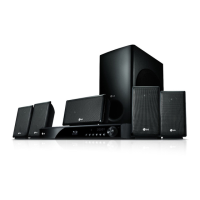
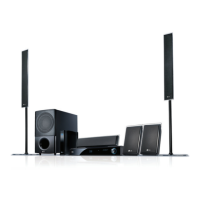
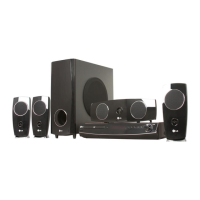
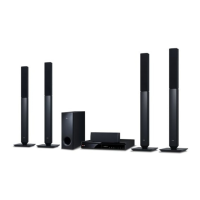
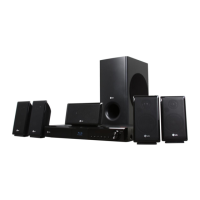
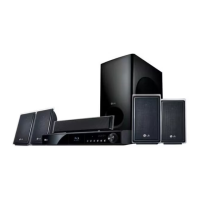
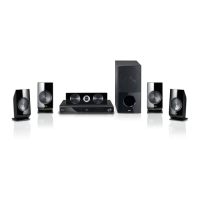
This document serves as the service manual for the LG Digital Home Cinema System, specifically covering models LHS-A4000WA, LHS-A4000WD, LHS-A4000C, and LHS-A4000T. It provides comprehensive technical information for troubleshooting, repair, and maintenance of these audio systems.
Function Description
The LG Digital Home Cinema System is designed to deliver an immersive audio experience for home entertainment. It functions as a complete audio system, integrating various components to process and amplify audio signals, providing surround sound capabilities. The system includes a main unit (subwoofer with integrated amplifier and control electronics), satellite speakers, and a center speaker. It supports multiple audio input sources, including analog, coaxial, and optical digital audio, making it compatible with a wide range of external devices such as TVs, DVD players, and gaming consoles. The system also features an integrated FM/AM tuner for radio reception. The core functionality revolves around digital signal processing (DSP) for audio decoding (AC-3/DTS), amplification, and output to the various speaker channels to create a surround sound field.
Important Technical Specifications
The manual provides detailed specifications for the main unit and the associated speakers:
Main Unit (Subwoofer with integrated amplifier):
- Power supply: Refer to the main label (specific voltage not provided in this section, but implied to be standard AC).
- Power consumption: 60 W.
- Mass: 10 kg.
- External dimensions (W x H x D): 246 x 430 x 420 mm.
- Operating conditions: Temperature: 5°C to 35°C, Operation status: Horizontal.
- Frequency response (audio): 120 Hz to 20 kHz.
- Signal-to-noise ratio (audio): More than 75 dB (1 kHz, NOP, W/IHF-A & 20 kHz Filter).
- Harmonic distortion (audio): 1.0% (1 kHz, at 12W position) (20 kHz LPF/A Filter).
- Surround mode Front: 60W + 60W (THD 10%).
- Center*: 60W (8Ω at 1 kHz, THD 10%).
- Surround*: 60W + 60W (8Ω at 1 kHz, THD 10%).
- Subwoofer*: 120W (4Ω at 250 Hz, THD 10%).
FM Tuner:
- Tuning Range: 87.5 - 108.0 MHz or 65 - 74 MHz, 87.5 - 108.0 MHz.
- Intermediate Frequency: 10.7 MHz.
- Signal to Noise Ratio: 60/55 dB.
- Frequency Response: 140 -10,000 Hz.
AM Tuner:
- Tuning Range: 522 - 1611 kHz or 530 - 1610 kHz or 530 - 1720 kHz.
- Intermediate Frequency: 450 kHz.
- Signal to Noise Ratio: 37 dB.
- Frequency Response: 140 - 25,000 Hz.
Inputs: AUX, COAXIAL, OPTICAL AUDIO.
Speaker Specifications:
-
Satellite Speaker (LHS-A4000T):
- Type: 2 Way 2 Speaker.
- Impedance: 8 Ω.
- Frequency Response: 120 - 20,000 Hz.
- Sound Pressure Level: 84 dB/W (1m).
- Rated Input Power: 60 W.
- Max. Input Power: 120 W.
- Net Dimensions (W x H x D): 100 x 162 x 120 mm.
- Net Weight: 0.8 kg.
-
Center Speaker (LHS-A4000C):
- Type: 2 Way 2 Speaker.
- Impedance: 8 Ω.
- Frequency Response: 120 - 20,000 Hz.
- Sound Pressure Level: 84 dB/W (1m).
- Rated Input Power: 60 W.
- Max. Input Power: 120 W.
- Net Dimensions (W x H x D): 225 x 102 x 120 mm.
- Net Weight: 0.9 kg.
-
Active Subwoofer (LHS-A4000WA/WD):
- Type: 1 Way 1 Speaker.
- Impedance: 4 Ω.
- Frequency Response: 40 - 180 Hz.
- Sound Pressure Level: 82 dB/W (1m).
- Rated Input Power: 120 W.
- Max. Input Power: 240 W.
- Net Dimensions (W x H x D): 246 x 430 x 420 mm.
- Net Weight: 10 kg.
*Designs and specifications are subject to change without notice.
Usage Features
The LG Digital Home Cinema System is designed for ease of use within a home entertainment setup.
- Multi-source Connectivity: It supports various audio input types (AUX, Coaxial, Optical), allowing connection to a wide array of audio sources.
- Integrated Tuner: The built-in FM/AM tuner provides access to radio broadcasts, expanding entertainment options beyond connected devices.
- Surround Sound Experience: The system is configured for surround sound, typically a 5.1 setup (Front L/R, Rear L/R, Center, Subwoofer), enhancing the cinematic experience.
- User Interface: While not explicitly detailed in the provided pages, the presence of a VFD (Vacuum Fluorescent Display) and front panel controls (tuning, volume, standby/on, memory, function) indicates a user-friendly interface for system operation. A remote control is also listed as an accessory, further simplifying interaction.
- Power Management: The system includes power management features, indicated by the "ST-BY/ON" control and power section schematics.
Maintenance Features
The service manual is primarily focused on providing detailed information for technical maintenance and repair.
- ESD Precautions: The manual emphasizes Electrostatic Sensitive Device (ESD) precautions, providing guidelines for safe handling of components to prevent damage during service. This includes grounding techniques, use of anti-static tools, and proper storage of ESD devices.
- Troubleshooting Guide: A comprehensive troubleshooting flowchart is provided to diagnose common issues, such as no power, no display, or no sound output. This guide directs technicians through logical steps to identify the root cause of problems, from checking power connections to verifying IC voltages and communication lines.
- IC Voltage Sheet: This section lists expected voltage values for key Integrated Circuits (ICs) within the Power & Micom, DSP, OP-AMP, DAP, and VFD Drive sections. This is crucial for diagnosing component failures by comparing measured voltages against specified values.
- Wiring Diagrams: Detailed wiring diagrams illustrate the interconnections between different PCBs (Printed Circuit Boards) and components, such as the main unit, front PCB, jack PCB, tuner, and speakers. These diagrams are essential for tracing signal paths and identifying incorrect connections.
- Block Diagrams: Block diagrams provide a high-level overview of the system's architecture, showing the functional blocks and their interactions. This helps technicians understand the overall signal flow and identify which sections might be affected by a particular fault.
- Schematic Diagrams: Extensive schematic diagrams are provided for the AMP, SMPS (Switched-Mode Power Supply), DSP (Digital Signal Processor), Micom (Microcontroller), Power, I/O, and Front sections. These detailed circuit diagrams are indispensable for component-level troubleshooting and repair.
- Printed Circuit Diagrams (Top and Bottom View): PCB layouts are included for the Main P.C. Board, Front P.C. Board, Jack P.C. Board, and SMPS P.C. Board, showing component placement and trace routing. These are vital for locating components on the physical board during repair.
- Exploded Views: Exploded diagrams of the cabinet, main frame, audio deck section, and speaker sections (LHS-A4000C, LHS-A4000T) are provided. These diagrams, along with corresponding parts lists, facilitate disassembly, reassembly, and identification of mechanical components for replacement.
- Replacement Parts List: A comprehensive list of replacement parts is included, detailing part numbers, descriptions, and specifications for various components, including PCBs, speakers, power cords, and accessories. This ensures that correct replacement parts can be ordered and installed.
- Graphic Symbols: The manual includes explanations of graphic symbols (lightning flash for dangerous voltage, exclamation point for important safety information) to alert service personnel to potential hazards and critical information.
- Safety Precautions: General safety precautions are highlighted, particularly regarding power application and handling of components, to ensure the safety of service personnel.
The manual's structured approach, with detailed diagrams and specifications, makes it an invaluable resource for professional technicians performing service and repair on the LG Digital Home Cinema System.

 Need help?
 General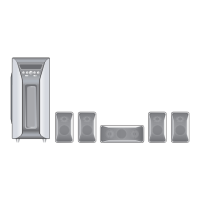

 To Next Page