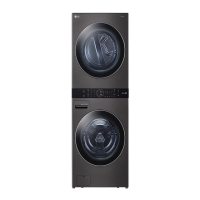
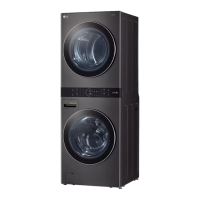
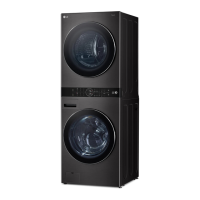
This document is a user manual for an LG Laundry Center, model WK22*S6P, which combines a washer and a dryer in a single unit. It provides detailed instructions for installation, operation, maintenance, and troubleshooting.
Function Description
The LG Laundry Center is designed for household use, offering both washing and drying capabilities. It features various wash and dry programs tailored to different fabric types and soil levels, as well as smart functions for remote control and diagnosis via the LG ThinQ application.
Washer Functionality:
The washer is a front-load type with a maximum capacity of 22 kg for washing. It offers multiple wash programs including Normal, Bedding, Delicates, Heavy Duty, Speed Wash, and Downloaded cycles. Users can customize wash settings such as temperature (Cold, Cool, Warm, Very Warm, Hot), spin speed (No Spin, Low, Medium, Medium High, High Spin), and soil level (Light, Medium Light, Normal, Medium Heavy, Heavy). Special options like Steam, Delay End, Extra Rinse, and Pre-wash are available to enhance cleaning performance and convenience. The washer also includes a Tub Clean cycle for internal maintenance and a Child Lock function to prevent unintended operation.
Dryer Functionality:
The dryer has a maximum capacity of 11 kg for dry clothes or 22 kg for wet clothes. It provides various drying programs such as Normal, Bedding, Delicates, Heavy Duty, Small Load, and Downloaded cycles. Drying settings can be adjusted for temperature (Low, Medium Low, Medium, Medium High, High) and dry level (Damp, Less, Normal, More, Very). Additional options include Energy Saver and Wrinkle Care. The dryer features a lint filter that needs to be cleaned after every cycle and a Flow Sense duct blockage sensing system to alert users to restrictions in the exhaust duct. A Child Lock function is also available for the dryer.
Smart Functions (LG ThinQ Application):
The appliance integrates with the LG ThinQ application, allowing users to:
- Remote Start: Control the appliance remotely from a smartphone.
- Download Cycle: Download new and specialized wash/dry cycles not included in the standard programs.
- Cloud Cycle: Access various cycles from the Cloud, which are deleted when the power is turned off.
- Tub Clean Coach (Washer): Track remaining cycles before a recommended Tub Clean.
- Venting Tips (Dryer): Receive advice for optimizing dryer ventilation.
- Energy Monitoring: Monitor the washer's power consumption.
- Smart Diagnosis™: Obtain useful information for diagnosing and resolving appliance problems based on usage patterns.
- Push Alerts: Receive notifications when a cycle is complete or if problems occur.
- Settings: Configure various appliance options through the app.
Important Technical Specifications
- Model: WK22*S6P
- Power Supply: 120 V~ 60 Hz
- Dimensions (Width x Depth x Height): 700 mm x 770 mm x 1890 mm
- Product Weight: 141 kg
- Max. Capacity:
- Washing: 22 kg
- Drying: 11 kg (Dry Clothes) / 22 kg (Wet Clothes)
- Maximum Power: 1320 W (Washing) / 400 W (Drying)
- Permissible Inlet Water Pressure: 50 kPa - 800 kPa (0.5-8.0 kgf/cm²)
- Gas Requirements (for Gas Models):
- NG: 10.2 - 26.7 cm WC
- LP: 20.4 - 33.1 cm WC
- Electrical Requirements (for Electric Dryer): 240 V~ 60 Hz, 30-ampere circuit, #10 AWG minimum copper conductor.
- Ventilation: Requires 10 cm diameter rigid, semi-rigid, or flexible metal ductwork. Total length of flexible metal duct should not exceed 2.4 m.
Usage Features
Installation:
The manual provides detailed instructions for installation, including requirements for the installation place (solid, level floor, minimum clearances), unpacking the appliance, connecting electric and gas dryers, connecting water supply hoses, installing the drain hose, and leveling the appliance. It emphasizes the importance of proper grounding and adherence to local electrical and gas codes. For electric dryers, it details wiring for both four-wire and three-wire power cords. For gas dryers, it specifies gas supply requirements and the need for a qualified installer.
Operation:
- Before First Use: Run a Normal wash program with half the detergent and no clothes to remove manufacturing residues.
- Loading: Sort clothes by fabric type, soil level, color, and load size. Check pockets for foreign objects. Combine large and small items, loading large items first, ensuring they don't exceed half the total wash load. Close zippers and hooks to prevent snagging.
- Detergent and Softener: Add appropriate amounts of detergent and softener to the dispenser compartments. Liquid detergent can be poured directly into the main detergent drawer for immediate cycles, but not for Pre-wash. Avoid overdosing detergent to prevent excessive suds.
- Cycle Selection: Use the program buttons or selector knob to choose the desired wash or dry cycle. Customize temperature, spin speed, dry level, and soil level as needed.
- Starting/Pausing: Press the Start/Pause button to begin or temporarily stop a cycle.
- End of Cycle: Remove clothes promptly to reduce wrinkling. If Wrinkle Care is selected, the dryer will tumble periodically.
- Child Lock: Activate by pressing and holding the Soil button (washer) or Time Dry button (dryer) for 3 seconds to disable controls.
- Signal: Turn the melody and button tones on/off by pressing and holding the Extra Rinse button (washer) or Reduce Static button (dryer) for 3 seconds.
Maintenance Features
General Maintenance:
- Cleaning Exterior: Wipe spills immediately with a damp cloth. Clean with a damp cloth and mild, non-abrasive household detergent, then dry.
- Cleaning Interior (Washer): Wipe the door and door seal after each cycle. Leave the door slightly open to dry the drum. Run the Tub Clean function once a month (or more often if needed) to remove detergent/softener buildup and odors.
- Cleaning Interior (Dryer): Wipe around the door opening and seal with a soft, damp cloth. Clean the window with a soft cloth and mild detergent. Stainless steel drum can be cleaned with a conventional stainless steel cleaner.
- Around and Under Appliance: Regularly vacuum lint and dust.
Specific Cleaning:
- Lint Filter (Dryer): Clean after every cycle by rolling off lint with fingers or vacuuming. If heavily soiled or clogged with fabric softener, wash in warm, soapy water and dry thoroughly before reinstalling. Never operate the dryer without the lint filter in place.
- Water Inlet Filter (Washer): Clean every six months or more often if water is hard or contains limescale. Turn off water, unscrew the inlet hose, remove the filter with pliers, and clean with a medium bristle toothbrush.
- Drain Pump Filter (Washer): Clean every six months. Allow water to cool before cleaning. Remove the drain plug, drain water, then slowly unscrew the filter to remove debris. Reinsert carefully.
Ductwork Maintenance (Dryer):
- Check ventilation ducts monthly for lint buildup and clean at least once a year.
- If airflow or drying performance reduces, check ducts immediately for blockages.
- Use rigid, semi-rigid, or flexible metal ductwork, keeping runs as short as possible with minimal elbow joints.
- Insulate ducts in unheated areas to reduce condensation.
Troubleshooting:
The manual includes comprehensive troubleshooting tables for both the washer and dryer, addressing common error messages (e.g., 1E for inlet error, UE for unbalance, OE for water outlet, tE for control error, LE for motor locked, FE for overflow, PE for pressure sensor, vS for vibration sensor, FF for frozen failure, AE for water leakage, PF for power failure on washer; tE1-tE7 for temperature sensor, PS for power error, d7S-dGS for duct block, CL for child lock on dryer) and operational issues (e.g., noises, water leaks, poor stain removal, staining, wrinkling, shrinking, lint on clothes, static, clothes taking too long to dry, appliance not turning on/heating, inconsistent drying time, Wi-Fi connection problems). Each symptom is accompanied by a possible cause and solution.

 Need help?
 General



 To Next Page