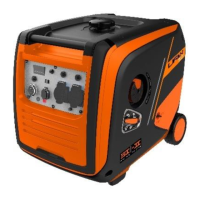
This document is the owner's manual for the LIFAN INVERTER PETROL GENERATOR, model KP2300i-2. It provides comprehensive information on the generator's function, technical specifications, usage, and maintenance.
Function Description
The LIFAN KP2300i-2 is an inverter petrol generator designed to provide reliable electrical power. It is characterized by advanced design, compact structure, reliable performance, convenient service, low fuel consumption, and quiet operation. It is suitable for a wide range of applications including living, open working, shopping, banking, and fishing. The generator features an inverter technology, which typically provides clean and stable power suitable for sensitive electronics. It includes various protection mechanisms such as DC protection, low oil warning, and overload indication to ensure safe operation.
Important Technical Specifications
The generator model is KP2300i-2, an inverter type.
- Rated frequency: 50/60 Hz
- Rated voltage: 120/220/230 V
- Rated output power: 1.8 Kw
- Max. output power: 1.95 Kw
- Power factor: 1
- DC output: 12V-8A
- AC output quality: ISO8528 G2
- THD/%: 3
- Noise: 64 dB
- Overload protection: Non-fuse protector (DC), Controlled by inverter overload protect program (AC)
Engine Specifications:
- Engine model: 148F
- Engine type: Single cylinder, 4-stroke, forced air cooled, OHV
- Displacement: 80 cc
- Fuel type: Unleaded petrol
- Fuel tank capacity: 4 L (0.88 UK gallons)
- Continuous running time: 4 hours
- Engine oil capacity: 350 ml
- Spark plug model: NGK CR5HS
- Starting mode: Hand Recoil
Dimensions:
- LxWxH: 495290460 mm
- Net weight: 18.70 Kg
The manual also mentions an optional parallel operation feature, which allows connecting two 2300i-2 generators of the same voltage and frequency. In parallel operation, the rated output power is 3.4KVA, with a rated current of 28.0A for 120V generators and 14.5A for 230V generators. The maximum power for parallel operation is 3.6kW.
Usage Features
The generator's control panel includes several key components for operation and monitoring:
- Three-in-one combination switch: This switch has "OFF", "ON", and "CHOKE" positions. "OFF" closes the ignition circuit, stopping the engine. "ON" opens the ignition circuit and fuel, allowing normal operation. "CHOKE" is used for cold starts, enriching the fuel mixture.
- Voltage recovery button: Used to restore voltage output after an overload.
- Low oil warning light (red): Illuminates when crankcase oil drops below a safe level, automatically shutting off the engine.
- Overload indicator light (red): Illuminates when the connected equipment overloads the generator, causing the inverter to overheat and the AC protector to stop the generator.
- AC indicator light (green): Indicates normal operation or overload/bus voltage status through different flash patterns.
- AC socket: For connecting AC loads.
- Energy conservation switch (ECS): In the "ON" position, it saves energy by adjusting engine speed according to the load. In "OFF", the engine runs at a rated speed regardless of load.
- DC socket: For connecting DC loads.
- USB socket: For charging USB devices.
- DC protection: The DC switch automatically turns to "OFF" if the rated current is exceeded, protecting connected electronic equipment.
- Parallel socket (optional): For connecting two generators in parallel.
- Grounding (earth) terminal: For connecting an earth wire to prevent electric shock.
- Fuel tank cap and vent lever: The vent lever must be in the "ON" position for fuel to flow to the carburetor and in "OFF" to stop fuel flow.
Starting the Generator (from cold):
- Turn the energy saving switch to "OFF".
- Turn the fuel tank cap ventilation lever to "ON".
- Rotate the three-in-one combination switch to "CHOKE", then to "ON" (ignition system on), and finally to "CHOKE" to assist the cold engine.
- Gently pull the hand starter until compression is felt, then pull it hard.
Stopping the Generator:
- Turn the energy saving switch to "OFF".
- Disconnect all electrical equipment.
- Set the combination control switch to "OFF" (fuel off, ignition system off).
- After the generator cools, move the fuel cap vent lever to "OFF".
Safety Warnings:
- Never operate in an enclosed room.
- Never connect directly to home/mains electricity without a qualified electrical engineer and an ATS (Automatic Transfer Switch).
- Do not operate in wet conditions.
- Keep inflammables at least 1m away from the unit.
- No smoking when filling fuel.
- Always fill fuel with the generator stopped.
- Avoid spilling fuel when filling.
- Ensure proper grounding.
- Do not use the generator in a confined space.
- Do not connect any electrical equipment before starting the engine.
- Prevent electrical misuse, be sure to ground the petrol generator.
- The generator is not filled with oil during transportation.
- Do not start the engine until the generator has been filled with the correct grade and amount of oil.
- Do not tilt the engine when adding oil to prevent over/underfilling and causing damage.
- The generator can work with rated output load under standard atmospheric conditions.
- Do not smoke while connecting or disconnecting the battery during charging.
- Battery electrolyte contains sulfuric acid, which is toxic and a burn hazard. Avoid contact with skin, eyes, and clothes.
- Batteries can produce explosive gases. Keep away from sparks, flame, cigarette, etc.
- Keep the battery away from children.
Maintenance Features
The manual outlines a detailed maintenance schedule for various components:
Routine Maintenance (daily pre-operation check):
- Check the oil level.
- Check fuel.
- Check the fuel oil pipe.
- Check the air filter.
- Check running condition.
- Consult the dealer if necessary.
Scheduled Maintenance:
- Every 6 months or 100 hours:
- Replace engine oil.
- Check fuel.
- Check the fuel oil pipe.
- Clean-adjust spark plug.
- Check air filter.
- Clean or replace fuel tank filter if necessary.
- Check-adjust valve clearance.
- Every 12 months or 300 hours:
- Replace engine oil.
- Check fuel.
- Check the fuel oil pipe.
- Replace spark plug.
- Clean air filter.
- Clean or replace fuel tank filter if necessary.
- Check-adjust valve clearance.
- Check-adjust spark eliminator.
- Clean carbon deposit from cylinder head & piston.
Specific Maintenance Procedures:
- Spark plug maintenance:
- Remove the outer plastic cover.
- Insert the spark plug spanner into the hole from the outside of the cover.
- Insert the metal bar into the spanner and remove the spark plug by rotating counterclockwise.
- Check the color for carbon deposits (should be moderately light brown).
- Check spark plug type and clearance (0.7-0.8mm).
- Install spark plug & tighten to the recommended torque (22 N*m).
- Replace spark plug cap and outer plastic cover.
- Changing the engine oil:
- Place the generator on a level surface.
- Rotate the locking handle of the oil port cover and remove to gain access to the dipstick.
- Unscrew the oil cap/dipstick.
- Fill with the specified amount of recommended oil (SAE SJ 10W-40, API standard SE or higher, 0.35L capacity).
- Replace the oil port cover.
- Air filter maintenance:
- Remove screws and outer plastic cover.
- Remove screws and air filter housing cover.
- Remove the foam element.
- Clean the foam element with solvent and dry it.
- Soak the foam element in oil and squeeze out excess.
- Place the foam element in the air filter.
- Return the air filter cover to the original position and tighten the screw.
- Replace the outer cover plate and tighten the screw.
- Muffler mesh and spark collector maintenance:
- Remove the screw, remove the rear grille.
- Remove the screw, remove the muffler bracket, muffler mesh, and spark collector.
- Use a wire brush to remove carbon deposits on the muffler mesh cover and spark collector.
- Check the muffler mesh and spark collector, replace immediately if damaged.
- Reinstall the spark collector.
- Replace the muffler mesh cover and muffler bracket.
- Re-position the rear grille and tighten the screw.
- Fuel tank filter maintenance:
- Remove fuel tank cap and strainer.
- Clean the fuel tank strainer with fresh petrol.
- Dry the strainer and replace back in the fuel tank.
- Replace and secure the fuel cap.
- Engine storage:
- Set the three-in-one combination switch to "OFF".
- Remove the spark plug, pour in approx. 15ml (1 tablespoon) of SAE10W30 oil, replace the spark plug then pull and release the hand-pull starter several times to lubricate the cylinder and valves with the oil.
- Pull the recoil starter gently until you feel the compression then release slowly. This protects the cylinder, cylinder head etc. by closing the valves to prevent rusting.
- Clean the outer surface with a soft clean cloth; place the engine in a dry ventilated place and cover with a protective sheet.
The manual also includes troubleshooting steps for common issues like the engine not starting or the generator having no voltage output.

 Need help?
 General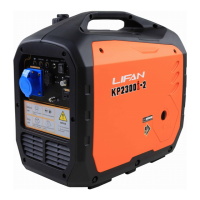

 To Next Page