Need help?
Do you have a question about the Livoo DOP156 and is the answer not in the manual?
Guides selection of milk for yogurt making, including UHT, non-pasteurized, and powder milk options.
Details options for yogurt starter cultures: commercial, homemade, or freeze-dried.
Outlines the steps for preparing yogurt, including mixing milk and culture, and filling pots.
Instructions for cooling and storing yogurt, including duration and handling notes.
Addresses common issues like appliance not turning on and provides possible causes.
Explains problems like lumps, liquid on surface, or liquid yogurts due to temperature or culture.
Covers issues like strange taste or soured milk, linking them to starter culture or milk quality.
Provides essential steps for cleaning the appliance, emphasizing unplugging and avoiding immersion.
This document provides a comprehensive user manual for the Livoo Yoghurt & Cheese Maker, a versatile appliance designed to create homemade yoghurts and cheese. The manual emphasizes the importance of reading the instructions thoroughly before first use to ensure proper operation and prevent damage or injury. The appliance is intended for household and similar applications, including staff kitchen areas, farmhouses, hotels, motels, and bed and breakfast environments.
The Livoo Yoghurt & Cheese Maker facilitates the fermentation process to transform milk into yoghurt and cheese. It operates by maintaining a consistent temperature suitable for starter cultures to thrive, solidifying the milk over several hours. The device offers flexibility in preparation, allowing users to make 12 yoghurts, 6 yoghurts with a cheese tray or filters, or solely a cheese tray or filters in a single batch. This adaptability caters to different preferences and quantities.
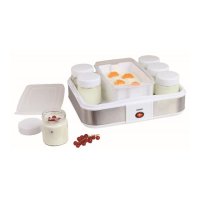
The appliance comes with several components designed for ease of use: an appliance cover, 12 glass pots of 0.21 L each with plastic lids, a plastic box cover, a 1.2 L box with a mesh strainer, and a base with a stop/start button.
Before First Use: Users are instructed to clean all accessories—glass yoghurt pots, their lids, the pot with strainers, and the yoghurt maker lid—in hot soapy water, then rinse and dry them. It is crucial not to immerse the base of the appliance in water.
Yoghurt Preparation: To prepare 6 yoghurt pots, 0.9 L of milk and a starter culture (or readymade yoghurt) are required. The manual details the choice of milk, recommending whole UHT milk for best results (firm and skinless yoghurt) as it doesn't need boiling. Non-pasteurized milk and fresh farm milk must be boiled and cooled to eliminate bacteria and skin formation, respectively. Powdered milk is noted for producing very smooth yoghurt that sets quickly. For thicker yoghurt, two to three tablespoons of powdered milk can be added per liter of milk. For soy and almond milk, heating to 35°C – 43°C (without overheating) and cooling before use is suggested.
Starter Culture Selection: Users can choose from plain commercial yoghurt with an expiry date, previously made homemade yoghurt, or freeze-dried culture/rennet available in pharmacies or health food stores. If using freeze-dried culture, an additional two hours should be added to the fermentation time for the first batch. This option is more advantageous due to a higher concentration of starter culture, allowing for approximately thirty batches of yoghurt. However, it is advised not to use homemade yoghurt as a starter more than ten times to maintain good taste.
Preparation Steps:
Sweetening Yoghurts: Sugar (up to 100g per 1.5 L preparation) can be added to the milk simultaneously with the ferments during preparation. Proper mixing with a fork or whisk is essential.
Fromage Blanc Preparation (with 1.2 L tray and drainer):
The appliance can also be used to make milky desserts, with a recommendation to use fresh eggs if the recipe includes them.
Refrigeration of Yoghurt:
Important Notes on Usage:
Greek Yoghurt Preparation:
Tips for Best Use:
Troubleshooting: The manual includes a troubleshooting section for common issues:
Cleaning:
The manual also includes general safety instructions, emphasizing the importance of proper use, avoiding immersion in water, and keeping the cord away from hot surfaces. It states that the appliance can be used by children aged 3 and above with supervision and understanding of hazards, and by persons with reduced capabilities if supervised and instructed. Children aged under 8 should not clean the appliance. The heating element surface remains subject to residual heat after use. The appliance is not intended for operation with an external timer or separate remote control system. It is absolutely necessary to keep the appliance clean as it comes into direct contact with food.
 General
| Pot capacity | 0.21 L |
|---|---|
| Product color | Grey, White |
| Number of pots | 12 |
| Total capacity | 1.2 L |
| Housing material | Stainless steel |
| Number of programs | - |
| Yogurt maker programs | Cottage cheese, Yogurt |
| Dishwasher-proof parts | Yes |
 Weight and Dimensions
| Depth | 250 mm |
|---|---|
| Width | 306 mm |
| Height | 124 mm |
| Weight | 3480 g |

 To Next Page