463-0620-01 Rev A. June-201524
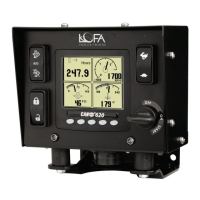
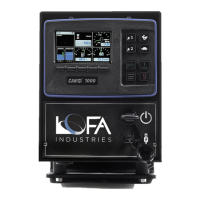
620 Operation and Troubleshooting Guide
plus
CAN
®
Installing the LOFA CP620—General Guidelines
Connection to Battery (12V or 24V)
LOFA CP620 Panels must be powered via direct battery connection. Powering the CP620 from the engine starter post
or other taps into the electrical systems may result in grounding and/or power quality issues which may damage the
panel components. When connecting the LOFA CP620 Panel power wires to the battery or when servicing the battery,
please use extreme caution and follow the warning below.
The installer MUST apply a suitable in-line fuse as close to the battery as possible. The recommended fuse rating for
CP620 installations is 30A. The recommended wire gauge for connecting wires is 12 AWG, as long as the distance
between the battery and the panel is no more than 12 feet. For applications that require wire runs longer than 12 feet,
please contact your reseller.
• Battery electrolyte is extremely caustic. Contact with battery electrolyte will cause chemical burns.
• Batteries emit explosive Hydrogen gases during recharging. Hydrogen gas is heavier than air and remains
around the battery after charging.
• Hydrogen gas can be ignited by a spark, flame or heat emitting device causing an explosion that could result in
severe burns or blindness.
• Service batteries in well-ventilated areas and wear protective safety glasses, rubber gloves and a rubber apron
when servicing batteries. If battery electrolyte gets in your eyes or on your skin, wash/ flush with water (15 minutes)
and seek medical attention.
• Use extreme care so as not to allow the positive and negative terminals (or ground circuit) to be bridged by tools
or any other conductor- SPARKS can result.
• DO NOT allow sparks, an open flame (including cigarettes) or a heat emitting device of any kind near a battery.
• DO NOT connect or disconnect battery cables when the engine is running or is being cranked
DANGER
Voltage Drop
If control system voltage drops below 6 volts for more than one tenth of a second, the control system
may reset causing the self-test to reactivate. Resetting the control system is equivalent to quickly turning
the key switch to off and back to run without starting the engine. Voltage drops can be caused by a
discharged battery, transients from external equipment, improper wire sizes, faulty wiring or nearby
lightning strikes.
Suppression of Voltage Transients (Spikes)
The installation of voltage transient suppression at the transient source is required. LOFA follows SAE
recommended electrical environment practices.
Inductive devices such as relays, solenoids and motors generate voltage transients and noise in
electrical circuits. Unsuppressed voltage transients can exceed SAE specifications and damage electronic
controls.
Relays and solenoids with built-in voltage transient suppression diodes are recommended whenever
possible. Refer to the illustration for proper installation of diodes when built-in voltage transient
suppression is not available.
Locate inductive devices as far as possible from the components of the electronic control system. When
using electric motors it may also be necessary to add isolation relays to eliminate voltage transients,
noise and prevent back feed.
Engine Starter Excitation Connection
LOFA CP620 Panels are equipped with a heavy-duty and long-lived key switch. However, in-rush
currents, when engine starter motors are energized, this can be very high—especially in low battery
voltage and low ambient temperature situations.


 To Next Page
 Loading...