Need help?
Do you have a question about the LONGI LR5-72HPH-M Series and is the answer not in the manual?
Covers general safety precautions for module installation and operation.
Addresses electrical hazards and module operation safety.
Details fire safety requirements and ratings for PV modules and installation.
Explains the process and hardware for mounting monofacial modules using bolts.
Describes clamp mounting for monofacial modules, ensuring proper fit and torque.
Details bolt mounting for bifacial modules, including hole specifications and hardware.
Explains how to install bifacial modules using clamps, specifying overlap and torque.
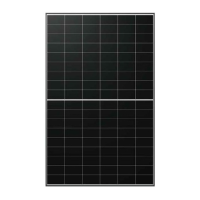
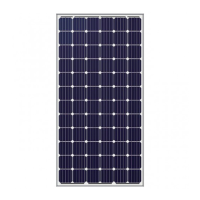
This document is an installation manual for LONGi Solar PV Modules, providing comprehensive guidelines for their safe and effective deployment. The modules are designed to convert sunlight into DC current, serving as a core component in photovoltaic power generation systems. They are suitable for various applications, including ground-mounted installations, building outer walls, roofs, and PV tracking systems, but are not intended for use in space or on vehicles.
LONGi Solar PV Modules are engineered to generate electricity from solar energy. The modules are available in both monofacial and bifacial designs, offering flexibility for different project requirements. Monofacial modules primarily capture sunlight from one side, while bifacial modules can generate power from both their front and rear surfaces, potentially increasing overall energy yield by utilizing reflected light. Each module is equipped with a junction box containing bypass diodes, which are crucial for mitigating the impact of shading or hot spots on individual cells. These diodes ensure that if a portion of the module is shaded or malfunctions, the main current can bypass the affected cells, preventing significant performance loss and potential damage from overheating. The modules are designed to be connected in series or parallel to form larger arrays, with specific wiring methods recommended to optimize performance and safety.
The installation process for LONGi Solar PV Modules requires professional skills and adherence to local electrical and construction regulations. The modules are identified by a nameplate detailing their product type, rated power, current, voltage, and certification indicators, as well as a unique serial number for tracking. They can be mounted using bolts, clamps, or embedded systems, with specific instructions provided for each method to ensure secure and stable installation. The manual emphasizes the importance of proper mechanical installation to withstand environmental loads such as wind and snow, with maximum static load limits specified for different mounting configurations.
For optimal performance, modules should be installed in locations free from shadows throughout the year and in environments with temperatures ranging from -40°C to 85°C. A tilt angle of no less than 10° is recommended to facilitate self-cleaning by rainfall and prevent water accumulation, which can affect appearance and performance. Modules connected in a string should have the same orientation and tilt angle to ensure uniform solar irradiation and power generation. The manual also highlights the importance of lightning protection in areas prone to frequent lightning and thunder.
Electrical connections are facilitated by IP67-rated junction boxes, which provide safety protection for cables and non-insulating electric parts. The modules use single-wire cables with appropriate insulation and cross-sectional area to minimize voltage drop. Connectors must be kept clean, dry, and securely fastened to prevent electric arcs or shocks. Only compatible connectors from the same vendor should be mated.
The modules are designed with a focus on safety, adhering to Class II application levels for systems operating at >50 V DC or >240 W. For rooftop applications, the overall fire rating of the structure must be considered, and a minimum gap of 10cm (0.39 inch) between the module frame and the roof surface is required to ensure proper air circulation and fire safety. The modules have passed IEC61701 salt spray corrosion tests, but anti-corrosion measures are recommended for installations near oceans.
Regular inspection and maintenance are essential to ensure the long-term performance and safety of LONGi Solar PV Modules. Users are responsible for carrying out these checks, especially during the limited warranty period, and for reporting any significant abnormalities to LONGI customer service.
Cleaning the module surface is crucial to prevent power output reduction caused by accumulated contaminants like dust, industrial waste, or bird droppings. While rainwater can help, manual cleaning with a sponge dipped in clean water or a soft cloth is recommended. Harsh cleaning agents like acid or alkaline detergents, or tools with rough surfaces, should be avoided. For safety, cleaning should be performed during early morning or evening hours when irradiance and module temperatures are low, particularly in hot regions. Modules with glass damage or exposed wires should not be cleaned to avoid electrical shock.
Appearance inspections should be conducted regularly to check for cosmetic defects such as glass cracks, corrosion at welding points, burning marks on the back sheet, or signs of aging like rodent damage. Any sharp objects in contact with the module surface or obstacles shading the modules should be addressed. Loose or damaged screws between modules and the mounting system should be adjusted and fixed promptly.
Electrical components also require periodic inspection. It is suggested to check the tightness of connectors and cables twice a year and to look for any cracks or gaps in the silicone around the junction box. The manual also provides guidance on PID (Potential Induced Degradation) protection, recommending connecting the negative side of the DC connection to ground to mitigate PID risks, especially in high humidity, high temperature, and high voltage conditions. For isolated PV inverters, direct grounding of the negative side is possible, while non-isolated inverters may require an isolated transformer.
 General
| Operating Temperature | -40°C to +85°C |
|---|---|
| Temperature Coefficient of Pmax | -0.35%/°C |
| Temperature Coefficient of Voc | -0.27%/°C |
| Maximum Load Rating | 5400 Pa (Snow), 2400 Pa (Wind) |
| Frame | Anodized Aluminum Alloy |
| Connector | MC4 Compatible |
| Model | LONGI LR5-72HPH-M Series |
| Type | Monocrystalline |
| Number of Cells | 144 |
| Dimensions | 1134mm x 35mm |
| Maximum System Voltage | 1500V |
| Junction Box | IP68 |
| Warranty | 12 years product warranty, 25 years linear power output warranty |


 To Next Page