This document is an operator's manual for the LUMAG RP1100 PRO Compactor Wacker Plate, a piece of equipment designed for compacting various materials.
Function Description:
The LUMAG RP1100 PRO Compactor Wacker Plate is primarily used for compacting loose and grained materials such as gravel and macadam. It is suitable for use in narrow spaces at construction sites, around border stones, and for foundations. Its application extends to ditches, surface compacting, and leveling finishing mortar. It is not intended for compacting ground areas with a high clay content. The machine operates by vibrating a base plate to achieve compaction. It is powered by a 1-Cylinder 4-stroke-OHV petrol motor.
Important Technical Specifications (Model: RP-110HP):
- Motor: 1-Cylinder 4-stroke-OHV petrol motor
- Power: 4.8 kW
- Rotation speed: 3600 1/min
- Fuel: Non-lead normal petrol
- Fuel tank volume: 3.6 liters
- Motor oil: SAE 10W-30 or 10W-40
- Oil volume: ~0.6 liters
- Spark plug: F7TC or equivalent
- Spark gap: 0.7-0.8 mm
- Compactor plate (L x B): 570 x 440 mm
- Total measurements incl. Steering shackle (L x B x H): 1080 x 440 x 940 mm
- Compacting frequency: 70 Hz
- Centrifugal force: 15 kN
- Compacting depth: 30 cm
- Surface capacity: 416.1 m²/h
- Max. Working speed: 19.5 m/min
- Vibration bounces/min: 4200 VPM
- Max. allowed tilt angle for the motor: 20°
- Weight (net / gross): 95 kg
- Hand/arm vibrations: 18.55 m/s²
- Noise level - pressure LPA: 96.6 dB(A)
- Noise level - power LWA: 106.79 dB(A)
Usage Features:
The compactor is designed for ease of operation with several controls:
- Steering Shackle (A): A flip-over handle for guiding the machine. It can be adjusted and folded for storage.
- Throttle Control (J/9): Allows adjustment of the motor speed from "SLOW" (turtle symbol) to "FULL SPEED" (rabbit symbol).
- Power Switch (1): To turn the motor ON/EIN or OFF/AUS.
- Starting Strap (2): Used to manually start the motor.
- Choke (4): For starting the motor in cold conditions (closed/geschlossen) or warm conditions (open/geöffnet).
- Fuel Tap (5): To open or close the fuel supply.
- Lifting Bar (I): Provides a point for lifting the equipment using appropriate lifting devices.
- Transportation Accessory: A separate accessory that can be hooked to the base plate to facilitate transportation over short distances on flat, firm surfaces.
- Rubber Mat: An optional accessory (5GRP110) measuring 575x440x8 mm, used to prevent damage when compacting paving stones and brick pavers. It should be removed when compacting loose, granulated foundations, pebble, and sand.
- Wheel Kit: An optional accessory (5RRP110) with a diameter of 95 mm.
Maintenance Features:
Regular maintenance is crucial for maximizing the life of the machine and ensuring safe operation. The manual provides detailed schedules and instructions for various maintenance tasks:
Engine Service & Maintenance Schedule:
- Engine Oil: Check level (each use), change (20hrs/1st month, then 100hrs/6th month).
- Air Filter: Check (each use), clean (50hrs/2nd month), replace (300hrs/yearly). Cleaning may be needed more often in dusty areas.
- Sediment Cup: Clean (100hrs/6th month).
- Spark Plug: Check/clean (100hrs/6th month), replace (300hrs/yearly).
- Idle Speed: Check/adjust (300hrs/yearly).
- Valve Clearance: Check/adjust (300hrs/yearly).
- Fuel Tank Strainer: Check/clean (300hrs/yearly).
- Combuster Chamber: Inspect/clean (300hrs/yearly).
- Fuel Lines: Check (300hrs/yearly).
Machine Service & Maintenance Schedule:
- Vibration Oil: Check level (each use), change (50hrs/2nd month, then 300hrs/yearly).
- Fasteners Tension: Check (each use).
- Clean Machine: Check (each use).
- Inspect Clutch: Check/adjust (300hrs/yearly).
- Drive Belt: Check/adjust (weekly), replace (300hrs/yearly).
- All Other Moving Parts & Cables: Lubricate (weekly).
Specific Maintenance Procedures:
- Oil Filling (Motor): The motor is delivered without oil. Before first operation, fill with 0.6 liters of 10W-30 or 10W-40 motor oil until the level is visible at the windings (lower part of the refill hole).
- Oil Change (Motor): Empty warm oil, clean around screws, and dispose of old oil environmentally. Refill with recommended oil.
- Air Filter Cleaning/Replacement: Loosen wing nut, remove filter hood, clean dirt. Separate foam rubber (16) from paper (15) sections. Clean foam rubber in warm water and mild soap, let dry, then dip in clean motor oil and squeeze out excess. Tap paper inset to remove dirt. Reassemble. Never run motor with damaged filters.
- Fuel Filter Cleaning: Close fuel tap, remove filter container (19) and O-ring washer (18), clean in non-flammable liquid, let dry, and reassemble.
- Spark Plug Check/Replacement: Lift ignition cable, remove spark plug (7), check for dirt, insulator damage, and gap distance (0.7-0.8 mm). Clean with a steel brush if needed, adjust gap, and reinsert.
- Adjusting Motor Speed: Place equipment on a rubber mat. Set gas lever to "SLOW". Start motor, run for 1 minute. Turn flow screw (21) in to increase speed, out to reduce speed.
- Adjusting Driving Belt: Loosen screws for belt protection, check tension (should not sag more than 10-15 mm). Loosen motor fixing screws, push motor backward to tighten belt, forward to loosen. Ensure belt wheels are in line.
- Lubrication of Agitator: Check oil level every 50 hours. Remove belt protection, console, and motor assembly. Remove oil refill screw (22). Oil level should be at the edge of the windings. Refill with SAE 80W-90 transmission oil (approx. 350 ml) if needed.
- Oil Replacement (Agitator): Replace every 300 hours. Remove drain screw (22), tilt plate to drain oil. Refill with SAE 80W-90 transmission oil. Do not overfill.
- Cleaning the Plate: After each operation, remove dirt and stones from under the motor console. Keep cooling flanges on the cylinder clean to prevent overheating.
The manual emphasizes reading and understanding all safety instructions before operation. Key warnings include:
- Never allow unskilled persons or those under 18 to operate.
- Never touch hot motor or exhaust system parts.
- Always use original spare parts.
- Never operate without the belt protection cover.
- Never leave unattended with motor running.
- Always use suitable protection clothing: hearing protection, respiratory protection, sight protection, gloves, and safety shoes.
- Noise levels can exceed 85 dB(A), requiring hearing protection.
- Close fuel tap when not in use.
- Store equipment in a safe, dry place.
- Check safety devices and moving parts before operation.
- Refuel only with motor off and cool, in well-ventilated areas, away from open flames.
- Smoking is forbidden during refueling.
- Never use petrol or other inflammable liquids for cleaning.
- Never store flammable materials near the exhaust system.
- Never start the motor in closed spaces due to carbon monoxide risk.
- Do not use on concrete or hard materials, as this can damage the motor and plate.
- Do not exceed a ground slope of 20° to avoid motor lubrication issues.
- All maintenance must be carried out with the motor not running and spark plug removed.

 Need help?
 General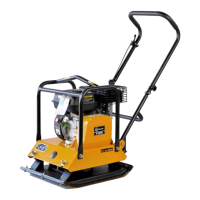

 To Next Page