Need help?
Do you have a question about the Luna LSM40 and is the answer not in the manual?
Emphasizes reading the manual carefully before operating the meter.
Lists conditions under which the warranty will be void.
Provides an introduction to the manual.
Essential safety guidelines for operating the electricity meter.
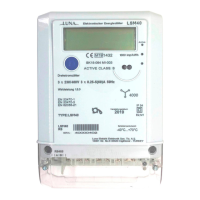
Measures and records active import/export energy, voltage, and current.
How to read the meter's software version using OBIS code 96.97.
Details on splitting day time by import/export and storing data for 4 tariffs.
Stores maximum demand and its date/time for the last 24 months.
Stores load profile data in non-volatile memory for 90-360 days.
Authorized personnel can write specific parameters to the meter using password.
Real-time clock compliance with EN 61038 protocol, deviation ±0.5 sec/day.
Meter operates with main and optional secondary battery for power supply.
Meter logs phase interruptions, phase failure notices, and phase active energy.
Records main/terminal cover opening dates, RTC failures, magnetic interventions.
Provides status codes for meter information, errors, warnings, and features.
Meter keeps logs of errors and events in non-volatile memory.
Optional bi-directional energy measurement for import and export.
Communication via RS485 protocol for single or multiple meters.
Meter supports DLMS Communication over communication ports.
Integrated PLC module for communication using power line.
Integrated RF module for wireless communication.
Integrated GPRS module for remote data readout and control.
Supports Gregorian, Hijri, and Persian calendars for records.
Feature to disconnect subscriber's electricity upon reaching monthly consumption limit.
Backlight turns on when menu button is pressed or on read/write attempt.
Connects/disconnects electricity remotely or locally via latching relay.
Optional non-volatile memory IC for higher memory requirements.
Used for audible alarm functions, e.g., terminal cover removal.
Detects and records over/under voltage events, including start/end times.
Detects and records over current events, including start/end times.
Automatically disconnects latching relay in case of over/under voltage.
Automatically disconnects latching relay in case of over current.
Disconnects relay if voltage exceeds 320V for 3 seconds.
Logs writings to the meter with date-time, password level, operator ID, OBIS code.
Allows configuration of LCD pages to display desired OBIS code values.
Modifies the number of integers and decimals displayed on LCD for consumption.
Provides a relay output that can be opened or closed by OBIS code 96.74.1.
Detects and records neutral current events and their start/end times.
Manually performs month-end operations and resets demand.
Measures total harmonic distortion (THD) for voltage and current.
Supports removable battery for operation when AC power is unavailable.
The meter displays data on a 5-integer, 3-decimal digit LCD screen.
Button used to browse and navigate through the LCD menus.
LEDs indicating active and reactive power consumption.
Enables data transfer and programming via EN 61107 protocol.
Embedded spots on the meter case to prevent unauthorized intervention.
Meters must be mounted/dismounted by authorized personnel. Energy must be cut off.
LCD screen displays 6 integers and 3 decimals as per MID regulation.
Lists the data displayed in the main menu, scrolling every 5 seconds.
Shows screens for Total Consumption Tariff T, T1, T2, T3, T4.
Displays reactive-inductive and reactive-capacitive energy consumption.
Shows active power for L1, L2, L3 phases.
Displays total export energy and tariff details.
Shows maximum demand, date, time, and serial number.
How to display and quit the sub-menu by pressing the menu button.
Displays instant voltage, current, power factor, and frequency.
Shows previous month's consumed energy for tariffs T, T1, T2, T3.
Displays previous month's demand, reset counts, dates, and times.
Provides detailed measurements of the meter's physical size.
Diagram showing phase and neutral connections for the meter.
Illustrates the meter's mechanical layout with key components.
Specifies the instrument model (LSM40) and its serial number.
Details the name and address of the manufacturer.
Declares conformity with relevant EU harmonisation legislation.
Brand, type, model, and serial number of the product.
Details for the manufacturer and vendor, including contact info.
Specifies the 5-year warranty period and what it covers.
Outlines consumer rights in case of defective goods (repair, discount, replacement).
Lists conditions not covered by warranty (misuse, transport damage, unauthorized intervention).
Specifies meter type (LSM40) and nominal voltage (3 x 230/400VAC).
Details nominal current (5(100)A) and test output (1000 imp/kWh).
Specifies operating temperature range (-40°C to +70°C) and humidity (%95).
Details T1, T2, T3 tariff intervals and Daylight Saving Time.
Information on battery life (10 years operating) and meter weight (1413 gr).
 General
| Type | Sound Level Meter |
|---|---|
| Frequency Range | 31.5 Hz to 8 kHz |
| Microphone | 1/2 inch Electret Condenser Microphone |
| Display | LCD |
| Power Supply | 9V battery |
| Measuring Range (dB) | 30 to 130 |
| Frequency Weighting | A, C |
| Resolution (dB) | 0.1 dB |
| Operating Temperature | 0°C to 40°C |


 To Next Page