EasyManua.ls Logo

Luna 4600 - User Manual

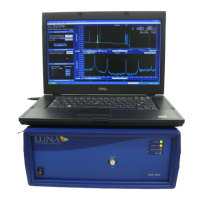
Luna 4600
236 pages
Print Icon
To Next Page IconTo Next Page
Loading...
Optical Backscatter
Reflectometer 4600
User Guide

Table of Contents

Question and Answer IconNeed help?

Do you have a question about the Luna 4600 and is the answer not in the manual?

Summary

System Overview

The Control Software

Explains the OBR control software's intuitive graphical interface and parameter access.

Time Domain Data

Describes the upper graph displaying time domain data amplitude, equivalent to OTDR measurements.

Frequency Domain

Details the lower plot showing linear amplitude of frequency domain data for insertion or return loss.

Frequency Domain Resolution

Discusses how impulse duration in time domain affects step size for group delay measurements.

Assembly and Startup

Components List

Lists all hardware, software, documentation, and cables included with the OBR.

Setting up the OBR

Provides step-by-step instructions for physically setting up the OBR instrument and connected PC.

Initial Startup

Guides the user through the initial power-on and software launch sequence for the OBR system.

Software Guide

Window Features

Outlines the main window's functional areas: System Control, Data Processing, Display Options, and Graphs.

System Control

Details the area for controlling the OBR instrument and setting test parameters like wavelength and gain.

Data Processing

Explains settings for spatial resolution and integration width, and sensing parameters if applicable.

Graphs

Covers controls for selecting graph content and manipulating display aspects like axes, cursors, and zoom.

Performing Measurements

Setting Up

Describes the front panel controls of the OBR instrument, including power switch and optical port.

Aligning the OBR Optics

Details the conditions requiring alignment and the procedure to align the instrument's internal optics.

Instrument Configuration

Allows selection of device length range and resolution, showing resultant values and number of traces.

Calibrating the System

Explains the necessity and procedure for calibrating the OBR system before performing measurements.

Acquiring Data

Covers options for data acquisition: Single Scan Mode and Continuous Scan Mode.

Data Processing and Display

Displaying Multiple Traces

Explains how the software stores and displays multiple data sets (Traces A-E) in memory.

Saving and Loading Data Files

Details the process of saving data in binary or text formats and loading saved binary files.

Manipulating Plots

Covers parameter selection, zooming, scaling, and cursor adjustments for data plot visualization.

Parameter Selection

Explains how to control the content of the two graphs by selecting parameters from the Title Bars.

Scaling Plot Axes

Describes adjusting plot axes for graphs using autoscale or manual scaling methods.

LightPath Analysis Software Guide

LightPath Analysis Tutorial

Guides users through adjusting parameter files and creating reference traces with sample data.

Changing Data Processing Parameters and Tolerances

Explains how to adjust parameters to improve feature detection and pass/fail criteria.

Suggested Setup and Use

Provides a recommended procedure for setting up and using the LightPath Analysis software for quality control.

Characteristic Length (m)

Defines the parameter affecting the rolling median calculation for peak detection in the data.

Peak Tolerance (dB)

Sets the maximum return loss allowed for artifacts, determining pass/fail status.

Controlling the OBR Remotely

Prerequisites for Remote Control Setup

Lists the necessary knowledge and compliance requirements for setting up remote control.

Standard Commands

Details mandatory IEEE 488.2 commands for instrument control and consistency.

System Level Commands

Covers commands for controlling system operations like scanning and laser status.

Configuration Commands

Covers commands for setting system parameters like wavelength, scan range, and units.

Measurement Theory

Fiber Optic Interferometry

Provides an introductory overview of the swept-wavelength coherent interferometry technique used by the OBR.

Resolution Bandwidth Calculations

Explains how time and frequency domain data relate and how visible window width affects frequency resolution.

Return Loss and Differential Loss

Details the calculation and display of average return loss and differential loss using cursors.

Distributed Sensing

Describes how spectral shift in Rayleigh scatter is used for distributed strain and temperature measurements.

Maintenance

Cleaning Connectors

Emphasizes the importance of cleaning fiber optic connectors before testing to prevent data errors.

Replacing Fuses

Provides instructions on how to safely replace fuses in the instrument's power module.

Packing and Shipping the OBR

Outlines procedures and materials required for safely packing and shipping the OBR system.

Troubleshooting

System Status Bar Messages

Explains non-fatal status messages that advise the user about the instrument's condition.

General Troubleshooting

Provides procedures for common hardware and software problems that occur without specific error messages.

Self-Diagnostic Software

Guides users on running the diagnostic software to help Luna support staff resolve issues.

Appendix A Specifications

Electrical

Lists electrical specifications including voltage, frequency, and power requirements.

Optical Output

Details optical output parameters like maximum rated power and emitted wavelengths.

Minimum PC Requirements

Specifies the hardware and software prerequisites for the PC used with the OBR.

Class 1 Laser Product

States the laser safety classification and compliance standards for the OBR 4600.

Summary

System Overview

The Control Software

Explains the OBR control software's intuitive graphical interface and parameter access.

Time Domain Data

Describes the upper graph displaying time domain data amplitude, equivalent to OTDR measurements.

Frequency Domain

Details the lower plot showing linear amplitude of frequency domain data for insertion or return loss.

Frequency Domain Resolution

Discusses how impulse duration in time domain affects step size for group delay measurements.

Assembly and Startup

Components List

Lists all hardware, software, documentation, and cables included with the OBR.

Setting up the OBR

Provides step-by-step instructions for physically setting up the OBR instrument and connected PC.

Initial Startup

Guides the user through the initial power-on and software launch sequence for the OBR system.

Software Guide

Window Features

Outlines the main window's functional areas: System Control, Data Processing, Display Options, and Graphs.

System Control

Details the area for controlling the OBR instrument and setting test parameters like wavelength and gain.

Data Processing

Explains settings for spatial resolution and integration width, and sensing parameters if applicable.

Graphs

Covers controls for selecting graph content and manipulating display aspects like axes, cursors, and zoom.

Performing Measurements

Setting Up

Describes the front panel controls of the OBR instrument, including power switch and optical port.

Aligning the OBR Optics

Details the conditions requiring alignment and the procedure to align the instrument's internal optics.

Instrument Configuration

Allows selection of device length range and resolution, showing resultant values and number of traces.

Calibrating the System

Explains the necessity and procedure for calibrating the OBR system before performing measurements.

Acquiring Data

Covers options for data acquisition: Single Scan Mode and Continuous Scan Mode.

Data Processing and Display

Displaying Multiple Traces

Explains how the software stores and displays multiple data sets (Traces A-E) in memory.

Saving and Loading Data Files

Details the process of saving data in binary or text formats and loading saved binary files.

Manipulating Plots

Covers parameter selection, zooming, scaling, and cursor adjustments for data plot visualization.

Parameter Selection

Explains how to control the content of the two graphs by selecting parameters from the Title Bars.

Scaling Plot Axes

Describes adjusting plot axes for graphs using autoscale or manual scaling methods.

LightPath Analysis Software Guide

LightPath Analysis Tutorial

Guides users through adjusting parameter files and creating reference traces with sample data.

Changing Data Processing Parameters and Tolerances

Explains how to adjust parameters to improve feature detection and pass/fail criteria.

Suggested Setup and Use

Provides a recommended procedure for setting up and using the LightPath Analysis software for quality control.

Characteristic Length (m)

Defines the parameter affecting the rolling median calculation for peak detection in the data.

Peak Tolerance (dB)

Sets the maximum return loss allowed for artifacts, determining pass/fail status.

Controlling the OBR Remotely

Prerequisites for Remote Control Setup

Lists the necessary knowledge and compliance requirements for setting up remote control.

Standard Commands

Details mandatory IEEE 488.2 commands for instrument control and consistency.

System Level Commands

Covers commands for controlling system operations like scanning and laser status.

Configuration Commands

Covers commands for setting system parameters like wavelength, scan range, and units.

Measurement Theory

Fiber Optic Interferometry

Provides an introductory overview of the swept-wavelength coherent interferometry technique used by the OBR.

Resolution Bandwidth Calculations

Explains how time and frequency domain data relate and how visible window width affects frequency resolution.

Return Loss and Differential Loss

Details the calculation and display of average return loss and differential loss using cursors.

Distributed Sensing

Describes how spectral shift in Rayleigh scatter is used for distributed strain and temperature measurements.

Maintenance

Cleaning Connectors

Emphasizes the importance of cleaning fiber optic connectors before testing to prevent data errors.

Replacing Fuses

Provides instructions on how to safely replace fuses in the instrument's power module.

Packing and Shipping the OBR

Outlines procedures and materials required for safely packing and shipping the OBR system.

Troubleshooting

System Status Bar Messages

Explains non-fatal status messages that advise the user about the instrument's condition.

General Troubleshooting

Provides procedures for common hardware and software problems that occur without specific error messages.

Self-Diagnostic Software

Guides users on running the diagnostic software to help Luna support staff resolve issues.

Appendix A Specifications

Electrical

Lists electrical specifications including voltage, frequency, and power requirements.

Optical Output

Details optical output parameters like maximum rated power and emitted wavelengths.

Minimum PC Requirements

Specifies the hardware and software prerequisites for the PC used with the OBR.

Class 1 Laser Product

States the laser safety classification and compliance standards for the OBR 4600.

Luna 4600 Specifications

General IconGeneral
BrandLuna
Model4600
CategoryMeasuring Instruments
LanguageEnglish

Related product manuals