Page 13
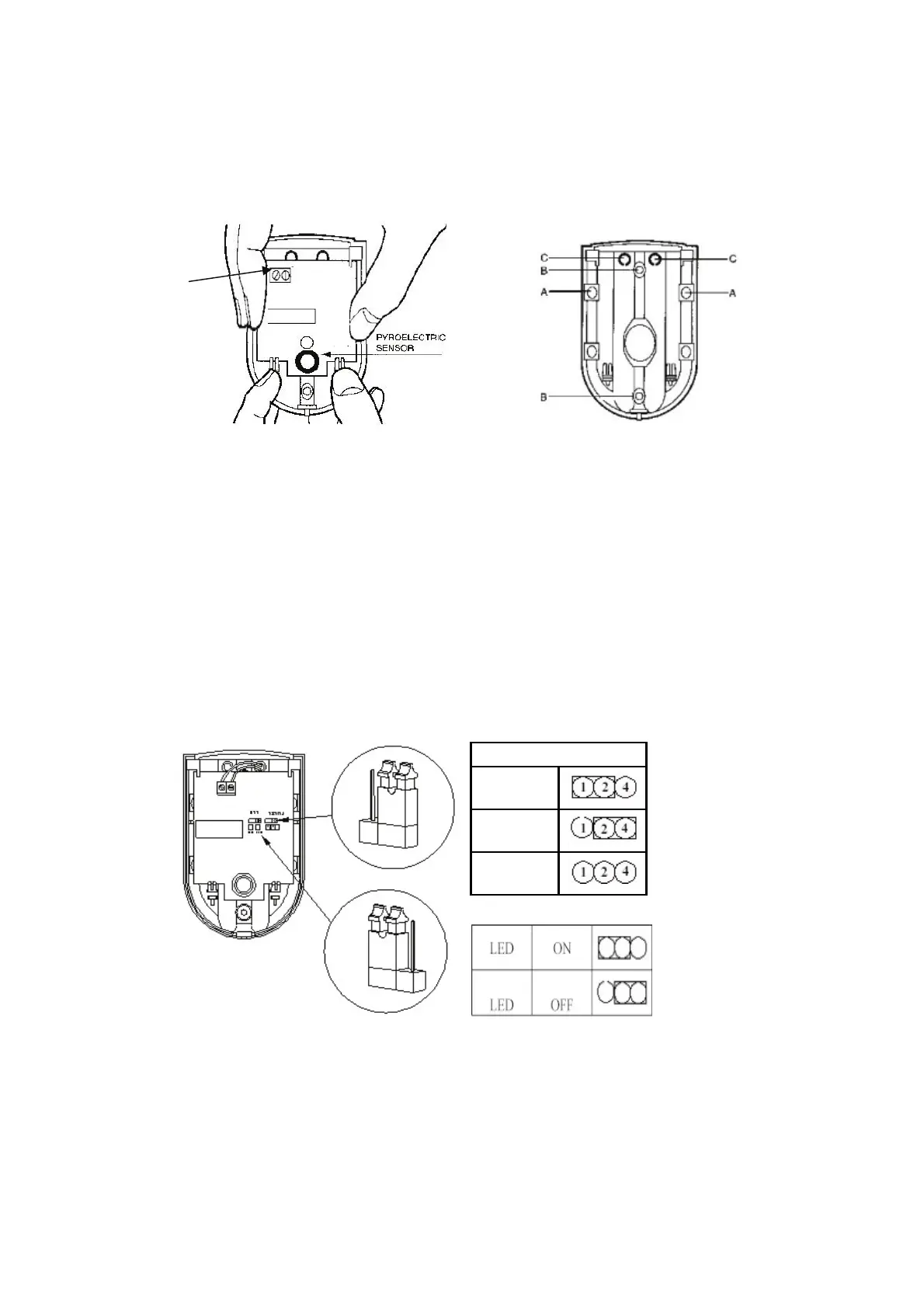
Connect the two
wires to these
two switch
terminals
Illustration 15
3.14 Installing Two-wired PIR
(For extension also available to purchase separately as an accessory)
i. Remove and retain the screw from the bottom of the PIR and lift off the cover.
ii. Carefully remove the electronic module from its retaining clips, ensuring not to touch the
pyroelectric sensor (Illustration 13).
Illustration 13 Illustration 14
iii. Use mounting points “A”, if you are fitting the detector in a corner. Use mounting points “B”, if
you are fitting the detector on a flat surface. Use a small drill to create two fixing holes at the
mounting points (Illustration 14).
iv. Hold the base of the PIR in the chosen position, ensuring that the front of the PIR will face towards
the center of the protected area, mark and drill two fixing holes in the wall. Choose one of the cable
entry holes “C” and make a third hole in the detector base. Put one end of the 2-core wire through
this hole “C”, then secure the PIR to the wall using two screws and wall plugs provided.
v. Replace the electronic module into the retaining clips, ensuring that it is correctly positioned and
firmly seated.
vi. If required, select the PIR LED “ON” or “OFF” option and the sensitivity (pulse count) by setting
the corresponding jumpers on the electronic module. Note that Pulse 1 option is more sensitive than
the pulse 4 option. Pulse 1 option is used when it is necessary to activate an alarm on the first
detected pulse, or in high security installations – where fast “catch” performance is of greatest
importance. Pulse 2 or 4 settings provides improved protection against false alarms caused by all
types of environmental disturbances. (Illustration 15)
vii. Connect the 2 wires to the PIR, polarity is not important.
viii. Run the cable back to the Control Unit, fixing the cable with cable clips and enter the wire into the
back of the Control Unit through any convenient cable hole.
ix. Connect to zone =1, =2, =3 or zone =4 terminals in the Control Unit as required, connection
polarity is not important. See wiring diagram 1.
Pulse Count
Pulse 1
Pulse 2
Pulse 4


 To Next Page
 Loading...