Need help?
Do you have a question about the Makita DFN350 and is the answer not in the manual?
Lists compatible battery cartridges for safe operation.
Details noise and vibration emission levels and related safety.
Covers general safety advice for all power tools.
Addresses safe work environment and electrical precautions.
Details essential personal protective measures for operators.
Guidelines for using and caring for the tool and battery.
Specific safety warnings for operating the cordless nailer.
Explains overload, overheat, and overdischarge protection features.
Describes how to check the remaining battery capacity.
Details the trigger lock mechanism and depth of nailing adjustment.
Explains the function and operation of the tool's lamp.
Instructions for loading nails and attaching the nose adapter.
Procedures for removing jammed nails and general maintenance.
Steps for driving nails and testing safety systems.
Lists recommended accessories for use with the tool.
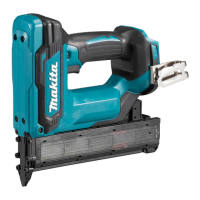
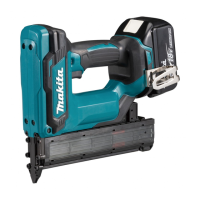
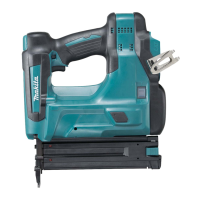
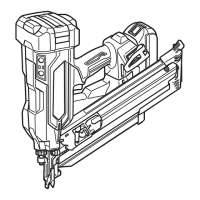
This document provides an instruction manual for the Makita Cordless Brad Nailer, model DFN350. It includes safety warnings, functional descriptions, and maintenance guidelines to ensure safe and effective operation of the tool.
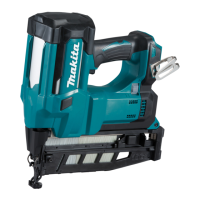
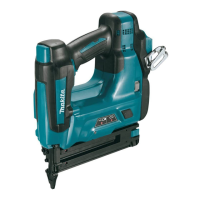
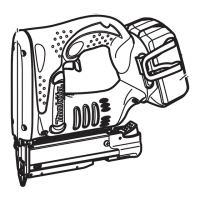
The Makita Cordless Brad Nailer DFN350 is a battery-operated power tool designed for fastening soft wood. It operates on a D.C. 18V battery and uses 18Ga brad nails ranging from 15 mm to 35 mm in length, with a magazine capacity of 100 pieces.
The tool features a trigger-lock button to prevent accidental actuation. To pull the switch trigger, the trigger-lock button must be depressed from side A. After use, it should always be pressed from side B to lock the switch trigger in the OFF position, ensuring safety when the tool is not in operation.
The DFN350 includes an adjustable depth of nailing feature. Users can adjust the depth by turning an adjuster. The deepest nailing depth is achieved when the adjuster is turned fully in direction A, and it becomes shallower as the adjuster is turned in direction B. The depth can be adjusted up to a maximum of 2.5 mm.
For enhanced visibility in various working conditions, the nailer is equipped with a lamp. The lamp lights up when the switch trigger is pulled or the contact element is actuated. It remains lit as long as the trigger is pulled or the contact element is actuated and turns off approximately 10 seconds after releasing them. A dry cloth should be used to wipe dirt off the lamp lens, taking care not to scratch it, as this may reduce illumination. The lamp may blink if the nailer detects an error during nail driving, in which case the tool should be taken to a Factory Service Center. If the battery power is low, the lamp may light up, but the nailer might not fire nails, indicating a need to charge the battery cartridge.
The tool incorporates an anti-dry fire mechanism. When the nail magazine is empty, the switch trigger cannot be pulled. To resume operation, a new nail strip must be inserted into the magazine. The remaining nails can be checked through a sight window, where a red indicator moves toward the firing opening as the number of nails decreases.
A nose adapter is provided for use when firing nails on easily-marred surfaces. This adapter can be attached to the driver guide cover and stored on a holder at the back end of the magazine to prevent loss.
The DFN350 is equipped with a tool/battery protection system that automatically cuts off power to the motor to extend tool and battery life. This system activates under specific conditions:
For battery cartridges with an indicator, the remaining capacity can be checked by pressing a check button. Indicator lamps light up for a few seconds to show the charge level, ranging from 75-100% (all lamps lit) down to 0-25% (one blinking lamp), or indicating a need to charge the battery or a potential malfunction.
The DFN350 is designed for user convenience and safety. Before any operation, it is crucial to ensure all safety systems are in working order. This involves unloading nails, installing the battery, releasing the trigger lock, and testing that the switch trigger does not actuate without the contact element pressed against a material, and vice versa.
Loading nails involves pressing the lock lever, opening the slide door of the magazine, setting a nail strip with tips touching the bottom of the magazine, and sliding it toward the firing opening. The slide door is then returned to its original position until the lock lever locks it. For unloading, the same steps are followed to remove nails from the magazine. It is important to load nails in the correct direction to prevent premature wear and damage to the driver and other parts. Deformed nail strips should not be used, and only specified nails should be used to avoid jamming and breakage.
To drive a nail, the trigger lock must be released, the contact element placed firmly on the material, and the switch trigger pulled fully. For subsequent nails, the trigger finger should be released and the process repeated. Nails can also be driven by dragging the tool with the contact element pressed against the material while pulling the switch trigger. If a nail head remains above the workpiece surface, the nailer head should be held firmly against the workpiece while driving the nail again. However, if this persists, the material may not be suitable for the nailer, and continued use could damage the driver or cause jamming.
A hook is provided for temporarily hanging the tool, and it can be installed on either side of the tool housing using a screw. This feature enhances convenience by keeping the tool accessible while working.
Regular maintenance is essential for the safety and reliability of the DFN350. Before performing any inspection or maintenance, the tool must be switched off, and the battery cartridge removed.
The manual advises against using gasoline, benzine, thinner, alcohol, or similar substances for cleaning, as these can cause discoloration, deformation, or cracks.
For any repairs, maintenance, or adjustments, it is recommended to use Makita Authorized or Factory Service Centers, ensuring that only genuine Makita replacement parts are used.
In case of jammed nails, the trigger must be released, and the battery cartridge and nails removed before attempting to clear the jam. Jammed nails should not be removed with bare hands, as they may jump out and cause injury. To remove jammed nails, hex bolts on the driver guide cover should be removed using the provided hex wrench. A slotted screwdriver can then be used to take the jammed nails from the nail guide groove. After clearing, the driver guide cover should be secured with the hex bolts, ensuring it actuates properly. If it does not, the hex bolts should be removed, and the cover reinstalled.
The manual also provides important safety instructions for the battery cartridge to ensure maximum battery life and prevent hazards. Users should always charge the battery cartridge before it is completely discharged and stop operation when less tool power is noticed. Overcharging a fully charged battery cartridge should be avoided as it shortens service life. Charging should occur at room temperature (10 °C - 40 °C / 50 °F - 104 °F), and a hot battery cartridge should be allowed to cool down before charging. If the battery cartridge will not be used for a long period (more than six months), it should still be charged.
When not in use, the hex wrench can be stored in its designated slot on the tool to prevent it from getting lost.
Optional accessories recommended for use with the DFN350 include nails, Makita genuine battery and charger, and safety goggles. These accessories are crucial for safe and effective operation, and users should contact their local Makita Service Center for assistance or more details.
 General
| Nail Size | 16 gauge |
|---|---|
| Magazine Capacity | 100 nails |
| Weight | 2.4 kg |
| Power Source | Battery |
| Battery | 18V |
| Fastener type | Nails |
| Fastener diameter | 1.2 mm |


 To Next Page