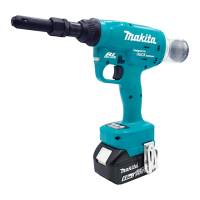
The Makita Cordless Rivet Gun, models DRV150 and DRV250, is a battery-operated power tool designed for installing blind rivets. This manual provides comprehensive instructions for its safe operation, maintenance, and assembly.
Function Description
The cordless rivet gun is specifically engineered to install blind rivets efficiently and effectively. It operates by pulling the rivet mandrel until the rivet body deforms and secures the workpiece, then breaking off the mandrel. The tool features a switch trigger for operation and a front lamp to illuminate the work area. A mandrel container collects broken-off mandrels, which should be emptied regularly to prevent clogging and malfunction. The tool is equipped with a tool/battery protection system that automatically cuts off power to the motor under conditions of overload, overheating, or low battery capacity, thereby extending the tool and battery life.
Important Technical Specifications
The DRV150 and DRV250 models share several core specifications but differ in their pulling force and stroke:
-
Model DRV150:
- Pulling force: 10 kN
- Stroke: 25 mm
- Overall length: 313 mm
- Net weight: 1.9 - 2.2 kg
- Sound pressure level (LPA): 75 dB(A) with an uncertainty (K) of 3 dB(A)
- Vibration emission (ah) for installing blind rivet: 2.5 m/s² or less with an uncertainty (K) of 1.5 m/s²
-
Model DRV250:
- Pulling force: 20 kN
- Stroke: 30 mm
- Overall length: 323 mm
- Net weight: 2.1 - 2.4 kg
- Sound pressure level (LPA): 74 dB(A) with an uncertainty (K) of 3 dB(A)
- Vibration emission (ah) for installing blind rivet: 2.5 m/s² or less with an uncertainty (K) of 1.5 m/s²
Both models operate on a D.C. 18 V rated voltage and are compatible with a range of Makita 18V Li-ion battery cartridges, including BL1815N, BL1820, BL1820B, BL1830, BL1830B, BL1840, BL1840B, BL1850, BL1850B, and BL1860B. They are charged using Makita DC18RC, DC18RD, DC18RE, DC18SD, DC18SE, DC18SF, or DC18SH chargers. The noise level under working conditions may exceed 80 dB(A), necessitating ear protection.
Usage Features
- Battery Installation/Removal: Battery cartridges are installed by aligning the tongue with the groove in the housing and sliding it in until it locks with a click. Removal involves sliding the button on the front of the cartridge and pulling it out. A red indicator on the upper side of the button signifies an unlocked or improperly inserted battery.
- Remaining Battery Capacity Indication: Battery cartridges with an indicator feature a check button. Pressing this button illuminates indicator lamps for a few seconds, showing the remaining capacity in 25% increments (75-100%, 50-75%, 25-50%, 0-25%). If the battery needs charging, the first lamp will blink. If the battery has malfunctioned, all lamps will blink.
- Switch Action: The tool is started by pulling the switch trigger and stops when released. It's crucial to ensure the switch trigger actuates properly and returns to the "OFF" position before installing the battery cartridge. The tool may not return to its initial position in certain cases (first use, after battery replacement, after overload, or after maintenance), requiring the user to pull and release the trigger to reset it.
- Front Lamp: Pulling the switch trigger activates the front lamp, which remains lit while the trigger is pulled and for approximately 10 seconds after release. Users should avoid looking directly into the light source.
- Head Assembly: The head assembly, including the nose piece, jaw case, jaws, jaw pusher, spring, and pipe, can be removed and installed for maintenance or to change components. This involves loosening and tightening nuts and using wrenches.
- Mandrel Container: The mandrel container collects broken mandrels. It is installed by rotating clockwise and removed by rotating counter-clockwise. It must be installed for the tool to operate.
- Installing Blind Rivets: To install a blind rivet, insert it into the nose piece (with the tool switched off), press the tool tip against the workpiece, and pull the switch trigger. After the mandrel breaks off, release the trigger. It is important to regularly empty the mandrel container and ensure broken mandrels are ejected into it by tilting the tool backward before installing the next rivet.
- Rivet Compatibility: The tool requires specific combinations of nose piece, jaw, jaw pusher, and pipe that match the mandrel diameter of the blind rivet. Using mismatched components can lead to poor fastening, clogging, or tool malfunction. Tables are provided in the manual detailing the correct combinations for various rivet sizes for both DRV150 and DRV250 models.
- Hook: A hook is provided for temporarily hanging the tool and can be installed on either side of the tool housing with a screw. Users are cautioned to remove the battery when using the hook and to avoid hanging the tool at high locations or on unstable surfaces.
Maintenance Features
- General Maintenance: Before any inspection or maintenance, the tool must be switched off, and the battery cartridge removed. The use of gasoline, benzine, thinner, alcohol, or similar solvents is prohibited as they can cause discoloration, deformation, or cracks.
- Jaw and Jaw Case Cleaning: The jaws and jaw case should be cleaned every 3,000 rivet installations, or when dust accumulation affects jaw movement. This involves removing the jaw case and jaws, cleaning them with a brush to remove metal powder, and applying molybdenum disulfide-based grease evenly to the inner periphery of the jaw case. When reinstalling, ensure the tips of the jaws are aligned and wipe off any grease from the jaw tips.
- Replacing Jaws: If the jaws are worn, they should be replaced with new ones following the same procedure as cleaning.
- Removing Jammed Rivets: If a rivet jams inside the tool, it can be removed using a pin. If removal is difficult, the jaw pusher or pipe may need to be replaced.
- Battery Life Maintenance: To maximize battery life, charge the cartridge before it's completely discharged, stop operation when power decreases, and avoid overcharging. Charge batteries at room temperature (10 °C - 40 °C / 50 °F - 104 °F) and allow hot batteries to cool before charging. Charge the battery if it hasn't been used for more than six months.
- Mandrel Container Emptying: The mandrel container should be emptied regularly before it becomes full to prevent tool damage and injury.
Makita Authorized or Factory Service Centers should perform all repairs and adjustments using genuine Makita replacement parts to maintain product safety and reliability.

 Need help?
 General

 To Next Page