Need help?
Do you have a question about the Makita GA5040CN01 and is the answer not in the manual?
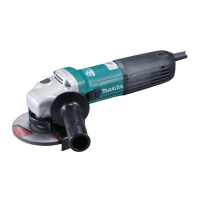
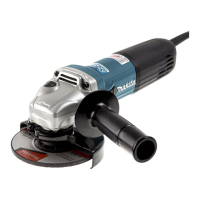
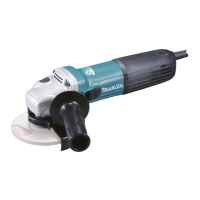
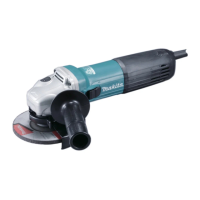
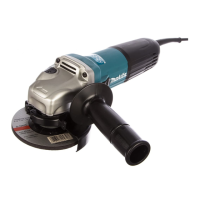
This document provides an instruction manual for Makita Angle Grinders, specifically models GA4040C, GA4540C, GA5040C, GA5040CN, GA6040C, GA4041C, GA4541C, and GA5041C. It covers various aspects of the tool, including its intended use, safety warnings, functional descriptions, assembly instructions, operation guidelines, maintenance, and optional accessories.
The Makita Angle Grinder is designed for grinding, sanding, and cutting of metal and stone materials. It is a double-insulated tool, meaning it can be operated from sockets without an earth wire, enhancing user safety. The tool features a shaft lock mechanism to prevent spindle rotation, which is crucial when installing or removing accessories.
The grinder incorporates several electronic functions for enhanced operation. Constant speed control ensures a fine finish by maintaining a consistent rotating speed even under load. A soft start feature suppresses the initial starting shock, contributing to smoother operation and potentially extending the tool's lifespan. Additionally, an overload protector is integrated to safeguard the motor from overheating by reducing power when the load exceeds admissible levels. For models GA4041C, GA4541C, and GA5041C, a mechanical brake is activated when the tool is switched off, providing an added layer of safety by quickly stopping the accessory.
The tool also includes an indication lamp that lights up green when plugged in, signaling power connection. If the lamp does not light up, it may indicate a problem with the mains cord or controller. If the lamp is lit but the tool doesn't start, it could point to worn carbon brushes or issues with the controller, motor, or ON/OFF switch. A key safety feature is the unintentional restart proof device, which prevents the tool from starting if the switch is in the "ON" position when plugged in. In this scenario, the indication lamp flickers red. To cancel this function, the slide switch must be returned to the "O (OFF)" position.
The angle grinder is operated via a slide switch. For models GA4040C, GA4041C, GA4540C, GA4541C, GA5040C, GA5041C, and GA6040C, the tool starts by sliding the switch to the "I (ON)" position and can be locked for continuous operation by pressing the front of the switch. To stop, the rear of the switch is pressed, and it slides to the "O (OFF)" position. For model GA5040CN, the tool starts by sliding the switch to "I (ON)" and stops by releasing it to "O (OFF)". Users are cautioned to ensure the slide switch actuates properly and returns to the "OFF" position before plugging in the tool.
The rotating speed can be adjusted using a speed adjusting dial, with settings from 1 to 5. Higher numbers correspond to faster speeds. This allows users to select the appropriate speed for different materials and applications. It is important not to force the dial beyond its limits.
The tool requires a side grip (handle) to be securely installed before operation, providing better control and safety. When performing grinding or sanding operations, the tool should be held firmly with one hand on the housing and the other on the side handle. The wheel or disc should be applied to the workpiece at an angle of about 15°. During the break-in period of a new wheel, it's advised not to work the grinder in the "B" direction (which would cut into the workpiece) until the wheel's edge has been rounded off.
For abrasive cut-off and diamond wheel operations, specific wheel guards are required. The direction for mounting the lock nut and inner flange varies based on wheel thickness. Users are warned against using cut-off wheels for side grinding and against applying excessive pressure, which can lead to wheel breakage or kickback. During cutting, the angle of the wheel should not be changed, and the tool should not be started while in contact with the workpiece.
When using wire cup brushes or wire wheel brushes, it is crucial to check their operation with no load to ensure they are balanced and free from damage. Applying excessive pressure to these brushes should be avoided to prevent premature wire breakage. A guard should always be used with wire wheel brushes, ensuring the wheel's diameter fits inside the guard.
Regular maintenance is essential for the tool's safety and reliability. Users are advised to always ensure the tool is switched off and unplugged before performing any inspection or maintenance. The tool's air vents must be kept clean to prevent obstruction, which can lead to overheating. Regular cleaning of the air vents or whenever they become obstructed is recommended.
For repairs, carbon brush inspection and replacement, or any other maintenance and adjustment, it is recommended to use Makita Authorized Service Centers and genuine Makita replacement parts to ensure the safety and integrity of the tool. Users are also cautioned against using gasoline, benzine, thinner, alcohol, or similar substances for cleaning, as these can cause discoloration, deformation, or cracks.
The manual also emphasizes the importance of cleaning out the dust cover attachment if it becomes clogged, as continued operation with a clogged attachment can damage the tool.
 General
| Power Source | Corded Electric |
|---|---|
| Wheel Diameter | 125 mm |
| No Load Speed | 11000 RPM |
| Spindle Thread | M14 |
| Cable Length | 2.5 m |
| Arbor | 22.23 mm |


 To Next Page