The chassis is drilled for a standard
size (Touring Car size) steering ser-
vo to be mounted on the right hand
side of the chassis. This is ne for
oval Hot Rod racing but does not
give an ideal weight distribution for
circuit racing.
You’ll get a better balance if you
mount the servo on the left hand
side of the chassis. It is also a
good idea to invest in a ‘low-prole’
type servo (eg Savox 1251MG or
Futaba s9550 for example) since
these are short front to back, and
using these will free up some more
room for cells and electrics in the
chassis. Choosing a servo with
fast movement (<0.10 sec to 60’ at
6V) and reasonable torque (>4Kg/
cm) is also wise. Dedicated 1/12
scale servos can be good as they
are light in weight, just as fast and
usually have lower current draws,
but they are often longer in the
body (so take up more room) and,
as they are so slim, they need to
be raised off the chassis so there
is clearance for the servo saver to
move freely. It is a close call be-
tween the two types and really de-
pends on budget and how/where
you plan to mount your cells.
NOTE: the holes that come pre-
drilled in the chassis are de-
signed to accept Futaba makes
of servo. The holes are spaced
so that the central output spline
on most Futaba servos is dead
centre on the chassis. Sa-
vox servos do not have the
same position for their out-
put splines and, although the
1251MG model will t the holes
as they come, it will not be
dead centre.
If you choose to re-drill your
servo holes, mark them extreme-
ly carefully. Get your steering
assembled, mount the track
rods onto the servo saver and
then mount that onto the servo
itself. Position the servo so that
the track rods are perpendicular
to the centre line of the chassis
and this will give you reasonable
Ackerman change.
6. SERVO
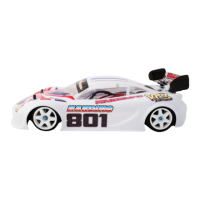
Lexan shells are lighter, ABS ones
can be a little tougher. Some good,
and popular choices are :
Lotus GT1: most front end down-
force of the common shells. Good
on slower, twisty tracks, but you’ll
need to add a bigger rear wing
and probably use small diameter,
harder compound front tires to sta-
bilize it on faster tracks.
Mazda Speed 6: good aerodynam-
ic balance makes this the safest,
most forgiving shell to drive.
Ascari GT3: half way between
the Lotus and Mazda for handling.
Common favorite for many drivers.
GT2 ‘Wedge’: can look nice,
but can also look like a piece of
cheese! Aside from looks, be very
careful when mounting it on your
chassis as the front/rear position
has a massive effect on aerody-
namic balance – 2mm forwards
gives oversteer, 2mm backwards
gives understeer. Front and rear
wheel mould lines are not an ideal
shape.
Calibra: another good looking
shell but complex molding splits
easily and a high roof line and
high rear wing positions make
it unstable / prone to grip roll
through high speed corners.
Porsche 911: Soon to be re-
leased.
All the above are ne for club
meetings. Only the Ascari, Lo-
tus, and GT2 shells are permitted
for Nationals.
A nal word on bodies – many
drivers suggest investing in a set
of vertical rear posts or a V10M
‘Banger Mount’ and have these
mounted to come through your
shell under the rear wing. If you
turn them so the body pin holes
face front to rear the pins are
then easy enough to get in and
out.
7. BODY SHELL
VISIT OUR FORUM! WWW.MARDAVE-FORUM.CO.UK


 To Next Page
 Loading...