
 Need help?
Do you have a question about the Marzocchi Bomber 58 and is the answer not in the manual?
Provides measurements for 15% (Firm) and 20% (Plush) sag based on fork travel.
Recommended starting sag settings for various rider weights, presented in a table.
Instructions and chart for adjusting the rebound damping based on rider weight and desired speed.
Guide to adjusting low-speed compression for optimal fork performance during rider inputs.
Step-by-step instructions for securely installing the front wheel using the axle and pinch bolts.
Critical warning regarding improper axle installation leading to detachment and serious injury.
Information on using clip-on volume spacers to adjust mid-stroke and bottom-out resistance.
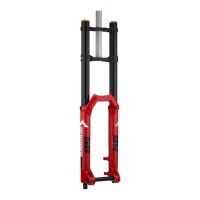
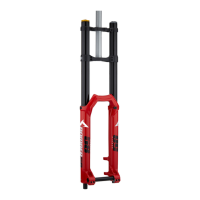
The Marzocchi Bomber 58 is a high-performance suspension fork designed for mountain biking, offering a range of tuning options to optimize ride quality and control. This tuning guide provides essential information for setting up and maintaining the fork, ensuring riders can achieve the best possible performance on various terrains.
The primary function of the Bomber 58 is to absorb shocks and vibrations from the trail, providing a smoother and more controlled riding experience. It utilizes an air spring system for adjustable suspension and features both rebound and compression damping adjustments to fine-tune its response to different riding conditions and rider preferences. The fork is designed to offer a balance of plushness for small bumps and firm support for larger impacts and aggressive riding.
Proper sag setting is crucial for optimal suspension performance. Sag is the amount the suspension compresses under the rider's weight and riding gear. The Bomber 58 recommends a sag range of 15-20% of total fork travel. To set sag, riders should adjust the air pressure in the fork. The guide provides a table with suggested starting air pressures (psi) based on rider weight (lbs and kgs) to help achieve the desired sag. For accurate sag measurement, the Low-Speed Compression (LSC) adjuster should be in the full counter-clockwise (OPEN) position. The fork has a total travel of 203 mm (8 inches), with 15% sag (firm) corresponding to 30 mm (1.2 inches) and 20% sag (plush) corresponding to 41 mm (1.6 inches).
Rebound damping controls the rate at which the fork extends after compressing. This adjustment is dependent on the air pressure setting; higher air pressures typically require lower rebound settings. To adjust, riders turn the rebound knob to the closed position (full clockwise) until it stops, then back it out (counter-clockwise) to the number of clicks specified in the provided table. The table correlates rider weight with the recommended number of rebound clicks. An "OPEN" setting (more clicks counter-clockwise) provides the least amount of rebound damping, resulting in faster fork rebound, while a "CLOSED" setting (fewer clicks counter-clockwise) provides the most rebound damping, leading to slower fork rebound.
The GRIP compression adjuster, specifically for low-speed compression (LSC), helps control fork performance during rider weight shifts, G-outs, and other slow inputs. This adjustment allows riders to fine-tune how the fork responds to gradual compressions. The guide suggests a starting point for the compression adjuster: turn it to the closed position (full clockwise) until it stops, then back it out (counter-clockwise) to 4 clicks. An "OPEN" setting (8 clicks) provides the least amount of compression damping, resulting in lighter fork compression, while a "CLOSED" setting (full clockwise) provides the most compression damping, leading to firmer fork compression.
Volume spacers are an internal adjustment that allows riders to change the amount of mid-stroke and bottom-out resistance.
The guide provides a step-by-step procedure for installing the front wheel:
The manual primarily focuses on initial setup and tuning, with less emphasis on detailed maintenance procedures. However, it directs users to "SEE ADDITIONAL INFORMATION AND VIDEOS" on Marzocchi.com, implying that comprehensive maintenance instructions, including installation procedures for volume spacers and other tuning options, are available online. This suggests that while basic tuning is covered in the guide, more in-depth maintenance tasks would require consulting the online owner's manual and resources. The presence of a 4-digit ID code on the back of the lower leg, which can be used at www.Marzocchi.com to find more information about the specific fork, further supports the reliance on online resources for detailed product information and maintenance.
 General
| Stanchion Diameter | 38mm |
|---|---|
| Spring Type | Coil |
| Steerer Tube | 1.5" Tapered |
| Offset | 44mm |
| Wheel Size | 27.5" |
| Damping | GRIP |
| Intended Use | Enduro |
| Adjustments | Rebound, Low-Speed Compression |
| Travel | 170mm |
| Axle | 15x110mm Boost |



 To Next Page