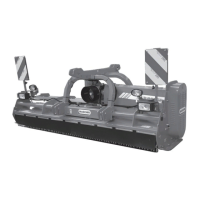
This manual describes the Maschio Gaspardo DC/DM RAPIDO STANDARD & COMBI power harrows, agricultural implements designed for soil preparation.
Function Description:
The Maschio Gaspardo power harrows are designed for various soil preparation tasks, including working the soil after ploughing, direct tillage on untilled ground, preparing the seedbed, and weeding. These machines operate by means of a cardan shaft connected to the tractor's PTO and are attached via a universal 3-point hitch. The implements are intended for professional use by specialized operators. The "STANDARD" models are typically used for general tillage, while the "COMBI" versions are designed for combination with seed drills, offering integrated soil preparation and seeding capabilities.
Important Technical Specifications:
The manual provides detailed technical data for various models, including DC (Standard) and DM (Heavy Duty) series, with both STANDARD and COMBI configurations. Key specifications include:
- Working Width (A): Ranges from 250 cm (99 inches) to 400 cm (158 inches).
- Overall Width (B): Ranges from 255 cm (100 inches) to 405 cm (160 inches).
- Power Requirement (KW/HP):
- DC models: 88-112 KW (120-150 HP) for 2500/3000 mm widths.
- DM models: 88-132 KW (120-180 HP) for 3000/3500/4000 mm widths.
- RAPIDO models (DC/DM): Higher power requirements, up to 117-150 KW (140-200 HP) for 4000 mm widths.
- Number of Rotors (nr.): Typically 20, 24, 28, or 32, depending on the model and width.
- Weight (Kg/lb):
- DC models (without roller): 768-950 Kg (1693-2094 lb).
- DM models (without roller): 906-1201 Kg (1997-2647 lb).
- COMBI models (without roller): Slightly heavier, e.g., DC COMBI 2500 at 895 Kg (1973 lb).
- Max Payload (Kg/lb): 4000 Kg (8818 lb) for most models, indicating the maximum weight with accessories like seed drills, track eradicators, row markers, and fertilizers.
- Noise Level (LpAm): 83.9 dB(A) for no-load operation (UNI EN 1553/2001).
- Roller Types and Weights: A variety of rollers are available, each with specific weights and suitability for different soil conditions and applications:
- Packer Rollers (Ø 450, Ø 500, Ø 600): Weights range from 267 Kg (588 lb) to 792 Kg (1746 lb) for widths from 1800 mm to 4000 mm. Used for compacting and levelling.
- Spiral Rollers (Ø 500): Weights from 263 Kg (580 lb) to 412 Kg (908 lb). Suitable for light, sandy soils, leaving clods on the surface and settling the ground at depth.
- Cage Rollers (Ø 370, Ø 450): Weights from 120 Kg (264 lb) to 404 Kg (890 lb). Used for medium-textured soils, controlling tilling depth, and refining the seedbed.
- Spike Rollers (Ø 500): Weights from 197 Kg (434 lb) to 404 Kg (890 lb). Used for deep-ploughed soil preparation, aerating and levelling without compacting.
- Rice Field Rollers (Ø 500): Weights from 214 Kg (471 lb) to 466 Kg (1027 lb). Specifically designed for rice cultivation.
- Rubber Rollers (Ø 500, Ø 600): Weights from 440 Kg (970 lb) to 872 Kg (1922 lb). Used with seed drills for compacting soil in strips.
- Flanged Rollers (Ø 500): Weights from 181 Kg (399 lb) to 630 Kg (1389 lb). Used for damp/clayey soils, breaking up clods and levelling.
- Roller Compatibility: Detailed charts indicate which roller types are compatible with STANDARD and COMBI versions.
- Seed Drill Compatibility: Charts show compatibility with DAMA, ALIANTE, and other seed drill hitches for both STANDARD and COMBI models.
Usage Features:
The manual emphasizes safe and efficient operation.
- Pre-operation Checks: Before use, operators must ensure the machine is in perfect order, lubricants are at correct levels, and all wear parts are efficient. For COMBI versions, the arm position must be checked and adjusted from storage to working position.
- Hitching to Tractor: The machine must be hitched on a flat surface. The correct tractor/machine position is achieved when the cardan shaft remains 5-10 cm from its maximum closing position. The 3-point hitch links must be locked to prevent lateral movement. The cardan shaft must be perfectly locked to the PTO, and its guard must rotate freely. The upper third-point link needs to be adjusted to ensure the machine's top surface is parallel to the ground.
- Work Depth Adjustment: This is primarily determined by the position of the levelling roller. Rollers can be adjusted hydraulically (optional) or mechanically (for STANDARD versions).
- Hydraulic Adjustment: Two hydraulic cylinders (accessory) allow the operator to adjust depth from the tractor cabin.
- Pin Adjustment: Pins can be set for fixed tilling depth (knives work at constant depth) or variable tilling depth (allowing the arm to swing over obstructions without damage).
- Levelling Bar: Positioned between the roller and harrow, it refines the soil before the roller passes. Optimal position is 4-5 cm higher than the roller bearing position.
- Tines (Knives): The machine is equipped with tines suitable for normal soil conditions, made of high-quality steel for durability. Quick Release knives are available for all soils, including hard ground. Tines must be oriented in the rotor's turning direction. Minimum tine length is 150 mm; replacement is required below this length.
- Side Guards: Dampened side guards (STANDARD) or overturning side guards (COMBI) are height-adjustable to compensate for tine wear. They should be in the lowered working position during operation and lifted only for maintenance.
- Gearshift: Equipped with a gearshift with one pair of gears, allowing various rotor rotation speeds to match operator needs and soil conditions.
- Working on Slopes: If possible, work by ascending the slope. If not, avoid working along the sides; operate downwards to reduce the "terrace effect."
- Transport: For public road transport, rear reflector triangles, side lights, and flashing beacons must be fitted. The machine should be lifted no more than 35 cm from the ground during transport.
Maintenance Features:
Regular maintenance is crucial for optimal performance and longevity.
- Maintenance Schedule: The manual provides a recapitulatory chart for maintenance operations:
- Every 8 hours: Grease cardan shaft cross journals, check tine fixation, grease side adjuster jacks of the rear bar and roller side supports.
- Every 50 hours: Change gearbox oil (after the first 50 hours), check oil levels in reduction gearbox and gear reservoir.
- Every 400 hours: Completely change oil in the reduction unit and gear reservoir. Clean clutch disks if a cardan shaft with clutch is used.
- Hydraulic System: Hydraulic pipes must be checked frequently for wear, cracks, and deformation. Replace pipes after 5 years of production or if any damage is observed.
- Lubrication: Recommended lubricants include AGIP ROTRA MP SAE 85W/140 oil for the reduction unit and transmission, and AGIP GR MU EP 2 grease for all greasing points.
- Troubleshooting: A detailed table lists common inconveniences, their causes, and remedies, such as noisy drivelines, excessive power draw, soil clods, clogged rotors, and machine vibrations.
- Storage: At the end of the season or for long periods of inactivity, the machine should be washed, dried, and checked for damaged parts. Fertilizers and chemicals must be removed.
- Disposal: When scrapping the machine, rubber, metal, and electrical parts must be separated. Used oils should be recovered and disposed of at appropriate collection centers. Plastic, aluminum, and steel parts can be recycled.

 Need help?
 General

 To Next Page