Page 14 of 20 1910308-12
you will be welding. It should be equal to or
greater than the thickness of the actual
work piece, and free of oil, paint, rust, etc.
7.2 Select a heat setting.
7.3 Hold the torch in one hand. Hold the
wire just off the work piece. (See
HOLDING THE TORCH section if you are
uncertain of the angle at which you will be
welding.)
7.4 Set the wire feed speed based on the
thickness of material and the set-up chart
on the back side of the wire feeder door.
7.5 Lower your welding helmet. Pull the
trigger on the torch and let the wire feed
into the work piece to start an arc. Then
begin to drag the torch toward you.
7.6 LISTEN! If the arc is sputtering,
increase the wire speed slightly and try
again. Continue increasing the wire speed
adjustment until you achieve a smooth
buzzing sound. If the wire seems to
"pound" into the work piece, decrease wire
speed slightly and try again. Use the wire
speed control to slightly increase or
decrease the heat and penetration for a
given voltage setting by increasing or
decreasing the wire speed slightly. Repeat
this tune-in procedure if you select a new
voltage setting, a different wire diameter,
or a different roll of wire.
8. WELDING TECHNIQUES
EXPOSURE TO A WELDING ARC IS
EXTREMELY HARMFUL TO THE EYES AND
SKIN! Prolonged exposure to the welding
arc can cause blindness and burns. Never
strike an arc or begin welding until you are
adequately protected. Wear flame-proof
welding gloves, a heavy long-sleeved shirt,
trousers without cuffs, high topped shoes,
and an ANSI approved welding helmet.
ELECTRIC SHOCK CAN CAUSE INJURY OR
DEATH! To prevent ELECTRIC SHOCK, do
not perform any welding while standing,
kneeling, or lying directly on the grounded
workpiece.
8.1 Moving the torch
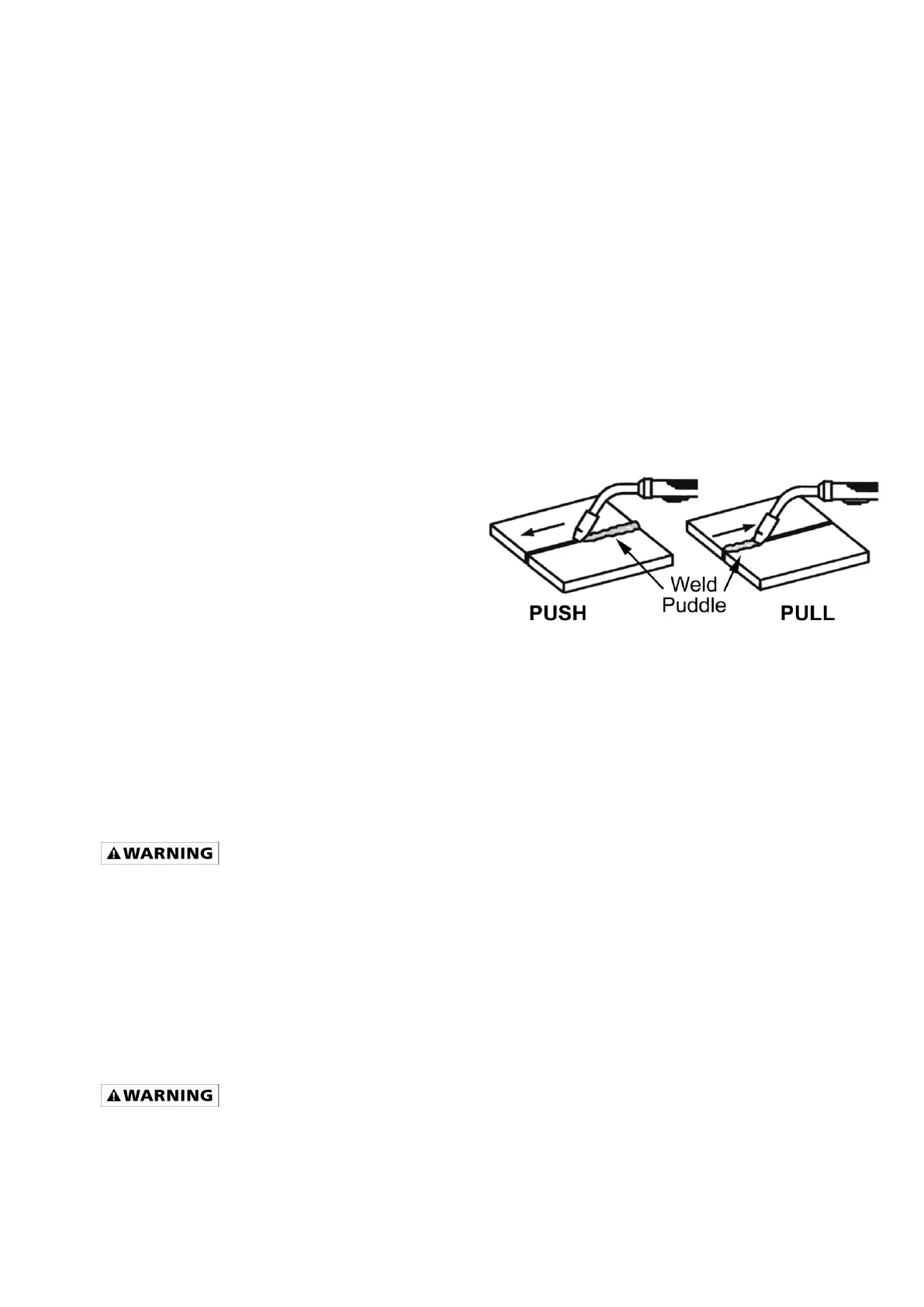
Torch travel refers to the movement of the
torch along the weld joint and is broken
into two elements: Direction and Speed. A
solid weld bead requires that the welding
torch be moved steadily and at the right
speed along the weld joint. Moving the
torch too fast, too slow, or erratically will
prevent proper fusion or create a lumpy,
uneven bead. Travel direction is the
direction the torch is moved along the weld
joint in relation to the weld puddle. The
torch is either PUSHED into the weld
puddle or PULLED away from the weld
puddle.
For most welding jobs you will pull the
torch along the weld joint to take
advantage of the greater weld puddle
visibility. Travel speed is the rate at which
the torch is being pushed or pulled along
the weld joint. For a fixed heat setting, the
faster the travel speed, the lower the
penetration and the lower and narrower
the finished weld bead, likewise, the
slower the travel speed, the deeper the
penetration and the higher and wider the
finished weld bead. As a good rule of
thumb, the thickness of a cross-section of
the weld bead should be approximately the
same thickness as the thinnest material
you are welding.
8.2 Types of welding beads
As you become more familiar with your
new welder and better at laying some
simple weld beads, you can begin to try
some different weld bead types.


 To Next Page
 Loading...