XT SERIES USER MANUAL 8
(10) Analog Crossover Section
.
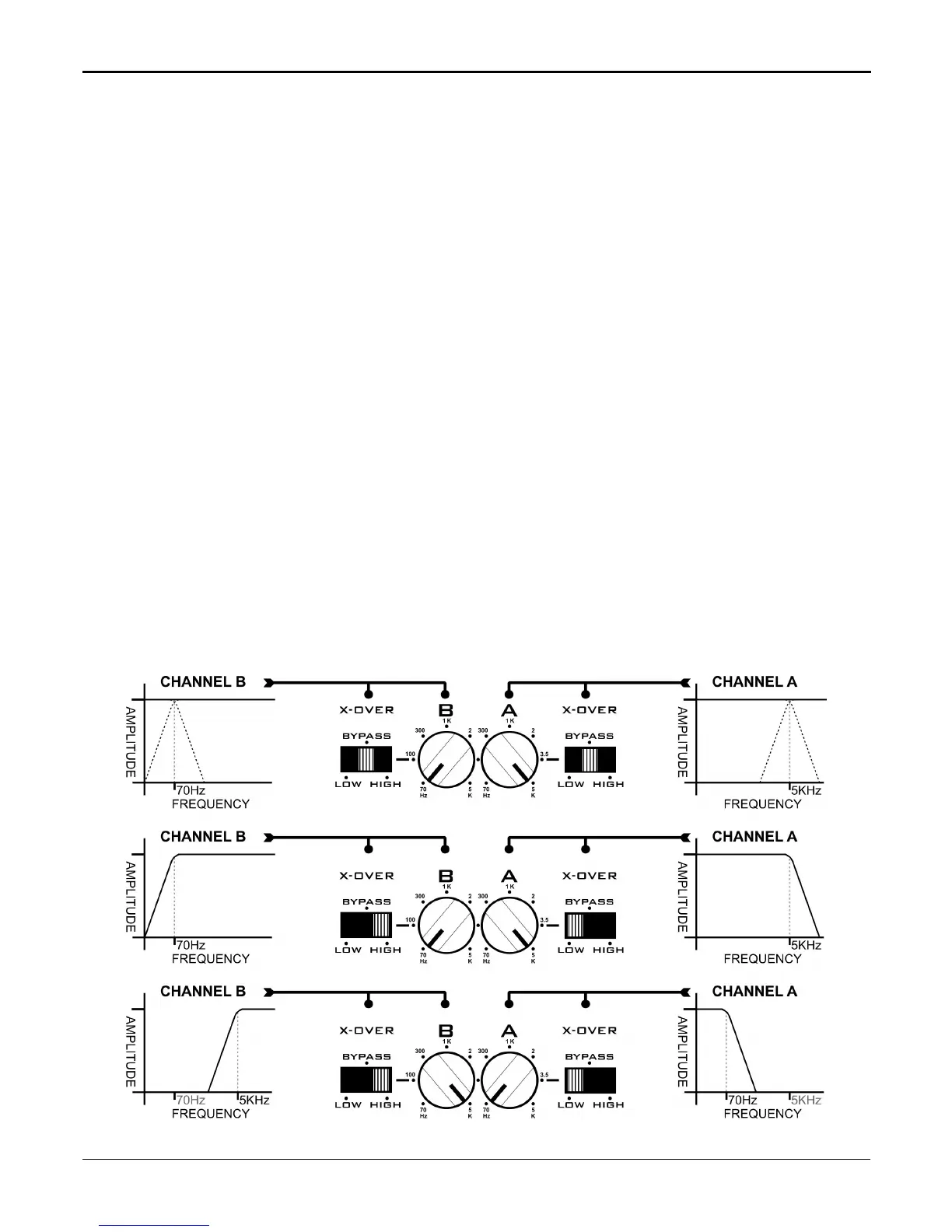
The Controls shown allow filters to be applied to the amplifier channels, in order to negate
the need for a separate crossover unit. This is useful for integrating sub-woofers into passive full
range systems and also with active cabinets - where the individual speaker elements (tweeters,
woofers and the like) are directly wired to the speaker connector and there is no passive internal
crossover which splits the incoming audio into the required bands for the drivers.
.
The below diagrams show some of the possible settings for this feature, in order to get an
idea of what is possible. Each channel of the amplifier has a selectable crossover filter of its own,
which is present in the form of one switch and one knob per each channel, as shown below.
It is possible to use each channel in one of three modes:
In Bypass, the filter is not active, therefore the incoming audio is not altered.
When Low is selected, the filter is in Low-Pass mode. This means that all frequencys
Below the control knobs setting are allowed to pass unchanged and those above it are
progressively reduced by 24 Decibels per an Octave.
When High is selected, the filter is in High-Pass mode and the opposite applies.
When Channel pair A and B Bridge or Mono mode are enabled, Only the filter for channel
A is active. Both channels will receive their signal via this input and its associated filter. The
same also applies for channel pair C and D.
Intended Usage:
.
For full range passive speakers, or where external crossovers are used, Bypass should be
selected for proper operation. However it may be beneficial to use the High Pass mode with
some smaller full range cabinets to prevent low frequencies they can not reproduce, reaching
them.
For use with Tweeters directly, High Pass should be selected.
For use with Bass drivers or Subwoofer systems, Low Pass should be selected.
Note: The Diagrams Shown here for channels A and B, also apply for channels C and D.
MATRIX AMPLIFICATION REV.1.15


 To Next Page