Need help?
Do you have a question about the matson MA3400 and is the answer not in the manual?
Essential safety warnings, guidelines, and precautions for using the jump start.
Key features and safety aspects of the MA3400 jump starter.
Using the jump starter to maintain vehicle electronics during battery changes.
Powering 12V DC accessories and 240V AC appliances.
Detailed technical specifications of the MA3400 jump starter.
Instructions for the initial charging of the jump starter unit.
How to check the charge status of the internal battery.
Step-by-step guide on how to operate the jump starter.
General description of the MAC02 Battery Charger.
Step-by-step guide for operating the MAC02 charger.
Recommended maintenance procedures for the jump starter.
Common problems and their possible solutions.
Answers to common questions about the jump starter.
Step-by-step instructions for removing the internal battery.
Procedure for claiming warranty against product defects.
Conditions under which the warranty does not apply.
Limitations and disclaimers on Matson's liability.
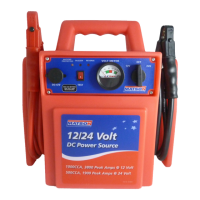
The Matson MA3400 is a versatile 12V/24V jump starter designed for portable and emergency power applications, suitable for starting most vehicles. It also functions as an alternative power supply and a multi-purpose power source.
The primary function of the MA3400 is to jump start vehicles with 12V or 24V systems. It is equipped with two 500CCA sealed AGM batteries and connects to the vehicle battery using 32mm² boost cables with copper jaws. The device incorporates built-in safety monitoring to prevent starting a faulty battery and includes reverse polarity connection warning indicated by flashing red LEDs.
Beyond jump starting, the MA3400 can serve as an alternative power supply, particularly useful when replacing a vehicle battery. By connecting the jump start clamps to the vehicle battery cables/terminals before disconnecting them from the battery posts, the vehicle remains powered, preventing the loss of memory for electronic components like alarm systems and radios. It's important to note that for this application, the jump start should be used only as emergency power, as its internal batteries are not designed for cyclic applications, and repeated deep discharges (below 12.2V / 24.4V) can reduce battery life.
As a multi-purpose power source, the MA3400 features a 12V DC outlet with overload protection, capable of powering most equipment that uses a 12-volt DC male adapter. Additionally, when used with an inverter (a maximum 150 Watt inverter is recommended), the jump start can operate appliances normally powered by 240 VAC.
Before initial use, the MA3400 must be charged for 24 hours, or until the supplied MAC02 Battery Charger indicates a full charge. Regular recharging is crucial for optimal performance and battery longevity. It should be recharged immediately after each use and at least monthly if not used. For continuous peak condition, the unit can be left connected to the MAC02 charger, which acts as a maintainer.
When operating the jump start, safety is paramount. Users must ensure the correct voltage (12V or 24V) is selected for the vehicle, as incorrect selection can lead to serious injury and equipment damage. The ignition of the vehicle should be turned off before making any connections. The red/positive clamp is attached to the battery positive terminal, followed by the black/negative clamp to the battery negative terminal. An audible click from the solenoid and the illumination of the BATTERY POWER LEVEL LEDs indicate correct connections and sufficient residual power in the vehicle's battery. If no audible click is heard, the "TEST & DEAD START" button should be pressed and held until the click and LEDs appear. Flashing red BATTERY POWER LEVEL LEDs indicate either an incorrect voltage setting or reverse polarity, requiring reconnection.
Once connections are secure and clear of moving components, the vehicle ignition can be turned on. If the vehicle does not start within 6 seconds, the MA3400 should be allowed to cool for 3 minutes before another attempt to prevent damage to the unit. After a successful start, the black/negative clamp must be disconnected first, immediately, followed by the red/positive clamp. The MA3400 should then be switched off.
The MAC02 charger, a fully automatic microprocessor-controlled unit, facilitates charging and maintenance. To charge, ensure both the MAC02 and the jump start are switched off. Plug the MAC02 male plug into the 12VDC socket on the jump pack, connect the MAC02 charger to 240VAC, and switch on the power. The jump start should be set to the 12V or ON position for charging. The MAC02 will begin charging, indicated by a solid red CHARGING LED. If a problem with the battery is detected, the ABNORMAL LED will flash amber. A solid green CHARGE LED signifies a fully charged battery. When connected to 240VAC, a flashing red CHARGING LED indicates the charger has power.
Maintaining the MA3400 primarily involves keeping it fully charged. It is recommended to recharge the unit upon purchase, immediately after every jump start, and monthly if not in use. Leaving the jump pack continuously connected to the MAC02 charger is recommended, as the charger acts as a maintainer and will keep the batteries in peak condition without causing damage.
Troubleshooting common issues is also covered. If the charger works but there's no volt charge display when connected, it could indicate a defective battery or faulty switch; testing with a DC plug device can help diagnose this. If the charger reaches full charge but the display shows low voltage, it might be a defective internal battery, possibly due to intense use without adequate cool-down. If the jump start is fully charged but has no power, users should check the wire connections at the clamp jaws for proper crimping and ensure the power switch is in the ON position. It's important to remember that there is no voltage on the clamps until they are connected to the battery terminal.
For battery replacement, the MA3400 internal battery is a sealed lead-acid type. The manual provides a procedure for battery removal, which involves taking out the clamps and cable assemblies, gently levering off the side compartment doors, removing screws on the back, detaching the rear cover, disconnecting internal battery connections (while preventing accidental arcing), and finally lifting the battery out. Old batteries should be recycled or disposed of according to applicable regulations.
 General
| Operating Voltage | 12V DC |
|---|---|
| Engine Start | Yes |
| Engine Stop | Yes |
| Trunk Release | Yes |
| Door Lock/Unlock | Yes |
| Security System | Yes |
| Keyless Entry | Yes |

 To Next Page