12
STEP 6
INSTALLING THE ANCHORS
D
B
A
C
E
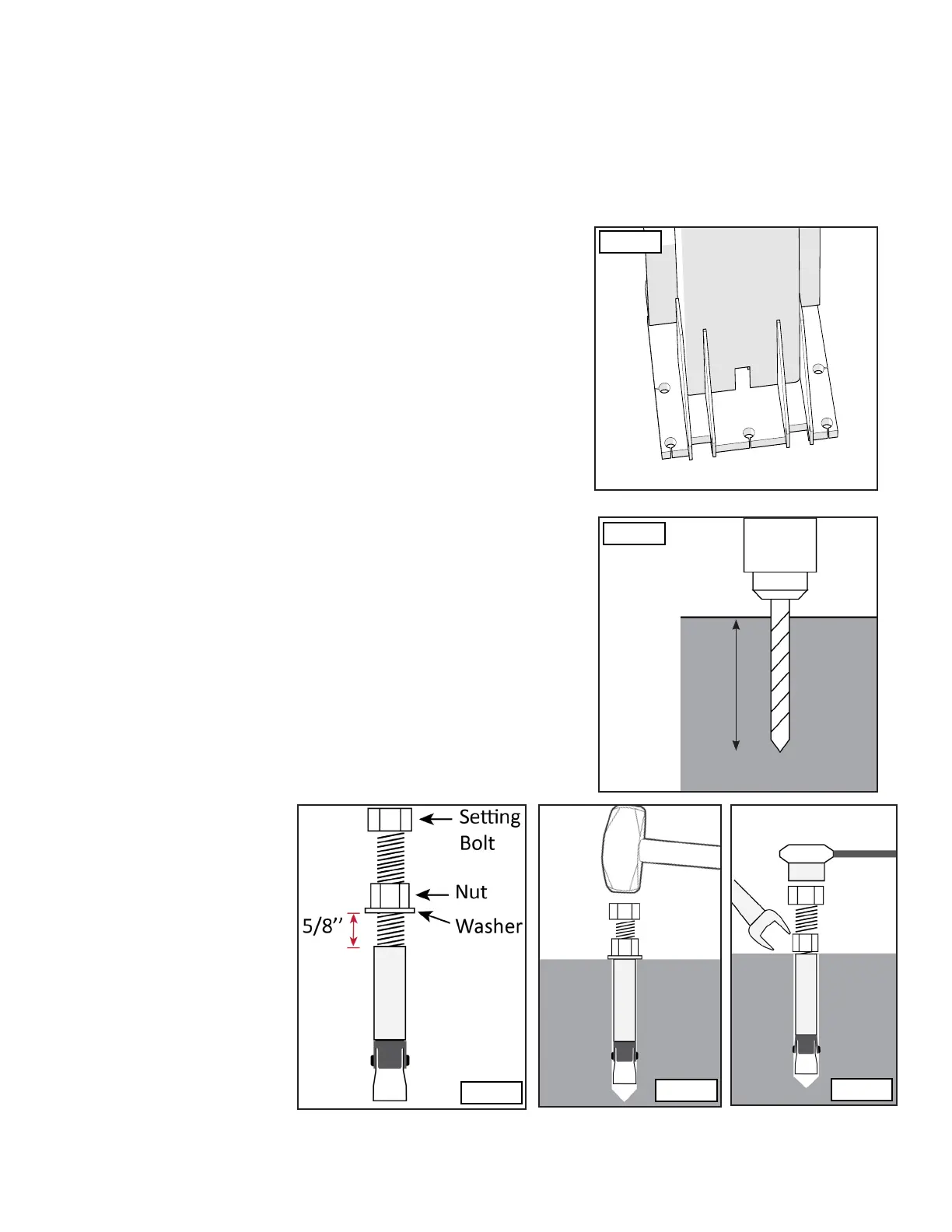
1. Use the Base Plate as a guide. Using a rotary hammer drill with a 7/8"
concrete bit, drill the concrete for each anchor to a minimum depth of
5". (See gure 11)
Do not ream the hole or allow the drill to wobble. Use caution to not
move the Posts when drilling through the Posts. We recommend having
someone secure or stand on the Post. Repeat for all holes on both
Posts and then move the Posts out of the way. After drilling, thoroughly
clean hole using a vacuum cleaner or compressed air and a nylon
brush.
NOTE: The drill will break through the bottom when drilling 5" in a 4"
concrete slab. This is an approved practice with these Anchors.
2. Set the Anchor Embedment Depth: Fully thread the 5/8" Setting Tool
(P/N 5530405) with Nut (P/N 5535100) and Washer into the Anchor. Set the
distance between the top of the Anchor and the bottom of the Washer to
5/8". (See gure 12)
3. After setting the Nut and Washer, place the Anchor into the hole and
hammer downward on the Setting Tool until the Washer is ush with the
surface of the concrete. (See gure 13)
4. To set the Anchor, tighten the Nut while holding the Bolt head (to ensure
the anchor does not spin in place). Do not use an impact wrench for this
step. Tighten to reach an installation torque of 90 ft-lbs. (See gure 14)
NOTE: Always wear safety
glasses. Follow drill
manufacturer’s instructions.
Use only solid carbide-tipped
drill bits meeting ANSI B212.15
diameter standards.
Fig. 11
Fig. 12
Fig. 13
Fig. 14
Fig. 10
Drill hole
a minimum of
5" (127mm) deep.
5. Once the Anchor is set, remove the Setting Tool and clear the Anchor
with compressed air to remove any concrete dust from the threads.
Before proceeding, verify location, measurements, and that the Base Plates are aligned with the Chalk Lines (Figure 10).
The concrete must be minimum of 4" (101mm) thick with a minimum compressive strength of 3000 psi (20 MPa).
Follow the procedure exactly for proper tting and alignment of Anchors.


 To Next Page
 Loading...