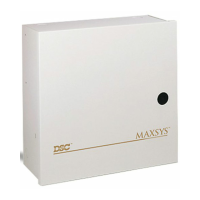
What does FTC Trouble mean on my Maxsys Control Panel?
- JJackie BarrAug 20, 2025
FTC Trouble on your Maxsys Control Panel signifies that the alarm control panel can no longer communicate with the central monitoring station.
What does FTC Trouble mean on my Maxsys Control Panel?
FTC Trouble on your Maxsys Control Panel signifies that the alarm control panel can no longer communicate with the central monitoring station.
What does communications error mean on Maxsys PC4020 Control Panel?
A communications error on your Maxsys Control Panel means that the main panel has lost communications with the module.
What does TLM Trouble mean on my Maxsys PC4020 Control Panel?
TLM Trouble on your Maxsys Control Panel indicates an issue with the telephone line.
Why is my Maxsys PC4020 Control Panel showing Module Com Fault?
A Module Com Fault on your Maxsys Control Panel means the panel has lost communication with a module. To resolve this, check if the module is properly connected, and then perform a system reset.
What does Device Low Batt mean on Maxsys PC4020?
Device Low Batt on your Maxsys Control Panel indicates that a wireless zone has a low battery. Press [*] to view which zone or device is affected.
What does Combus Low Pwr mean on Maxsys PC4020?
Combus Low Pwr on your Maxsys Control Panel suggests that modules are not receiving enough voltage from the Combus. Check the Combus connection for proper setup, and if needed, repower the Combus.
What does Aux Supply Trouble mean on Maxsys Control Panel?
Aux Supply Trouble on your Maxsys Control Panel indicates that the AUX, SAUX+ or PGM terminals on the alarm control panel are overloaded.
What does Device Fault mean on Maxsys PC4020?
Device Fault on your Maxsys Control Panel means a wireless zone has failed to report a zone supervisory. Press [*] to view which zone is affected.
Why is my Maxsys PC4020 Control Panel showing low voltage?
If your Maxsys Control Panel is showing a low voltage error, it indicates that the module is not receiving enough voltage from the Combus.
What does Device Tamper mean on Maxsys Control Panel?
Device Tamper on your Maxsys Control Panel indicates that a wireless zone has a tamper condition. Press [*] to view which zone is affected.
Provides an overview of the PC4020's flexibility and features for demanding security requirements.
Defines key terms used in the PC4020 system, crucial for installation and operation.
Explains that modules (keypads, expanders, boards) must be enrolled for proper system function.
Describes the process of adding modules to the system, starting with the first keypad.
Defines the COMBUS as the 4-wire cable connecting all system modules in parallel.
Explains partitions as independent areas within the system, up to 8, with assigned zones and codes.
Defines common zones assigned to multiple partitions, armed only when all are armed.
Describes the PC4020's upload/download capability using PC and modem for programming.
Details the 512-event buffer storing time/date-stamped events, retrievable via software.
Explains the PC4020's menu-driven programming method, easily done via keypad.
Lists the essential components included with the PC4020 system for installation.
Introduces additional modules and keypads that can be connected to expand system capabilities.
Describes the LCD4500 keypad for programming and operation, with a limit of 16 per system.
Explains zone expanders (PC4108/PC4116) that increase zone capacity up to 128.
Details the PC4204 for additional power supply (1.5A) and 4 Form 'C' relays for outputs.
Describes the PC4216 module providing 16 low-current voltage outputs for programmed activation.
Explains the PC4400 module enabling a serial printer connection for on-site event printing.
Introduces graphic annunciator kits (PC4600/PC4650) for displaying zone status with LEDs.
Outlines the initial steps for designing a PC4020 installation, focusing on system layout.
Covers drawing a building sketch, marking zones, locating modules, assigning partitions and keypads, and drawing COMBUS runs.
Guides calculating the number of modules and detectors and their total current draw.
Details calculating total system power needs, considering the main panel and PC4204 modules.
Explains the main panel's 500 mA limit and when PC4204 modules are needed for additional current.
Highlights the benefit of identifying line loss issues early to correct wiring or component placement.
Introduces a method to determine if line loss requires additional PC4204 modules.
Provides a step-by-step guide to calculate line loss, involving block diagrams and charts.
Demonstrates calculating line loss through a practical example with a block diagram and distances.
Discusses three methods to rectify line loss, including wiring changes, thicker wire, and PC4204 placement.
Lists base numbers for modules and how they increase with additional power-requiring devices.
Provides a chart listing power units available for different wire gauges (24, 22, 18, 16 AWG).
Offers a chart to calculate Power Units needed based on distance and module base numbers.
Presents an alternative method for line loss calculation, involving voltage measurement at modules.
Describes a final test procedure to verify calculations and confirm no excessive line loss.
Advises when line loss calculations should be performed, including pre-wiring and troubleshooting.
Explains the main panel's power limit and the requirement for PC4204 modules for additional power.
Details the specific wiring diagram for a PC4204 module used to provide COMBUS power.
| Keypads | Up to 8 |
|---|---|
| Display | LCD |
| Input Voltage | 16.5 VAC |
| Operating Temperature | 0°C to 49°C (32°F to 120°F) |
| Communication Formats | Contact ID, SIA |
| Power Supply | 16.5 VAC, 40 VA |
| Battery Backup | 12 V, 7 Ah rechargeable sealed lead-acid |
| PGMs | 2 |
| Communication | PSTN |
| Communication (additional) | Optional GSM, IP |
| Dimensions | 290 mm x 298 mm x 86 mm |
Loading...