4-- 12© 2012 Mobile Climate Control T-299 Rev. 08/2012
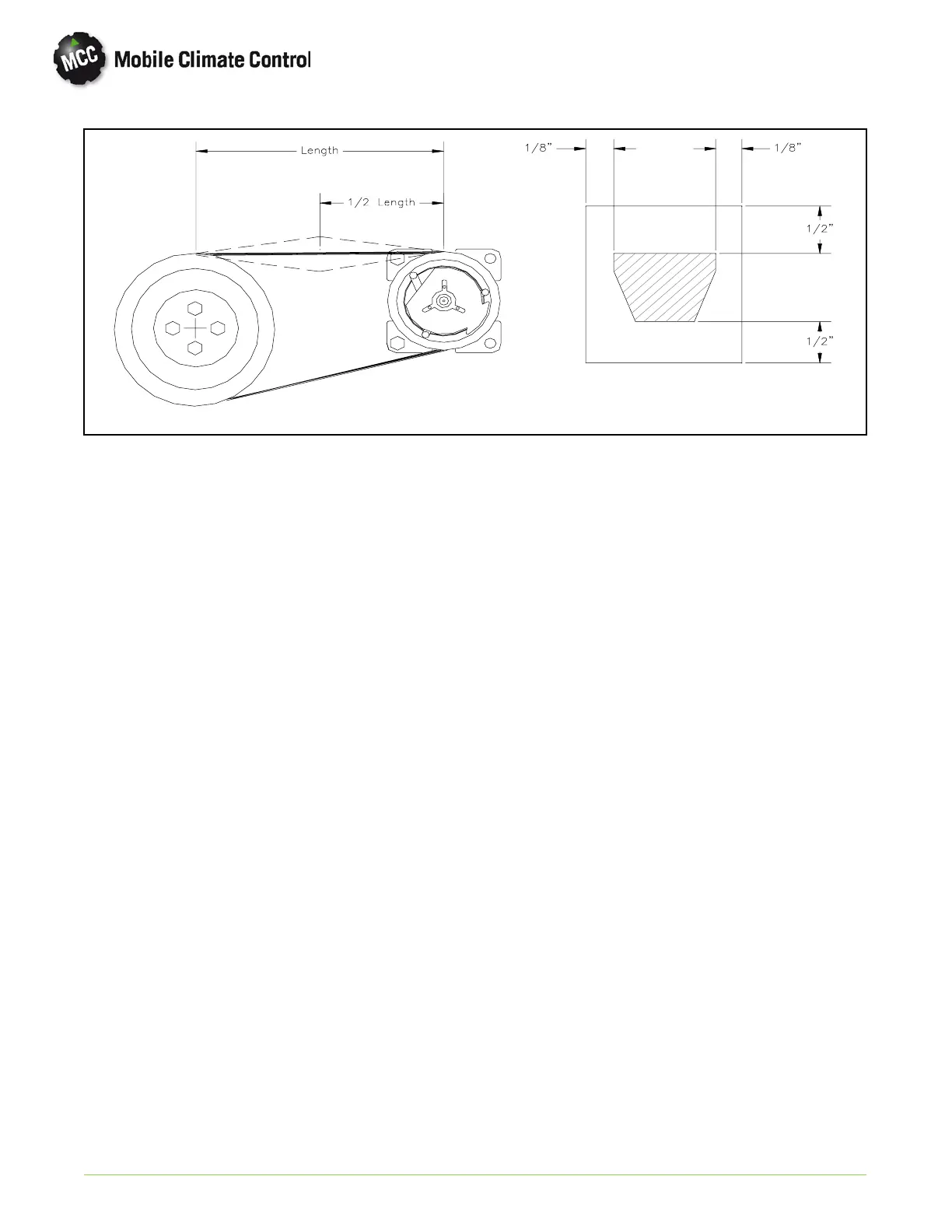
Clearance Zone Identification
Clearance at Mid Span
Figure 4-5 Belt Clearance Requirements
4.12 DRIVE BELT INSTALLATION
4.12.1 Introduction
There are several factors that have major effects on
compressor and alternator drive belt(s) life
expectancy and reliability. Belt alignment and proper
tension being the most critical and controllable by
the installer and end-user. Improper alignment
and/or tension will cause premature failure of drive
belts, driven components as well as a possible safety
issue. When improperly installed and/or
maintained, drive belts can cause significant damage
to equipment. The following are the biggest factors
that effect belt life and system dependability.
A. Belt Alignment
B. Belt Tension
1. Over Tensioned
2. Under Tensioned
C. Belt Clearance
D. Temperature-Heat
E. Fluids
F. Maintenance Procedures
4.12.2 Belt Clearance
A certain belt clearance needs to be maintained for
belt span vibration when installing compressors and
alternator belts. Figure 4-5 shows the recommended
guidelines for clearance. Due to the large number of
variables, actual testing is required to determine
whether th e clearances are acceptable.
4.12.3 Pulley Alignment
Correct belt alignment is essential for alternator and
compressor belt life. The center line of all pulleys
related to compressor or alternator drive must be
within 1/3 degree of true center. Refer to Figure 4-6
for approximate measurements, and keep in mind,
these are maximum values. You should try to attain
perfect alignment whenever possible to maximize
component and belt life.
Maximum allowable run-out for Poly ”V” belts is
1/8 inch.
Maximum allowable run-out for Standard ”V” belts
is 1/4 inch.
Alignment methods are illustrated in Figure 4-6 and
Figure 4-7. A high quality straight edge is a necessity,
your eye is not an acceptable meth o d of determining
proper belt alignment. All mounting brackets should
allow for minor belt center line adjustments.


 To Next Page
 Loading...