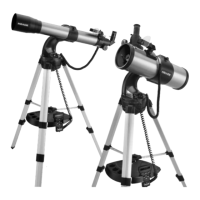
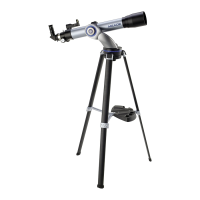
To use an eyepiece for visual observations through the DS-10, place the extender tube into the focuser first,
followed by placement of the eyepiece into the extender tube. Tighten the lock screw in the extender tube to
hold the eyepiece firmly in position.
The eyepiece normally included as standard equipment with the DS-10 is a Kellner 25mm, yielding 46X. For
higher or lower powers, different eyepieces may be used, either individually or in conjunction with a Barlow
lens (see "Optional Equipment"). When trying to locate astronomical objects, begin with a lower-power
eyepiece in any case: it will present a wider field of view for easier object locating. Then, if desired, switch to
higher power eyepieces once the object has been centered in the telescopic field.
DO NOT OBSERVE THE SUN WITH
YOUR MEADE REFLECTING TELESCOPE!
Observation of the Sun without the proper professional equipment can cause
serious and irreversible eye damage. Under no conditions should the observer
point the telescope directly at the Sun, or attempt to observe the Sun through the
telescope, without obtaining equipment specifically designed for this purpose.
III. OBSERVING NOTES
1. Try not to touch the eyepiece while observing. Any vibrations resulting from such contact will immediately
cause the image to move.
2. Allow your eyes to become "dark-adapted" prior to making serious observations. Night adaptation generally
requires about 10 - 15 minutes.
3. Let the telescope "cool down" to the outside environmental temperature before making observations.
Temperature differentials between a warm house and cold outside air require about 30 minutes for the main
mirror to regain its true and correct figure. During this period, the telescope will not perform well. A good idea
is to take the telescope outside 30 minutes before you want to start observing.
4. If you wear glasses and do not suffer from astigmatism, take your glasses off when observing through the
telescope. You can re-focus the image to suit your own eyes. Observers with astigmatism, however, should
keep their glasses on, since the telescope cannot correct for this eye defect.
5. "Stopping-Down" the Telescope: In using the DS-10 for lunar and planetary observations, particularly if
atmospheric "seeing" conditions are unsteady, it is often helpful to reduce the effective aperture of the
telescope. In this way the telescope's effective focal ratio is increased, generally permitting the resolution of
finer lunar and planetary detail.
A simple way to "stop-down" the DS-10 is to cut a 6" or 7" hole in a piece of cardboard, and tape this
cardboard mask to the front of the telescope. (We recommend attaching the tape to the rubber end-ring of the
telescope, and not to the tube body itself, to avoid marring the tube’s painted finish when the tape is removed.)
If local atmospheric conditions are not conducive to good astronomical "seeing" (as evidenced by rapid
twinkling of the stars), the above-mentioned stop-down mask--may also improve the observations of deep-
space objects, e.g. nebulosity’s and galaxies. In general, however, if your local atmosphere is fairly steady, you
will probably want to use the full 10-inch aperture of the DS-10 on these latter objects, in order to achieve
maximum image brightness.
IV. CARE OF THE OPTICS


 To Next Page
 Loading...