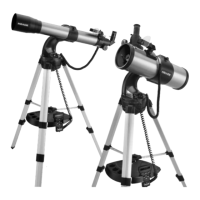
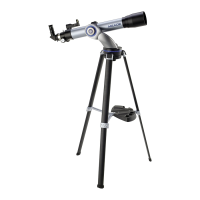
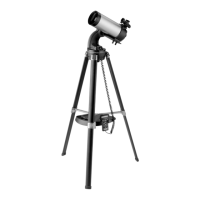
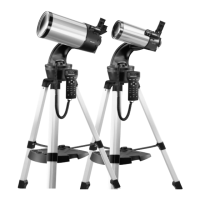
With the reasonable care due any fine instrument, your Meade telescope will last a lifetime. If the eyepiece
lenses become dirty, try brushing them with a camel’s hair or other soft brush. If you must wipe the lenses, do it
gently with a soft cloth so as not to scratch the glass.
The thin aluminum coatings on the primary and secondary mirrors may last up to ten years without
deteriorating; they will last a shorter period in polluted or salt air. In any case, re-coating the mirrors is not a
particularly expensive process. A little dust on the mirrors has an insignificant effect on performance; perhaps
the most common error is to clean the mirrors more often than necessary. When the main mirror becomes
excessively dirty, clean as follows:
1. With the mirror resting face up on a towel in a sink, turn on the cold water and play a stream of water on its
face. This will loosen some of the particles and wash off unattached dust. Dip a wad of cotton in mild solution
of detergent (
1
/
2
teaspoon detergent to 1 pint of water). Then gently swab the entire surface. Keep the water
going while swabbing to wash off the detergent solution as you clean. Very important: do not let the surface dry
or bead, as water marks will be formed. Keep the stream of water going.
2. After swabbing the surface with detergent solution, cover the mirror with a stream of water. Make ready
three wads of cotton for the following: Dip one-half of a cotton swab into isopropyl alcohol. At the time you
place the swab on the surface of the mirror, turn off the water. Now swab the entire surface. Caution: Do not
turn the swab over or dissolved skin oils will deposit on the mirror. Immediately take a dry swab and wipe
gently. Keep changing cotton swabs until the surface is totally dry.
V. OPTIONAL EQUIPMENT
The Meade DS-10 telescope is shipped as a complete astronomical instrument. Many optional accessories and
systems may be ordered, however, permitting a very wide range of additional visual and photographic
applications.
Electric Motor Drive: The Model 787 Electric Motor Drive System may be ordered at any time, for direct
attachment to the Model DS-10 telescope. If you ordered the motor drive at the same time as you ordered your
telescope, the drive was already installed at the factory, prior to shipment. The drive system is normally
equipped with a synchronous timing motor of 115 volts A.C./60 Hertz, for use in the United States and Canada.
(Alternately, for use in foreign countries, 220 volt/50 Hz units are available, including reversed drives for
operation in the Southern Hemisphere.) With the electric motor drive installed on your DS-10, astronomical
tracking is fully automatic: simply align the telescope to the Pole (see Section II, "Lining up the Telescope with
the Pole", above), plug in the electric drive to a standard AC outlet, and the telescope will immediately begin to
follow celestial objects at the correct rate.
Because the stars move slowly, you will not be able to detect the telescope's motion caused by the motor drive.
With the drive plugged in, an object in the telescope's field of view will appear to "stand still." When the drive
is unplugged, the object will move out of the field rapidly.
The drive system has a built-in automatic clutch, so that even when the drive is plugged in, you may still move
the telescope manually at will in any direction. When you release manual contact with the telescope, the drive
automatically resumes tracking.
Viewfinders: Optional viewfinders of any aperture are best located at the "one o'clock" position, as shown in
Fig. 6. This position results in easier balancing of the complete telescope system.
Alignment of-a viewfinder is most easily performed on a fixed terrestrial object. Center the main telescope on a
well-defined, sharp object, and then, using the viewfinder bracket's alignment screws, place the crosshairs of
the finder so that they too are centered on the object. Thereafter, objects may be sighted first in the finder, then
viewed through the main telescope.


 To Next Page
 Loading...