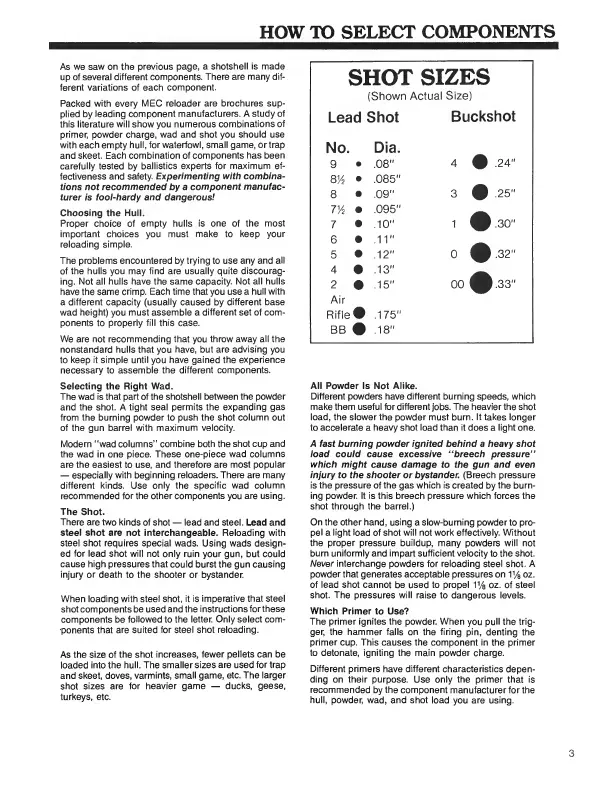
EasyManua.ls Logo

Mec 8567 Grabber - Page 3

Default Icon
20 pages
Print Icon
To Next Page IconTo Next Page
To Previous Page IconTo Previous Page
Loading...
HOW
TO
SELECT
COMPONENTS
As
we
saw
on
the
previous
page,
a
shotshell
is
made
up
of
several
different
components.
There
are
many
dif¬
ferent
variations
of
each
component.
Packed
with
every
MEC
reloader
are
brochures
sup¬
plied
by
leading
component
manufacturers.
A
study
of
this
literature
will
show
you
numerous
combinations
of
primer,
powder
charge,
wad
and
shot
you
should
use
with
each
empty
hull,
for
waterfowl,
small
game,
or
trap
and
skeet.
Each
combination
of
components
has
been
carefully
tested
by
ballistics
experts
for
maximum
ef¬
fectiveness
and
safety.
Experimenting
with
combina¬
tions
not
recommended
by
a
component
manufac¬
turer
is
fool-hardy
and
dangerous!
Choosing
the
Hull.
Proper
choice
of
empty
hulls
is
one
of
the
most
important
choices
you
must
make
to
keep
your
reloading
simple.
The
problems
encountered
by
trying
to
use
any
and
all
of
the
hulls
you
may
find
are
usually
quite
discourag¬
ing.
Not
all
hulls
have
the
same
capacity.
Not
all
hulls
have
the
same
crimp.
Each
time
that
you
use
a
hull
with
a
different
capacity
(usually
caused
by
different
base
wad
height)
you
must
assemble
a
different
set
of
com¬
ponents
to
properly
fill
this
case.
We
are
not
recommending
that
you
throw
away
all
the
nonstandard
hulls
that
you
have,
but
are
advising
you
to
keep
it
simple
until
you
have
gained
the
experience
necessary
to
assemble
the
different
components.
Selecting
the
Right
Wad.
The
wad
is
that
part
of
the
shotshell
between
the
powder
and
the
shot.
A
tight
seal
permits
the
expanding
gas
from
the
burning
powder
to
push
the
shot
column
out
of
the
gun
barrel
with
maximum
velocity.
Modern
“wad
columns”
combine
both
the
shot
cup
and
the
wad
in
one
piece.
These
one-piece
wad
columns
are
the
easiest
to
use,
and
therefore
are
most
popular
especially
with
beginning
reloaders.
There
are
many
different
kinds.
Use
only
the
specific
wad
column
recommended
for
the
other
components
you
are
using.
The
Shot.
There
are
two
kinds
of
shot
lead
and
steel.
Lead
and
steel
shot
are
not
interchangeable.
Reloading
with
steel
shot
requires
special
wads.
Using
wads
design¬
ed
for
lead
shot
will
not
only
ruin
your
gun,
but
could
cause
high
pressures
that
could
burst
the
gun
causing
injury
or
death
to
the
shooter
or
bystander.
When
loading
with
steel
shot,
it
is
imperative
that
steel
shot
components
be
used
and
the
instructions
for
these
components
be
followed
to
the
letter.
Only
select
com¬
ponents
that
are
suited
for
steel
shot
reloading.
As
the
size
of
the
shot
increases,
fewer
pellets
can
be
loaded
into
the
hull.
The
smaller
sizes
are
used
for
trap
and
skeet,
doves,
varmints,
small
game,
etc.
The
larger
shot
sizes
are
for
heavier
game
ducks,
geese,
turkeys,
etc.
All
Powder
Is
Not
Alike.
Different
powders
have
different
burning
speeds,
which
make
them
useful
for
different
jobs.
The
heavier
the
shot
load,
the
slower
the
powder
must
burn.
It
takes
longer
to
accelerate
a
heavy
shot
load
than
it
does
a
light
one.
A
fast
burning
powder
ignited
behind
a
heavy
shot
load
could
cause
excessive
“breech
pressure”
which
might
cause
damage
to
the
gun
and
even
injury
to
the
shooter
or
bystander.
(Breech
pressure
is
the
pressure
of
the
gas
which
is
created
by
the
burn¬
ing
powder.
It
is
this
breech
pressure
which
forces
the
shot
through
the
barrel.)
On
the
other
hand,
using
a
slow-burning
powder
to
pro¬
pel
a
light
load
of
shot
will
not
work
effectively.
Without
the
proper
pressure
buildup,
many
powders
will
not
burn
uniformly
and
impart
sufficient
velocity
to
the
shot.
Never
interchange
powders
for
reloading
steel
shot.
A
powder
that
generates
acceptable
pressures
on
V/
8
oz.
of
lead
shot
cannot
be
used
to
propel
V/
8
oz.
of
steel
shot.
The
pressures
will
raise
to
dangerous
levels.
Which
Primer
to
Use?
The
primer
ignites
the
powder.
When
you
pull
the
trig¬
ger,
the
hammer
falls
on
the
firing
pin,
denting
the
primer
cup.
This
causes
the
component
in
the
primer
to
detonate,
igniting
the
main
powder
charge.
Different
primers
have
different
characteristics
depen¬
ding
on
their
purpose.
Use
only
the
primer
that
is
recommended
by
the
component
manufacturer
for
the
hull,
powder,
wad,
and
shot
load
you
are
using.
3

Related product manuals