EasyManua.ls Logo

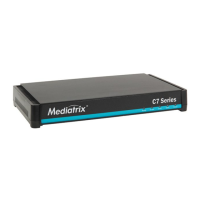
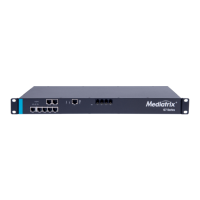
Media5 Mediatrix C7 Series - User Manual

Media5 Mediatrix C7 Series
4 pages
Print Icon
To Next Page IconTo Next Page
Loading...
Discover the Power of 5
© 2013, Media5 Corporation Document Revision 14
Mediatrix C7 Series
Installation – SIP
Warning: In the following installation procedures, do not disconnect the
Mediatrix C7 Series while the LEDs are flashing.
Thank you for choosing the Mediatrix C7 Series. This Quick Start will help you to properly connect all of the cables to the Mediatrix C7 Series and access
its web interface.
Please read the Mediatrix C7 Series Hardware Installation Guide for detailed installation information and the Mediatrix C7 Series
Software Configuration Guide for in-depth configuration information.
Step 1 Connecting Cables
The following describes how to connect the various cables to the Mediatrix C7 Series. Since there are many flavours of the Mediatrix C7 Series unit, some
of the information provided may not apply to your particular Mediatrix C7 Series unit model.
Before you begin, make sure that you have a working network connection. Then follow these steps to install the Mediatrix C7
Series.
1. Before you begin, be sure that the Mediatrix C7 Series is
powered off.
2. Connect the power adaptor to the Mediatrix C7 Series.
3. Models with FXS ports: Connect analog telephones or fax
machines into the FXS connectors.
Use a standard telecommunication cord with a minimum of
26 AWG wire size.
4. Models with FXO ports: Connect a SCN line into the FXO Ports.
Use a standard telecommunication cord with a minimum of 26 AWG wire size.
5. Connect a 10/100 BaseT Ethernet RJ-45 cable into the ETH1 connector of the Mediatrix C7 Series; connect the other end to a compatible
Ethernet interface that supplies TCP/IP network access (e.g., router, switch, hub or computer).
You can either use a crossover or straight Ethernet cable because it performs automatic MDI / MDIX detection.
Model Interfaces
C710 4 FXS
C711 8 FXS
C730 4 FXO
C733 8 FXO
C731 4 FXS + 8 FXO
Note: The FXS and FXO ports may differ location depending on the model you have.
1234 1234
FXO
FXS
ETH2
ETH1
USB
Power
Reset /
Default
12V
2.5A
2
3
4
65
Question and Answer IconNeed help?

Do you have a question about the Media5 Mediatrix C7 Series and is the answer not in the manual?

Summary

Connecting Cables

Connecting FXS Ports

Connect analog telephones or fax machines into the FXS connectors using a telecommunication cord.

Connecting FXO Ports

Connect a SCN line into the FXO ports using a standard telecommunication cord.

Connecting Ethernet Cable

Connect the ETH1 connector to a compatible Ethernet interface using a 10/100 BaseT RJ-45 cable.

IP Address Discovery or Configuration

Dynamic IPv4 Address Discovery

Obtain an IP address dynamically through a DHCP server. Methods include dialing *#*0, checking DHCP logs, or using a packet sniffer.

Default Static IPv4 IP Address Configuration

Configure IP address statically if no DHCP server is available via a partial reset procedure.

IPv6 Link Local Address Configuration

Accessing via Link Local Address

Access the unit using its IPv6 link local address, typically found on a sticker or derived from the MAC address.

Access the Mediatrix C7 Series Web Interface

Login Credentials

Log in using default credentials 'public'/'public' or 'admin'/'administrator'.

End User Technical Support

Overview

The Mediatrix C7 Series is a versatile device designed to facilitate communication by connecting various types of telephony interfaces to an IP network, primarily using the SIP (Session Initiation Protocol). Its core function is to act as a gateway, allowing traditional analog telephones, fax machines, and PSTN (Public Switched Telephone Network) lines to integrate seamlessly with modern IP-based communication systems. This enables users to leverage the benefits of VoIP (Voice over IP) while retaining their existing analog equipment or connecting to external telephone networks.

Function Description:

The Mediatrix C7 Series serves as a robust and flexible media gateway, bridging the gap between legacy telephony infrastructure and IP networks. It supports different configurations, including models with FXS (Foreign Exchange Subscriber) ports, FXO (Foreign Exchange Office) ports, or a combination of both.

  • FXS Ports: These ports are designed to connect analog telephones, fax machines, or other analog terminal devices. When an analog device is connected to an FXS port, the Mediatrix C7 Series converts the analog signals into digital IP packets for transmission over the network and vice versa. This allows analog phones to make and receive calls over a VoIP system, effectively extending the life and utility of existing analog equipment.
  • FXO Ports: These ports are used to connect to traditional PSTN lines (also known as "landlines" or "SCN lines"). When an FXO port is connected to a PSTN line, the Mediatrix C7 Series can route incoming calls from the PSTN to IP endpoints or allow IP users to make outgoing calls over the PSTN. This is particularly useful for businesses that need to maintain a connection to the public telephone network for local calls, emergency services, or as a fallback in case of IP network failure.
  • Ethernet Ports (ETH1, ETH2): The device features 10/100 BaseT Ethernet RJ-45 ports for network connectivity. The ETH1 port is typically used for primary network connection and IP configuration, providing TCP/IP network access. The device supports automatic MDI/MDIX detection, meaning it can work with both crossover and straight Ethernet cables, simplifying installation.

The Mediatrix C7 Series operates by converting voice signals between analog and digital formats, encapsulating them into IP packets, and routing them according to SIP protocols. This enables features such as call routing, call forwarding, and integration with IP PBXs or softswitches.

Usage Features:

The Mediatrix C7 Series is designed for straightforward installation and configuration, though some technical knowledge is beneficial for optimal setup.

  • Initial Setup and Connectivity: The first step involves physically connecting the necessary cables. This includes connecting the power adapter, analog telephones/fax machines to FXS ports (if applicable), SCN lines to FXO ports (if applicable), and an Ethernet cable to the ETH1 port for network access. The device is designed to be powered off during initial cable connections to ensure safety and proper initialization.
  • IP Address Discovery and Configuration: After physical connections, the device needs an IP address to be accessible on the network. The Mediatrix C7 Series can obtain an IP address dynamically via DHCP or be configured with a static IP address.
    • Dynamic IP Address Discovery: In a network with a DHCP server, the device will automatically request an IP address. Users can discover this assigned IP address by dialing a specific code (*#*0) from an analog phone connected to an FXS port, consulting DHCP server logs, or using network packet sniffers. It is recommended to reserve an IP address in the DHCP server for the device using its MAC address to ensure consistent connectivity.
    • Static IP Address Configuration: If no DHCP server is available, the device can be configured with a static IP address. This involves connecting the device to a computer via a hub, temporarily reconfiguring the computer's IP address, and performing a "partial reset" on the Mediatrix C7 Series. A partial reset enables a default static IP address (192.168.0.1/24) for initial access.
    • IPv6 Link Local Address Configuration: For units supporting IPv6, a link-local address can also be used for access, particularly after a partial reset. This address is automatically enabled after the reset procedure and can be determined from the unit's MAC address or through command-line tools on the connected computer.
  • Web Interface Access: Once an IP address is established, the device's web interface can be accessed through a web browser. This interface is the primary tool for configuring the unit.
    • Login Credentials: The default login credentials are "public" with no password, or "admin" with "administrator" as the password. These credentials allow access to the system information and configuration settings.
    • Configuration Options: The web interface provides comprehensive options for configuring SIP settings, call routing, network parameters, and other telephony features. It allows users to tailor the device's operation to their specific communication needs.

Maintenance Features:

The Mediatrix C7 Series incorporates features that aid in troubleshooting and maintaining the device's operation.

  • LED Indicators: The device has LED indicators (e.g., Power LED) that provide visual feedback on its status. For instance, a blinking Power LED can indicate that the device is searching for a DHCP server or undergoing a reset procedure. Understanding these LED patterns is crucial for diagnosing initial connectivity issues.
  • Reset / Default Hole: A small "Reset / Default" hole is located at the rear of the unit. Inserting an unbent paper clip into this hole allows users to perform a "partial reset." This procedure is vital for recovering access to the device if its IP configuration is lost or if default settings need to be restored for troubleshooting. A partial reset enables the default static IPv4 IP address or the link-local IPv6 address, facilitating re-access to the web interface.
  • Documentation and Support: The device comes with comprehensive documentation, including a Hardware Installation Guide and a Software Configuration Guide. These resources provide detailed information for installation, configuration, and troubleshooting. In case of technical issues, users are encouraged to contact their vendor for support, as Media5 works through its partners to resolve such issues.
  • Automatic MDI/MDIX Detection: The Ethernet ports' ability to automatically detect and adapt to crossover or straight cables simplifies network cabling, reducing potential installation errors and making maintenance easier.
  • Firmware Updates: While not explicitly detailed in the provided text, devices like the Mediatrix C7 Series typically support firmware updates through the web interface. Keeping the firmware updated is a standard maintenance practice to ensure optimal performance, security, and access to new features.
  • System Information Display: The web interface provides a "System Information" page that displays critical details such as firmware version, MAC address, serial number, system uptime, and current system time. This information is invaluable for support personnel when diagnosing issues or verifying the device's operational status.

In summary, the Mediatrix C7 Series is a reliable and adaptable media gateway designed to integrate analog telephony into IP networks. Its user-friendly installation process, flexible IP configuration options, and accessible web interface make it a practical solution for various communication environments, while its diagnostic features and comprehensive documentation support ongoing maintenance and troubleshooting.

Media5 Mediatrix C7 Series Specifications

General IconGeneral
ModelMediatrix C7 Series
CategoryGateway
Network Interfaces10/100 Mbps Ethernet
Protocols SupportedSIP, MGCP
CodecsG.711, G.723.1, G.726, G.729
Fax SupportT.38
Operating Temperature0°C to 40°C

Related product manuals