How to Perform a Test
AVTMST16 Rev 1 May 2016
25
Locating a Cable Fault (shielded MV power cable)
How to Test the Dielectric Strength of the Cable
A HIPOT/breakdown test is used to test the dielectric strength of a cable and, if
the test fails, to determine the breakdown voltage. For this purpose, a test
voltage of up to 16 kV is applied to the cable under test.
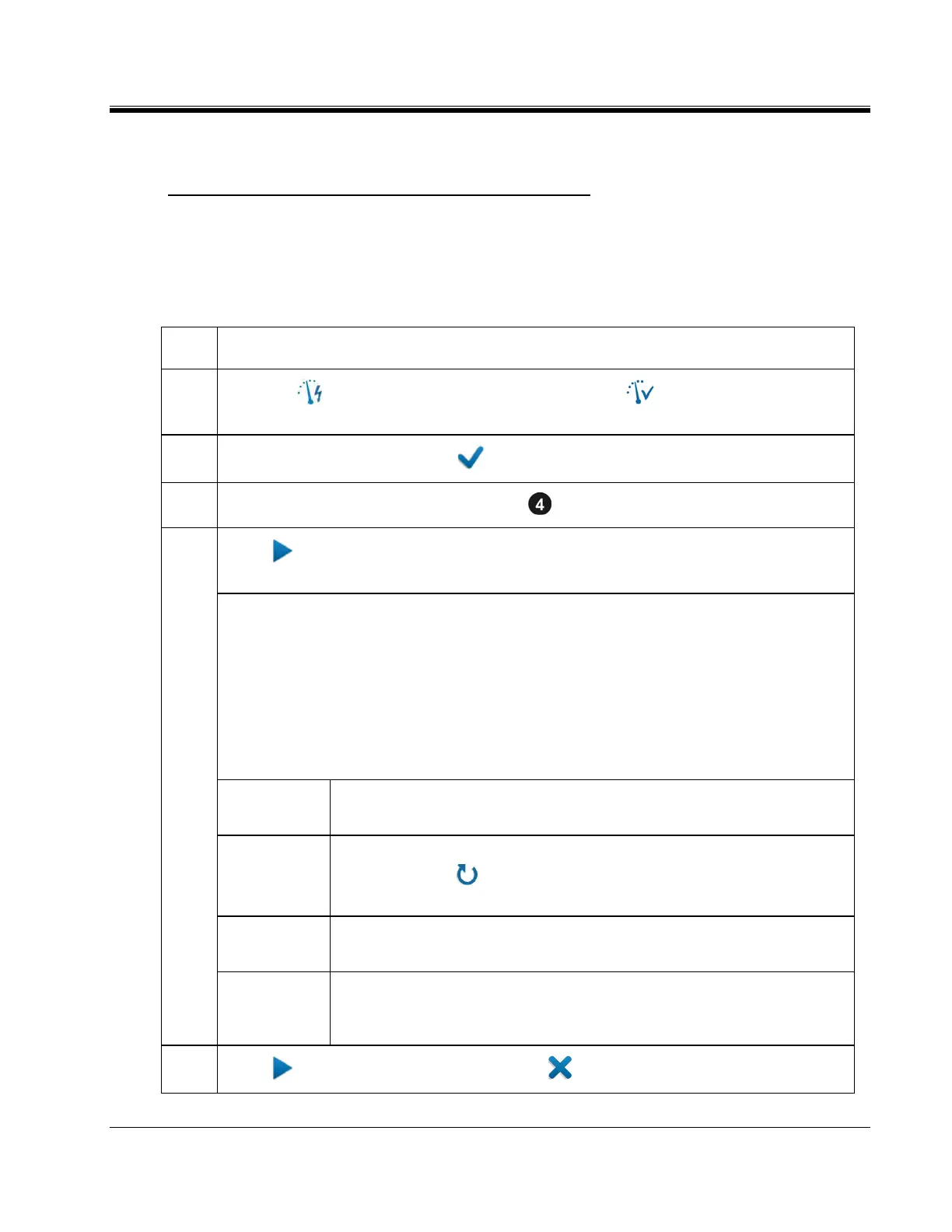
Proceed as follows to perform a HIPOT test:
Step Description
1
Select the menu item from the main menu or from the submenu (depends on the
system configuration).
2
Adjust the test voltage and select to confirm the value.
3
Press the green illuminated “HV ON" button .
4
Select to start the test (only if Measurement Start option is set to Manual. See section
“System Settings” on page 17).
Result: The selected voltage is applied to the cable.
During the rise of the voltage the maximum current of the HVPS will be displayed till the
cable has been fully charged, at which time the current will drop down to the actual leakage
current level. The insulation resistance is displayed. This scenario is observed if the cable
has no insulation breakdown, otherwise the high voltage will be shut off when the flashover
/ breakdown occurs.
Depending on whether a breakdown takes place during the test, one of the following
results is presented in the display:
Breakdown
at…kV
A voltage breakdown took place at the indicted test voltage.
No Flash-over
The cable has successfully withstood the applied DC test voltage. If
required, repeat ( ) the test with higher voltage (do not exceed the
maximum permissible voltage).
Cable not
chargeable
The cable could not be charged while the test voltage was applied. This
may be due to a short on the cable.
Low
resistance at
…kV
The HV source cannot charge the cable beyond the indicated voltage
value due to a very high leakage current level.
5
Select to proceed with fault pre-location or to return to the main menu.


 To Next Page