EasyManua.ls Logo

Merc-O-Tronics 98 - TESTING FOR FAULTY WIRING; Wiring Fault Identification

Default Icon
132 pages
Print Icon
To Next Page IconTo Next Page
To Previous Page IconTo Previous Page
Loading...
$P?msor
@fiDElslR
tuPPusslox
DroDl
1.
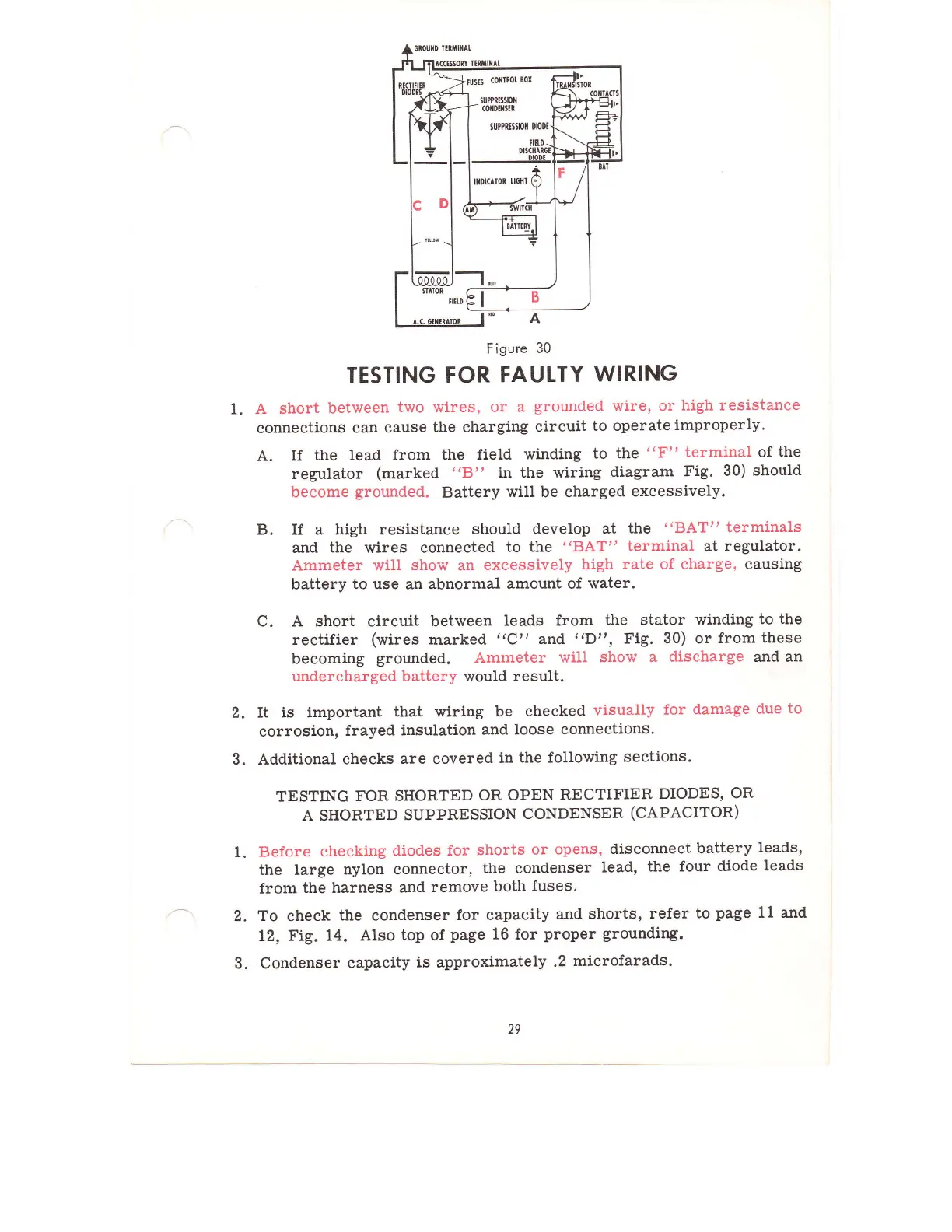
Figure
30
TESTING
FOR
FAUTTY
WIRING
A
short
between
two
wires,
or
a
gronnded
wire, or
high resistance
connections
can
cause
the
charging
circuit
to operate
improperly.
A.
If
the lead from
the
field
winding
to the
"F"
terminal of
the
regulator
(marked
'tB"
in
the wiring
diagram
Fig.
30)
should
become
grounded.
Battery
will
be charged
excessively.
B. If a high resistance
shoutd
develop
at
the
((BAT"
terminals
and
the
wires connected
to
the
.'BAT"
terminal
at
regulator.
Ammeter wiil
show
an
excessively
high
rate of charge, causing
battery
to use an abnormal
amount of
water.
C. A short circuit between
leads from
the stator
winding
to
the
rectifier
(wires
marked
"C"
and
"D",
Fig. 30) or
from
these
becoming
grounded.
Ammeter will
show a
discharge and an
undercharged battery
would
result.
It
is important
that wiring be
checked
visually
for
damage
due
to
corrosion,
frayed
insulation
and loose connections.
Additional
checks
are
covered
in
the following
sections.
TESTING
FOR SHORTED
OR
OPEN
RECTIFIER
DIODES,
OR
A
SHORTED
SUPPRESSION
CONDENSER
(CAPACITOR)
Before
checking
diodes
for
shorts
or
opens, disconnect
battery
leads,
t}te large
nylon connector,
the condenser
lead,
the four
diode leads
from
the harness
and
remove
both
fuses.
To
check
the condenser
for capacity
and shorts,
refer
to
page
11 and
12,
Fig. 14.
Also
top
of
page 16
for
proper
grounding.
Condenser
capacity
is approximately
.2
microfarads.
,
3.
1.
2.
3.
29