This document serves as an installation and operation instruction manual for Mercator Grange Series ceiling fans. It provides comprehensive guidelines for safely installing, operating, and maintaining the fan, emphasizing the importance of adhering to safety precautions and proper wiring procedures. The manual is designed to assist both licensed electricians and fan owners in ensuring the correct setup and optimal performance of the ceiling fan.
Function Description
The Mercator Grange Series ceiling fan is designed to provide air circulation for cooling in summer and to assist in warming rooms during winter. It functions by rotating blades to create airflow, which can be directed downwards for a cooling effect or upwards to circulate warm air from the ceiling area. The fan is equipped with a reversible switch to change the direction of blade rotation, allowing for seasonal optimization of airflow. Additionally, some models are compatible with light kits, providing ambient illumination. The fan can be controlled via a wall controller or an optional remote controller, offering flexibility in operation. Its primary purpose is to enhance comfort within a living space while potentially reducing energy costs associated with air conditioning and heating.
Usage Features
The Mercator Grange Series ceiling fan offers several features designed for user convenience and optimal performance:
- Reversible Operation: A key feature is the reversible switch, which allows the fan blades to rotate in either a counter-clockwise (summer setting) or clockwise (winter setting) direction.
- In the summer setting (counter-clockwise), the fan creates a downward airflow, producing a cooling effect. This allows users to set their air conditioner to a higher temperature while maintaining comfort, potentially saving energy.
- In the winter setting (clockwise), the fan creates an upward airflow, which moves warm air off the ceiling and circulates it downwards into the living areas. This can help to distribute heat more effectively, allowing the heating unit to be set at a lower temperature. It is recommended to use the fan on a lower speed in winter than in summer.
- Control Options: The fan can be operated using either a dedicated wall controller or an optional remote controller.
- The wall controller allows for speed adjustment and light control (if a light kit is installed). It is crucial to use only Mercator-approved wall controllers to maintain warranty validity and ensure safe operation. Solid-state controllers are not to be used.
- An optional remote controller provides wireless control over fan speed and light functions. For infrared (IR) remote controls, the antenna eyeball should be left outside the canopy for optimal signal reception.
- Lighting Capability: The fan is approved for use with a light kit, specifically designed for 2 x MAX 20W CFL globes. For optimum lighting, 2 x 12W CFL globes are recommended. The diffuser twists into place to secure the globes and can be twisted anticlockwise for lamp replacement.
- Compatibility with Smart Home Systems: The fan is compatible with some HOME IT systems, offering potential integration into a broader smart home ecosystem. Users are advised to contact Mercator for further details on compatibility.
- Adjustable Fan Speed: Both the wall and remote controllers offer multiple speed settings, allowing users to adjust the airflow intensity according to their comfort needs and room conditions.
Maintenance Features
The manual outlines several maintenance considerations to ensure the longevity and safe operation of the Mercator Grange Series ceiling fan:
- Pre-Installation Checks: Before installation, it is essential to read all instructions and safety information, review assembly diagrams, and verify that all components are present and undamaged. This proactive approach helps prevent issues and ensures a smooth installation process.
- Secure Mounting: The fan mounting bracket must be firmly screwed to a load-bearing building structure (e.g., concrete ceiling, steel structure, or timber frame) to support the fan's weight (approximately 35 kg). This prevents the fan from falling and ensures stability during operation.
- Electrical Safety: All electrical work must be performed by a licensed and qualified electrician. Power must be disconnected at the main power box (by removing fuses or turning off the circuit breaker) before commencing any electrical work, including installation, lamp replacement, or controller installation. This ensures all-pole isolation of the electrical supply and prevents electric shock.
- Earthing: Both the fan (including any light kit accessory) and the hanging bracket must be earthed during installation to ensure electrical safety.
- Blade Installation and Alignment: Blades should be attached after the motor housing is securely installed. Care must be taken not to bend or damage the motor drive shaft or fan blades during handling and installation. For optimal performance and to minimize wobble, blade holes should align with holes on the blade bracket, and blades should be secured using supplied screws and fiber washers.
- Wobble Troubleshooting: The manual provides a detailed troubleshooting guide for fan wobble, which is a common concern.
- Users should check that all blade brackets are securely tightened.
- Inconsistent blade levels are a primary cause of wobble; measuring the distance from each blade tip to the ceiling can identify discrepancies, requiring bracket adjustments.
- Deviations in blade separation (distance from blade tip to blade tip) can also cause wobble. Loosening and re-tightening screws to shift blades to the proper position can resolve this.
- Noise Troubleshooting: The manual addresses common noise issues.
- Noisy operation can sometimes be resolved by fully tightening the light fitting (if applicable) and all screws on fan blades, hanging bracket, and covering plate.
- Mechanical noise may settle after the fan has run for about 8 hours.
- The manual acknowledges that all electric motors produce some noise and may feel warm, which is normal. It also notes that slight signals superimposed on the electricity supply (e.g., for off-peak hot water control) can cause changes in motor noise, which is also normal and not a fault.
- Regular Checks: Fan owners are advised to periodically check for loose threaded components or slightly bent blade carriers, which can cause wobble and noise. Gentle care and maintenance can prevent these issues.
- Lamp Replacement: When replacing lamps, ensure electricity is turned off at the main power box. The diffuser twists anticlockwise for removal and clockwise to lock it back into place. Keeping globes clean is important for their useful lifetime.
- Warranty Considerations: Using unapproved wall controllers or attempting to install the fan without proper qualifications will void the warranty. It is crucial to follow all instructions to maintain warranty coverage. The manual also clarifies that fan lights rattling (if not supplied with the fan) are not covered by warranty.

 Need help?
 General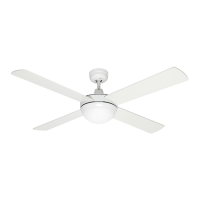

 To Next Page


