Need help?
Do you have a question about the Merging Anubis Series and is the answer not in the manual?
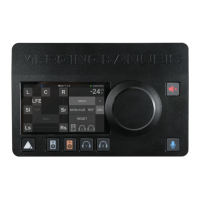
Describes the controls and features of the Anubis unit's top surface.
Details the features and connections found on the bottom panel of the Anubis unit.
Explains the components and functionality of the Anubis unit's side panel, including the fan.
Outlines the various ports, connectors, and switches located on the rear panel of the Anubis.
Describes the connectors and controls present on the front panel of the Anubis unit.
Instructions on connecting the Anubis to a network via Ethernet for RAVENNA compatibility.
Guidance on correctly connecting balanced outputs to unbalanced inputs, with diagrams.
Step-by-step guide for installing the RAVENNA ASIO driver on Windows PCs.
Instructions for installing the Virtual Audio Device (VAD) Premium driver on macOS.
Procedure for installing the ALSA driver for Linux operating systems.
How to connect and use the Anubis via its DC power adapter.
Instructions on powering the Anubis using a Power-over-Ethernet (PoE) connection.
Steps involved in powering on the Anubis unit and initiating the boot-up sequence.
Explanation of the functions and usage of the Anubis rotary control knob for navigation and adjustments.
A detailed list and explanation of Anubis log message IDs and their meanings.
An overview of the different categories available within the Anubis settings menu.
Configuration options for general Anubis parameters like sampling rate, auto mode, and latency.
Defining and managing audio sources that can be monitored through the Anubis.
Highlights the capabilities and supported sample rates for the Anubis EQ.
Details limitations and unavailable features for the Anubis EQ, especially in DSD modes.
Options for enabling bass management, setting crossover frequency, and filter slope.
Diagrams illustrating the signal path for bass management in single and dual-channel configurations.
Setting the maximum volume boundary for monitor outputs.
Determining the reference listening level for monitor recall.
Adjusting the dim level for main monitor outputs.
Reference table detailing GPI trigger states and pulse behavior.
Diagram illustrating the audio signal path for PCM formats processed by the Anubis.
Diagram showing the audio signal flow for DSD formats processed by the Anubis.
The main interface for selecting and controlling monitor sets and speaker outputs.
The interface for selecting and managing different audio sources for monitoring.
Displays metering information for both sources and monitors, with level controls.
Detailed controls for managing individual speakers within a selected monitor set.
Right-side controls for monitor sets, including volume, downmix, and special functions.
Explains how to define and classify different types of audio sources for monitoring.
Detailed metering overview for all available audio sources, showing peak levels and channel types.
Description of the dB level scale and its associated SUM and PK functions on the meters page.
Lists the supported features and limitations when working with DSD audio formats on the Anubis.
Setting the sampling rate for DXD or DSD audio formats on the Anubis Premium.
Configuration for the analog-to-digital converter mode for DXD and DSD formats.
Settings for hot metering levels specific to DXD and DSD audio formats.
Explanation of peak meter scale differences for DXD/DSD formats.
Configuration options for the Anubis SPS version, including ST2022-7 and switch modes.
A fundamental setup guide for monitoring DAW playback through speakers and headphones.
Describes direct remote access to the Anubis monitoring interface from a computer.
Explains how to access Anubis monitoring remotely via a network using tablets or computers.
Instructions for PC users to open the Anubis monitoring web interface via ANEMAN or MT Discovery.
Instructions for Mac users to access the Anubis monitoring web interface via VAD Panel or ANEMAN.
Essential requirements and software needed before starting the Anubis firmware update process.
The core steps involved in downloading and installing new firmware onto the Anubis unit.
General physical and design specifications of the Anubis unit.
Technical details regarding the Anubis's power supply requirements and options.
Detailed specifications for the Anubis's combo microphone and line input channels.
Specifications for the Anubis's line inputs, including dynamic range and impedance.
Technical specifications for the Anubis's instrument and line inputs on the front panel.
Specifications for the Anubis's main XLR audio outputs.
Technical specifications for the Anubis's line outputs via TRS connectors.
Detailed specifications for the Anubis's headphone outputs, including impedance and level control.
Technical details regarding the Anubis's analog-to-digital and digital-to-analog conversion capabilities.
Information on additional input/output connections like RAVENNA, Talkback, and MIDI.
Details on the Anubis's software drivers and compatibility with operating systems and ANEMAN.
Pinout and specifications for the Anubis's MIDI connector.
Example demonstrating how to use a footswitch to trigger functions via the Anubis GPI connector.
Details on how MIDI is implemented for controlling Anubis preamplifier functions.
Links to download the latest software, firmware, and manuals for the Merging+Anubis.
Access to a knowledge base, frequently asked questions, and tutorials for the Merging+Anubis.
Collection of online resources detailing practical application scenarios for the Merging+Anubis.
Contact information for Merging technical support and assistance.
Official website for the Merging+Anubis, providing product information and resources.
Link to the Merging YouTube channel for video content related to Anubis and other products.
 General
| Type | Audio Interface |
|---|---|
| Display | Touchscreen |
| Power | 12V DC |
| Connectivity | Ethernet, USB |
| Analog Inputs | 2 x XLR/TRS combo |
| Power Supply | External power supply |
| USB | USB 2.0 |
| Headphone Outputs | 1 x TRS jack |

 To Next Page