Need help?
Do you have a question about the Merging Anubis and is the answer not in the manual?
Essential safety guidelines for operating the device, covering electrical hazards and proper usage.
Lists items included in the product packaging and advises on handling potential shipping damage.
Details the different product versions (PRO/PREMIUM) and core functionalities of the Anubis.
Technical details on microphone input stages, gain, phantom power, and features like phase inversion.
Description of hi-Z and line input connections and their capabilities, including dynamic range.
Overview of monitoring output capabilities including headphone and main outputs with level control.
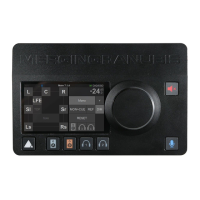
Describes the controls and indicators on the top surface of the Anubis unit, including display and buttons.
Details the features located on the bottom panel, like the mic stand thread.
Describes the side panel components, including the cooling fan and its settings.
Explains the rear panel connectors and controls for power, network (RAVENNA/AES67), and I/O.
Details the front panel connections for headphones and instrument/line inputs.
Guide for establishing network connectivity using the Ethernet port for RAVENNA audio.
Step-by-step instructions for installing the RAVENNA ASIO driver on Windows PCs.
Instructions for installing the Virtual Audio Device driver on macOS for RAVENNA/AES67.
How to connect and use the Anubis via its DC power adapter (9-15V DC).
Guide for powering the Anubis using Power-over-Ethernet (PoE+ IEEE 802.3at).
Procedure for powering the Anubis device on and off using the rear panel switch.
Explains the functionality and usage of the Anubis rotary control knob for various adjustments.
Describes the information displayed on the Anubis status bar, including indicators and sampling rate.
Details the various input options like 48V phantom power, mic/line switching, and gain.
Technical explanation of the Anubis's dual gain analog-to-digital conversion circuit for expanded headroom.
Explains the split channel functionality for flexible signal routing and independent gain control.
Covers general device configurations like sampling rate, latency, and display/network settings.
Adjusts the brightness of the TFT display using the rotary encoder.
Configures the cooling fan's operational thresholds and modes (Low, Mid, High).
Stops the fan when the talkback button is engaged, resuming when released.
Configuration for obtaining an IP address for network connectivity (Manual or Auto).
Configuration options for the device's metering display, including hot, alignment, decay, and peak hold.
Functionality for saving and loading device configurations and settings for quick project switching.
How to configure and manage audio sources for monitoring, including creation and patching.
Steps to create and configure new monitor sets for output routing and control.
Defines the type of monitor output (Speaker Set, Headphones, Cue) and its features.
Configuration and usage of the built-in and external talkback features, including triggers and sources.
Settings for adjusting maximum, reference, and dim listening levels for monitor sets.
Configuration options for input channels, including split channel functionality for flexible routing.
Configuration for output settings, including roll-off filters and channel trims.
Options for rebooting, saving configuration, or resetting to factory defaults.
Diagram illustrating the signal path for PCM audio formats within the Anubis.
Explanation of the Anubis monitoring engine and signal routing for comprehensive control.
Core concepts for understanding sources and monitor routing in the Anubis monitoring system.
Overview of the available monitor types (Speaker Set, Headphones, Cue) and their features.
The primary page for monitoring setup and control, accessing speaker set configurations.
Page for selecting and managing audio sources for monitoring, including standard and AoIP streams.
Page displaying metering information for sources and monitors with level and peak functions.
Controls for managing speaker sets within the monitor page, including mute, solo, and polarity.
Interface for selecting and configuring audio sources for monitoring, including standard and AoIP streams.
A fundamental setup for monitoring DAW output with speakers and headphones.
Configuration for monitoring surround sound setups with RAVENNA/AES67 devices like Horus or Hapi.
Setting up microphones and instruments for recording and monitoring DAW outputs with cues.
How to set up a low-latency cue mix for performers using the Headphones 1 monitor set.
Configuring dual talkback systems using RAVENNA/AES67 devices for studio communication.
Connecting and configuring MIDI devices with the Anubis unit for DAW and sound module integration.
Steps to access the Anubis monitoring interface via a web browser on PC or Mac.
Detailed steps for updating the Anubis firmware using ANEMAN.
Comprehensive list of technical specifications for the Anubis device, including power and I/O details.
Pinout details for MIDI connectors used with the Anubis.
Common problems and their solutions for the Anubis device, covering startup, connectivity, and settings.
Links to downloads, knowledge base, support, website, and YouTube channel for the Anubis.
 General
| Type | Audio Interface |
|---|---|
| Connectivity | Ethernet (AES67/RAVENNA) |
| Mic Preamps | 2 |
| Control | Touchscreen |
| Inputs | 2 x AES/EBU |
| Outputs | 2 x AES/EBU |
| Phantom Power | +48V |

 To Next Page