BOOST
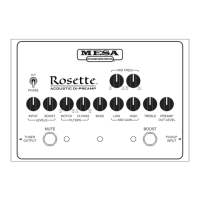
This control sets the amount of BOOST (or Solo) level applied when the BOOST FOOTSWITCH is engaged. Fully
counterclockwise there is almost no gain increase, and fully clockwise there is about 6dB gain increase applied to the original level.
NOTCH FILTER
This control sets the frequency point where a narrow notch (cut) in the response is positioned. This filter is
used to remove feedback caused by excessive resonance from the body of the acoustic instrument by decreasing the amount of
energy amplified within that resonant band. If low or low mid frequency resonance/feedback is encountered (more common at higher
volumes), slowly rotate clockwise (from 7:00/off) until the resonance drops out or diminishes greatly in volume. Generally, this control
would be used after the HI-PASS FILTER control has been set. The sweep range of the notch is from 40Hz to 500Hz. Set at the 40Hz
position the filter is effectively bypassed/off.
HI-PASS FILTER
This control is an important feature in establishing control over the extreme low frequency response, especially
under higher volume conditions. This precision 2-pole variable frequency filter has a turnover frequency that sweeps from 40Hz –
200Hz with a smooth, minimum-ripple response. While HPF’s have been standard fare within the pro audio industry for decades, this
feature has only recently begun to appear in acoustic instrument and bass amplifiers within the past few years (with a few notable
exceptions). This variable filter helps you coordinate the sub-sonic harmonics generated by the acoustic cavity of larger instruments
(like cello, mando-cello, upright bass, viola, jumbo guitars and even some dreadnought guitars). Starting with the control fully counter-
clockwise, plug in your instrument and slowly increase the INPUT until you hear the very beginning of low frequency feedback (don’t
let it run away into excessive feedback, of course). At this point, rotate the HI-PASS FILTER control clockwise until this low frequency
ring is no longer a problem. As a tone enhancement feature, if your instrument feels heavy or “woofy” on the low end, try rotating this
control clockwise until you hear adequate improvement before attempting to adjust the BASS EQ. Experimentation and practice is
key with this approach and it can be a musician’s best kept secret to getting great Tone in many different musical applications – live
performance, recording, and mixing especially.
BASS
This active EQ control is responsible for the amount of low frequencies present in the signal, relative to the rest of the
spectrum. Low frequencies (150Hz and below) are responsible for the bottom-end, roundness, fullness and “feel” of the tone. These
are an active controls with boost and cut, the amount of boost proportional to the clockwise rotation to the right of “flat” (12:00 straight
up) position and the amount of cut proportional to the counter-clockwise rotation to the left of “flat” (12:00 straight up) position. As
with everything related to EQ, generally, a little bit goes a long way. Use enough to get the job done and no more. Note that if you
are experiencing low frequency woofiness, or tubbiness, try turning this control down a little bit. This is a shelving style filter. It will be
helpful to first fine tune the response with the variable HI-PASS FILTER before using the BASS EQ control, as often a combination
of the BASS EQ and HI-PASS FILTER is more effective than applying only one of these low frequency controls.
LOW & HIGH Sweepable MID BANDS
These Active EQ controls are responsible for the amount of LOW and HIGH MIDRANGE
frequencies present in the signal, relative to the rest of the spectrum. Like all semi-parametric tone controls, they are comprised of
the GAIN control that determines either a cut or a boost of the selected Frequency range from a 12:00 “flat” (neither cut or boost)
setting, and a FREQUENCY control that allows selection of the frequency you wish to control within a wide and adjustable range.
SUBTRACT FOR TONE! SETTING THE SWEEPABLE MIDS
Recording and live sound engineers have long known that, when searching for a great sound, removing what you don’t want works
far better than boosting what you find pleasing to achieve a balanced sound. This method reduces noise floor, avoids clipping and
produces better overall results than trying to boost frequencies. Don’t frustrate yourself by ignoring this time-proven Golden Rule of
Audio and you will arrive at great Tone quickly and easily.
LOW MID BAND: With the BASS set at 10:00 and the TREBLE set at 11:00, set both LOW and HIGH MID FREQUENCY Controls
all at NOON. Increase the LOW MID GAIN to 2:00 and sweep the LOW MID FREQUENCY back and forth from 12:00 until you hear
a frequency you do not like and stop there. Then, reduce the LOW MID GAIN until you reach a desired blend, keeping in mind you do
not want to remove too much of that frequency, or the sound will be unnatural.
HIGH MID BAND: Repeat the same procedure with the HIGH MID FREQUENCY Control; Increase the HIGH MID GAIN to 2:00,
sweep the HIGH MID FREQUENCY back and forth from 12:00 until you hear a frequency you do not like and stop there. Then, reduce
PAGE 3


 To Next Page
 Loading...