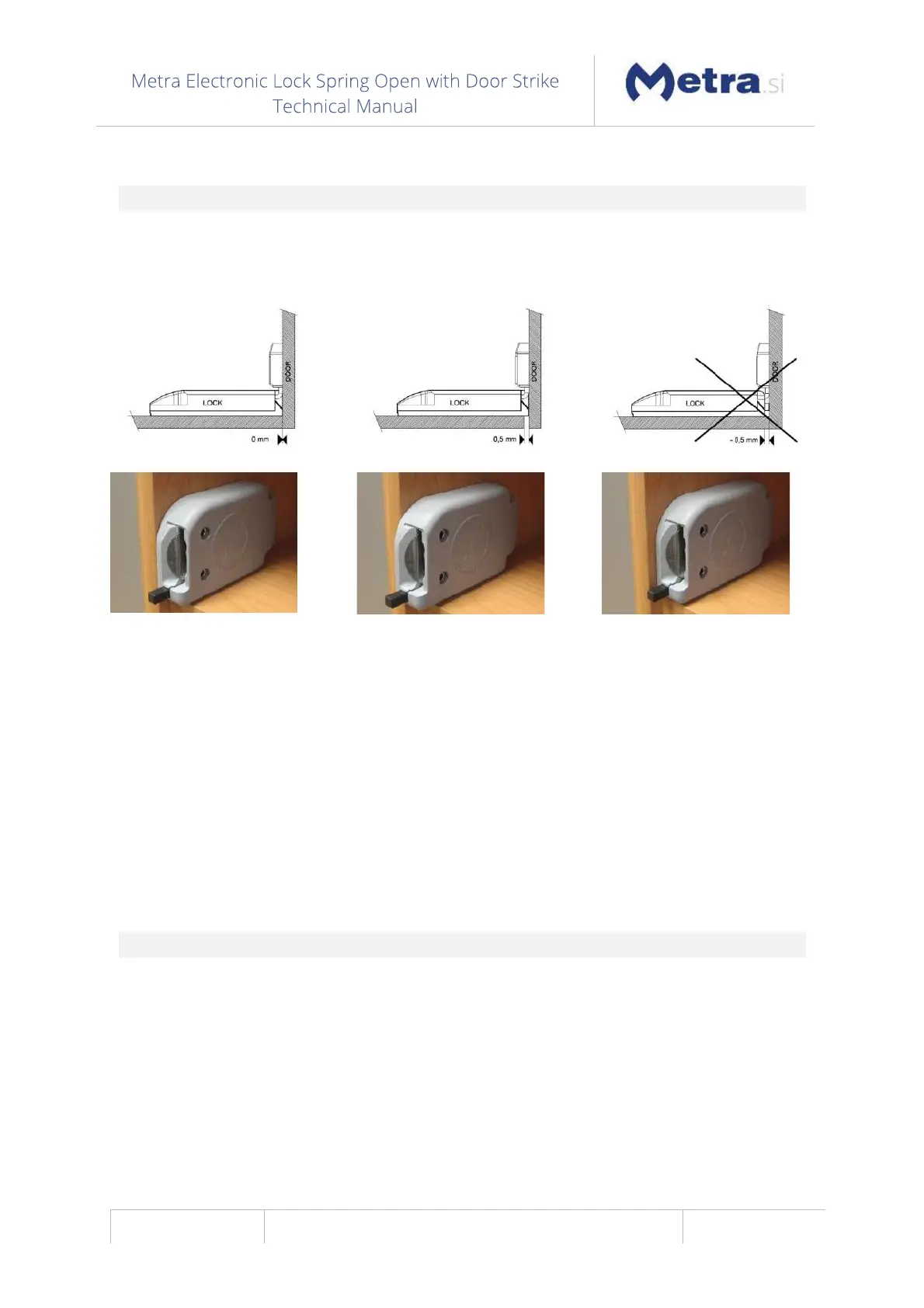
General rule is that the lock is better to be placed a bit forward of the closed inner
plane of the door and should never be even a fraction back from that plane.
OK – Lock tip is even with the
inner plane of the door, the
door will reach the lock tip.
Locking is possible.
OK – Lock tip is over the
inner plane of the door, the
door will reach the lock tip.
Locking is possible.
WRONG! – Lock tip is behind
the inner plane of the door,
the door CAN NOT reach the
lock tip. Locking is NOT
possible.
ATTENTION
With the term inner plane of the door we refer to the surface on which the door strike will
be placed and should be able to completely compress the ejector and touch the lock front. All
eventual parameters such as rubber bumpers, bent doors, hinge type, euro deposit pad, etc
should be taken into consideration.
5. ADJUSTING THE EJECTOR SPRING FORCE
Depending on the door size and type of the hinges you might need to adjust the spring
force. Ejector is important part of the lock and should be able to push the doors open
when unlocked. For the great majority of locker and hinges type factory settings (normal
spring force) are in order. However, in some cases (very small doors, spring - shut hinges,
etc.) the spring might need to be adjusted. There are two stronger positions and two
weaker positions (from approx. 0.5 to 1.5 times of original force). With this intention a
2.5/16 mm screw is supplied. Be sure to screw it all the way in so the head is level with
the lock base.


 To Next Page