is done on the IC; the external electronics only supplies 5V power and two digital
lines to select one of four ranges. This represents a tremendous simplification of
the magnetometer as a whole. (Image courtesy of Senis GmbH)
But there’s more… All Hall magnetometers suffer from measurement offset – in
other words, the instrument measures a non-zero result even in a zero field.
What’s more, this offset varies with time and temperature. One should calibrate
the instrument in a zero-gauss chamber before each use, and the instrument has
to continuously correct the measurement for temperature variations. Even so,
offset remains a significant source of error.
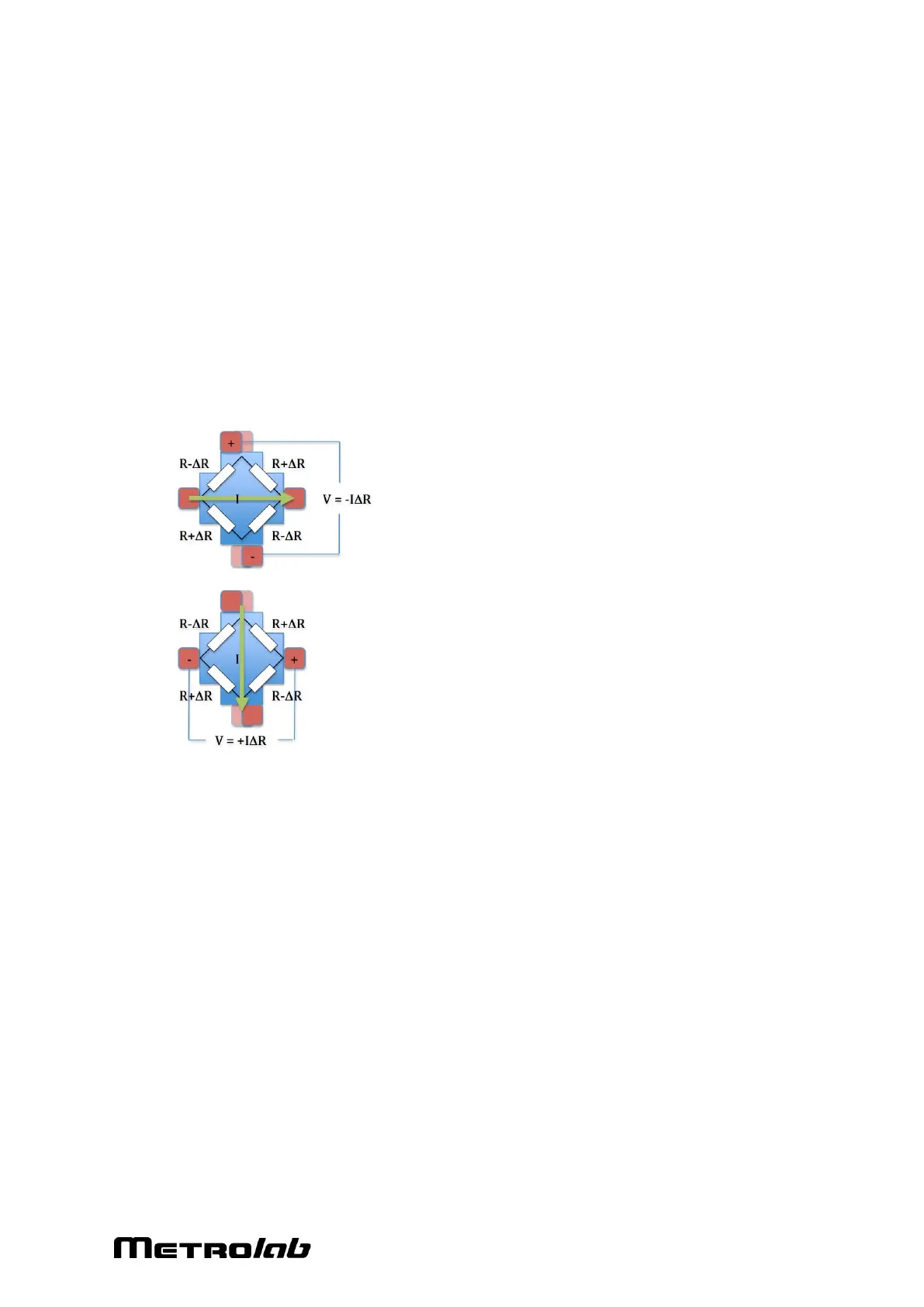
Where does offset come from? One common source
is misalignment of the terminals. As shown in the
figure, the effect can be modeled with a resistance
network, where the longer current paths result in
higher resistances, and vice versa. In our example,
the resulting offset voltage would be negative. But if
we exchange the current and voltage leads, thereby
functionally rotating the Hall element by 90°, the offset
voltage becomes positive. It is important to note that
the Hall voltage is unaffected by this rotation.
The MAG3D exploits this effect in two ways. The
“spinning current” technique, where the voltage and current leads are rapidly
switched back and forth and the results averaged, compensates for manufacturing
imperfections such as terminal misalignment. In addition, by wiring orthogonally
oriented pairs of sensors in series, the MAG3D increases its sensitivity while at
the same time compensating for dynamic offset errors. This includes the planar
Hall effect, whose magnitude changes sign when the current direction is rotated
by 90°. The combination of these techniques results in a sensor with significantly
reduced offset, offset drift, and sensitivity to planar Hall effect.


 To Next Page