Need help?
Do you have a question about the Meyra 1.163 and is the answer not in the manual?
Expresses gratitude for choosing the scooter and outlines the manual's purpose.
Instructions for inspecting the scooter for damage upon delivery and reporting issues.
Details German legal requirements and liability for scooters under 6 km/h.
Explains CE directive compliance and potential high-frequency interference.
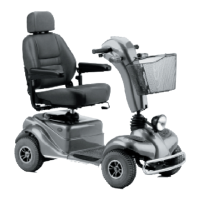
Illustrates and lists the main components of the Model 1.163 scooter.
Describes the horn button, status indicator, and battery capacity indicator on the control panel.
Explains the speed adjustment wheel and the location for inserting the drive key.
Details the correct procedure for inserting and removing the drive key for operation.
Identifies the location of the battery charging socket and its protective cover.
Advises on safe handling, general use, and references other safety information.
Outlines the scooter's environmental friendliness and compliance with EN 614-1.
Warns about potential interference from mobile phones and other devices.
Emphasizes the need to check functions and safety before each journey.
Guides on safe initial driving practice, speed adjustment, and obstacle handling.
Covers safe driving on curves, slopes, and handling obstacles like curbs.
Explains how to lock the scooter using the drive key to prevent unauthorized use.
Details how to engage push mode for manual maneuvering on level surfaces.
Explains how to switch to motor mode for driving operations.
Recommends charging batteries before first use and refers to the charging chapter.
Provides safety warnings for entering/exiting the seat and inserting objects into sockets.
Guides on loosening, adjusting, and retightening the steering column.
Explains how to disengage the steering column lock using a lever.
Describes inserting the drive key and checking the operational readiness indicator.
Explains how the battery indicator reflects charge condition after switch-on.
Details meanings of slow or rapid blinking of the operational readiness indicator.
Advises on immediate recharging after daily use and monthly for storage.
Specifies using suitable chargers and the impact on guarantee validity.
Highlights safety regarding charging, sparks, and synthetic floor covers.
Step-by-step guide for connecting the battery charger to the scooter and power outlet.
Recommends overnight charging (approx. 8 hours) and proper disconnection sequence.
Guides on pre-operation checks, referring to maintenance instructions.
Explains the meaning of different colors on the battery indicator and its limitations.
Discusses factors influencing battery value display like temperature and load.
Explains how speed is pre-selected upon switching on and adjusted via a knob.
Details continuous speed adjustment using the turning knob (turtle to rabbit).
Warns about accident risk from unsuitable speed pre-selection, especially in confined spaces.
Advises careful driving during first journeys with pre-selected low speed.
Covers abrupt stops, inclines, obstacles, and mobile phone usage while driving.
Explains how the accelerator lever controls driving speed and direction.
Details moving the lever for desired speed and direction (forward/backward).
Describes dosed braking and emergency braking using the accelerator lever.
Guides on using handlebars for turns and reducing speed, with tilting caution.
Explains the electric service brake and the automatic parking brake.
Advises timely braking and warns about abrupt downhill braking.
Notes that braking distance depends on road surface and speed.
Instructs passengers to exit the scooter for vehicle transport to ensure safety.
Mentions the possibility of reducing dimensions for transport and refers to a specific chapter.
Provides instructions on how to properly secure the scooter using approved devices.
Details switching off the scooter and removing the battery pack for transport security.
Outlines steps to reduce scooter size, including removing the basket and seat.
Explains how to lock and swivel the steering column down, with safety warnings.
Lists components that can be disassembled for transport in a small vehicle.
Step-by-step guide for safely removing the battery pack, including loosening straps.
Details disconnecting the electrical plug and activating the steering column lock.
Explains removing the locking bolt, swiveling the drive unit, and placing it on the floor.
Covers pre-assembly checks and the process of attaching the drive unit to the chassis.
Details re-connecting electrical parts and inserting the battery pack.
Provides safety information for loading with ramps or lifting platforms.
Describes different ramp types like parted, one-piece, and firm ramps.
Covers safety for unloading, ramp incline, and securing ramps.
Specifies requirements for approved ramps and their load capacity with/without driver.
Explains how to adjust the seat and detach it from the scooter.
Details the process of adjusting the seat height using a plug bolt.
Guides on swiveling arm supports up and adjusting their angle.
Explains how to adjust the seat width by moving the arm supports.
Describes how to fold down and raise the back support.
Details how to lift off and replace the front basket on its holder.
Highlights the necessity of regular care for safety, readiness, and value.
Provides guidelines on maintaining correct tyre pressure and checking tread condition.
Advises on cleaning methods for the scooter, including upholstery, plastic, and finish.
Recommends specific agents for disinfection and notes cleaning upholstery first.
Covers reinstallation procedures and how to contact customer service for help.
Details ordering spare parts, safety precautions, and vehicle identification.
Outlines guidelines for disposing of packaging, metal, plastic, and electrical components.
Discusses special drive batteries, sealed types, and when to replace them.
Covers initial recharging and safety warnings related to batteries.
Provides instructions for battery storage, such as before winter pauses.
Advises on periodic charging to increase battery life during extended pauses.
Details critical safety measures when handling battery acid, including first aid.
Specifies technical requirements for the scooter's charger and compatible batteries.
Details the pin assignments for the charging plug and socket for correct connection.
Explains the location and function of the overload safety device and its reset.
Outlines safety precautions and technical knowledge needed for wheel changes.
Details the process of unscrewing the hexagon nut to detach the drive wheel.
Explains how to disassemble steering wheels by unscrewing the hexagon nut.
Guides on deflating tyres, removing nuts, and separating rim halves safely.
Information for authorized dealers regarding service manuals and inspections.
States that the scooter's driving behavior is pre-set and not programmable.
Provides guidance for carrying out maintenance work and safety precautions.
Recommends annual inspections by specialist workshops for safety and reliability.
Details checks for brake operation and wheel attachment tightness before starting.
Instructs on checking tyre air pressure and minimum tread depth.
Guides on visually inspecting the frame, components, and electrical connections for damage.
Outlines battery maintenance schedules and general checks every 2-6 months.
Specifies that safety inspections are to be performed by an authorized dealer annually.
Troubleshooting steps for the operational readiness light not illuminating or blinking.
Resolving issues with indicator gauge blinking and the scooter failing to start.
Lists factors affecting kilometric performance and conditions for nominal values.
Details the scooter's hill climbing ability and gradient limitations.
Explains the overload safety device and its function as an automatic circuit breaker.
Lists the specific tools required for scooter adjustments and maintenance.
Highlights essential warning stickers on the scooter and the importance of reading documentation.
Explains symbols related to push mode, drive mode, and touching areas.
Provides overall model details, type plate information, and class of use.
Details the drive control, overall dimensions, seat adjustments, and wheel sizes.
Lists dimensions for transport and specifications for sealed drive batteries.
Specifies the scooter's range based on battery type and charger details.
Lists key performance data including speed, power, climb-in height, and ground clearance.
Details maximum permissible weights for total load, user, axle, and component weights.
Fields for recording vehicle model, delivery note, and identification numbers.
Sections for recording pre-delivery and recommended safety inspections with dealer stamps.
A dedicated section for user notes and observations.
Outlines the warranty periods for frame, electronics, and batteries.
Details damages and improper actions that void the guarantee and product liability.
Instructions and fields for filling out the guarantee coupon for registration.


 To Next Page

 General