All living cells contain the enzyme phosphatase. In the
presence of phosphatase, the indicator in the 3M
™
Petrifilm
™
Yeast and Mould Count Plates is activated and stains the
yeast and mould colonies a blue colour.
Some raw and processed food products that contain living
cells (and therefore, phosphatase) may also cause this blue
colour reaction to occur. Two types of colour reaction from
products are sometimes seen: a uniform blue background
colour, or intense, pinpoint blue spots (often seen with
spices or granulated products).
A colour reaction caused by natural phosphatase in a
product can be distinguished from yeast and mould
colonies by one or more of the following techniques:
1. Dilution: When possible, further dilution will eliminate
blue background colour, or reduce the number of pinpoint
blue spots.
2. Late Supernate: Mix sample and let settle 3-5 minutes
to eliminate large product particles that can often cause the
pinpoint colour reactions.
3. Incubation Temperature: Incubate plates at the proper
temperature 20-25°C. Enzyme (phosphatase) reactions occur
faster as temperatures increase.
4. Check & Note: Check Petrifilm Yeast and Mould
count plates after 24-48 hours of incubation. Product
colour change can occur within 24-48 hours. Make note
of any colour seen, to aid in final interpretation.
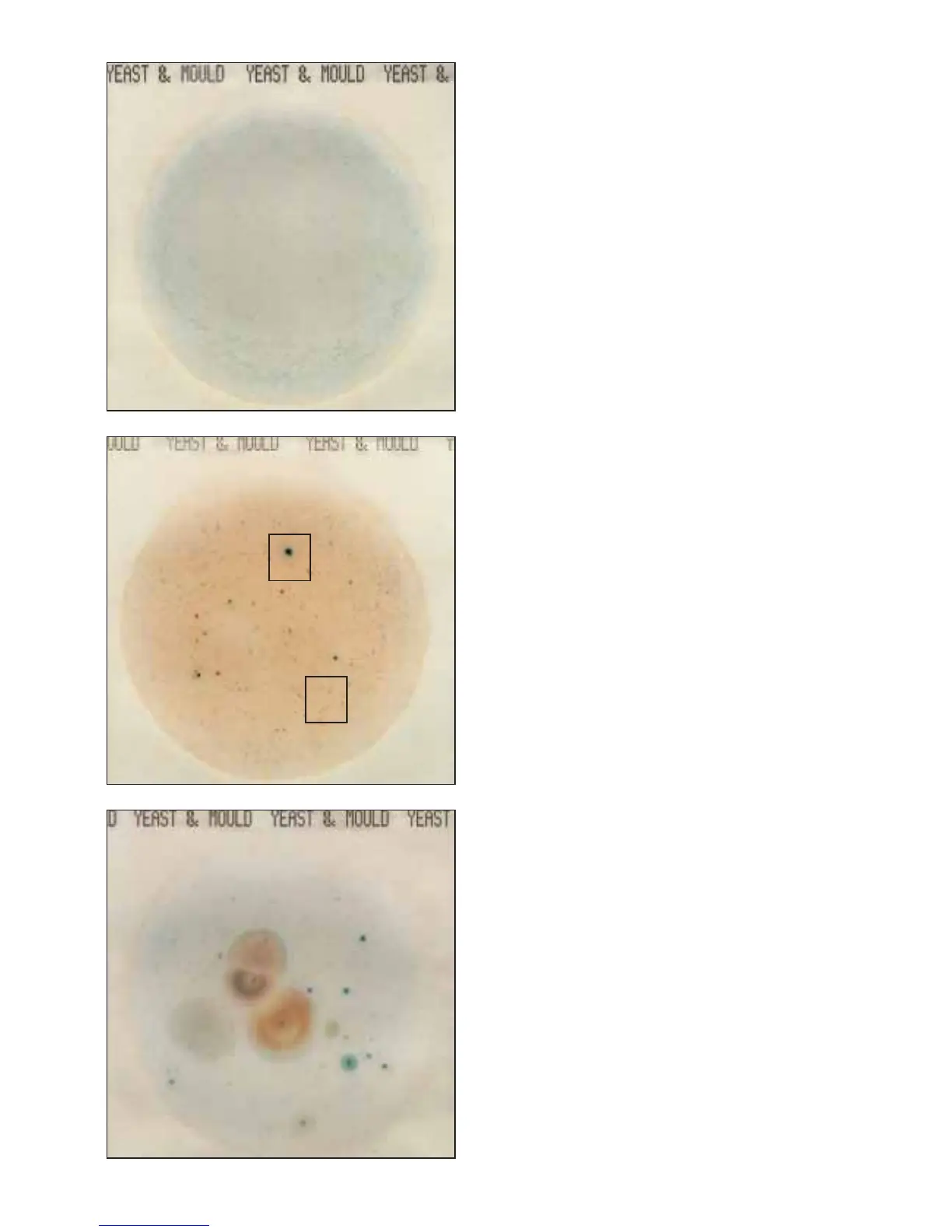
The Petrifilm Yeast and Mould count plate in figure 11,
is an example of a plate with uniform background colour
caused by the "natural phosphatase" present in the sample
tested. The "grainy" appearance is due to particles of
product in the dilution plated. To help distinguish from the
TNTC yeast or mould count, note the edges of the plate.
(Yeast and Mould count = 0)
Figure 12 is an example of intense, pinpoint blue spot
reactions seen occuring from the "natural phosphatase" in
some food products. Note their SHAPE - tiny, pinpoints or
irregularly shaped, and COLOUR - deep blue, that often
look faint, or smeared around the edges of some of the
larger particles. (Yeast and Mould count = 0)
Another example of intense blue pinpoint colour reactions
is shown in figure 13. The pinpoint dots are very bright,
tiny, and irregularly shaped. The yeast colonies are small,
blue-green colonies with defined edges. The mould
colonies are large, variably pigmented colonies with
diffuse edges and centre foci. (Yeast count = 7;
Mould count = 7)
Phosphatase Reaction
Yeast and Mould count = 0
Figure 11
Yeast and Mould count = 0
Figure 12
Yeast count = 7; Mould count = 7
Figure 13



 To Next Page
 Loading...