6
Introduction No. 2:
For Experienced Hams, Enthusiasts or Engineers
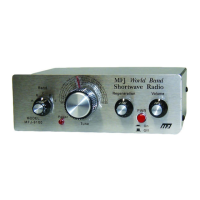
Why use a REGENERATIVE circuit for a kit new for the 1990's? A fair question, but
the MFJ-8100 is not like any regenerative HF receiver you've ever used before!
Our GOAL determined the design and circuitry of this receiver. We wanted the following
features:
• Good reception of both shortwave AM and CW-SSB
• Ease of kit-construction for newcomers
• Reasonable price
• A quality look and feel
• Relatively simple circuit
• No critical alignment requirements
• Low parts count, yet not dependent on specialty IC's
• Purposeful choice of tuning ranges for SWLing anytime.
Satisfactory AM-CW-SSB listening and circuit simplicity were our primary goals.
Despite the popularity of NE602-type "direct conversion'' circuits among today's
experimenters and some kit vendors, direct conversion is not satisfactory for enjoyable
listening to AM shortwave broadcasts. Merely nulling the carrier does not result in true
listenability. Similarly, a multi-band superhet with BFO could not fit our goals of
simplicity and economy.
To meet our goals, we chose to refine the regenerative concept as much as possible, using
contemporary design concepts and component characteristics. Our first goal was to
"tame'' the regeneration process itself to minimize the instability and unwanted
oscillations so typical of traditional regenerative circuits -- and so that even a beginner
can enjoy and understand the use of the Regeneration Control. The result of our re-design
is an HF SWL receiver with better performance than many low-end factory-built
superhets of yesteryear.
Some highlights of our design efforts:
• Significantly reduced RFI back through antenna, a chronic regenerative receiver
shortcoming, through use of carefully designed RF amplifier stage.
• Effective RF filtering between detector and audio sections of the receiver.
• Simplified L-C tuning; notice that there are 5 band switch positions but no coil taps
or second windings!
• Elimination of antenna trimmer so critical in most regenerative designs. We
replaced the traditional trimmer with an RF gain pot that has little effect on
frequency or regeneration.
• Manageable, "tame'' regeneration control circuit. Regeneration begins smoothly with
no pop and has a comfortable adjustment range.


 To Next Page