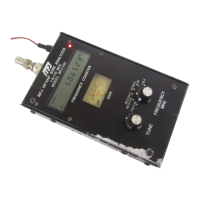
MFJ-259C Instruction Manual HF/VHF SWR Analyzer
22
If calculations and the Vf accurate, your null should occur ~20% below the target frequency to
reflect the added length. Next, calculate a scaling factor to determine exact cut length. You've
initially cut the cable 20% "long and low", so your scaling factor will always be less than 1.0:
[ ] To find the Scaling Factor (SF), divide the null freq. F1 by the target freq. F2: (SF = F1/F2)
[ ] Multiply the Scaling Factor (SF) by the present physical length (SF x LCut) for a final length.
[ ] Cut the stub and confirm the new reactance null (X=0) is on your target frequency.
7.3 Measure Velocity Factor (Vf) of a Unknown Cable: Velocity of Propagation (Vp) and
Velocity Factor (Vf) are terms that express how fast RF propagates on a conductor relative to
the speed of light. Although the two terms are often used interchangeably, Velocity of
Propagation is usually given as a percentage (example: Vp = 66%) while Vf expresses the
percentage as a multiplier for making frequency and length calculations (example: Vf = .66). To
determine Velocity Factor (Vf) for a unknown transmission line:
[ ] Refer to DTF (Chapter 5.5) and find the Electrical Length of your cable in feet.
[ ] Follow the DTF procedure.
Your cable's Electrical Length will be the DTF result without a Vf calculated in to the resut (see
below). Label your result LEL (for Electrical Length).
[ ] Using a tape or rule, measure the Physical Length of your cable in feet. Label it LPH.
[ ] Divide Physical Length by Electrical Length to find Velocity Factor: Vf = LPH / LEL.
Example: If the Electrical Length is 64 feet and the Physical Length is 42' 3" (42.25) feet, then
the measured Vf of the cable calculates 0.66: (42.25 / 64 = .66).
7.4 Impedance of a Transmission Lines or Beverage Antenna: This procedure measures
the Impedance of an unknown transmission line (or Beverage), from 7-650 Ohms. If needed,
the range may be extended using a broadband transformer or a known resistance. Use the
analyzer's Basic Mode (R&X) augmented by the Impedance Magnitude feature (Z) provided by
the Gate key.
Methodology: Transmission lines have a "characteristic impedance" (50 Ohms, 70 Ohms,
300, 450 Ohms, etc). When a line is terminated by a load of the same impedance, no
impedance transformation occurs between the near end and far end, regardless of electrical
length. However, if we introduce a mismatch at one end, the impedance at the far end cycles
above and below the cable's characteristic impedance with changing frequency.
Dist. to fault
64.0 ft x Vf


 To Next Page
 Loading...