EasyManua.ls Logo

MFJ MFJ-956 - User Manual

Default Icon
2 pages
Print Icon
To Next Page IconTo Next Page
Loading...
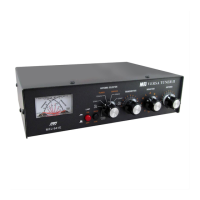
MFJ-956
Shortwave
/
Longwave
Antenna
Tuner
Your
MFJ-956
tuner
is
actually
a
tunable
preselector
designed
to
enhance
reception
over
the
continuous
150
KHz
to
30
MHz
spectrum.
INSTALLATION
1.
Connect
the
antenna
to
the
antenna
SO-239
connector
on
the
tuner.
2.
Connect
the
receiver
to
the
receiver
SO-239
connector
on
the
tuner.
OPERATION
Be
sure
the
band
control
is
properly
set
to
frequency
band.
Set
the
band
switch
to
BYP
position.
Tune
your
receiver
in
the
normal
manner,
listening
for
a
desired
signal.
Then,
switch
your
tuner
band
control
to
the
appropriate
frequency
band
and
adjust
the
TUNE
control
for
best
reception.
It
is
not
uncommon
for
the
user
to
notice
very
little
difference
with
or
without
the
tuner
on
some
frequencies
when
receiving
conditions
are
optimum.
This
is
normal.
Usually,
the
greatest
improvement
will
be
noted
on
the
lower
frequencies
and
when
images
and
intermodulation
are
bothering
shortwave
reception.
Note:
The
frequencies
indicated
on
the
RANGE
dial
are
approximate
and
used
for
initial
tuning.
It
may
be
necessary
to
switch
on
position
higher
or
lower
in
frequency
range
for
band-edge
signals
|
CAUTION:
The
tuner
is
designed
for
receiving
purposes
only
and
§
should
not
be
used
with
transmitting
equipment.
As
|
with
all
outside
antennas,
be
sure
the
tuner
is
|
disconnected
from
your
antenna
when
not
in
use
to
|
avoid
lighting
damage.
Question and Answer IconNeed help?

Do you have a question about the MFJ MFJ-956 and is the answer not in the manual?

Overview

This document describes the MFJ-956 Shortwave / Longwave Antenna Tuner, a tunable preselector designed to enhance radio reception.

Function Description

The MFJ-956 is primarily a tunable preselector, not a traditional antenna tuner for impedance matching. Its main function is to improve reception over a broad frequency spectrum by allowing the user to select specific frequency bands and fine-tune for optimal signal reception. It is specifically designed for receiving purposes and should not be used with transmitting equipment. The device aims to mitigate issues like images and intermodulation, which can degrade shortwave reception, especially on lower frequencies.

Important Technical Specifications

  • Frequency Coverage: The tuner operates over a continuous spectrum from 150 KHz to 30 MHz. This wide range covers both longwave and shortwave bands.
  • Connectors: It features two SO-239 connectors: one for the antenna and one for the receiver.
  • Internal Components (from schematic):
    • Inductors: The device incorporates a switched bank of inductors, including 2.5 mH, 330 uH, 22 uH, and 1 uH. These inductors are likely selected via the "BAND" control to cover different frequency ranges.
    • Variable Capacitor: A 365 pF variable capacitor is used for fine-tuning, controlled by the "TUNE" knob.
    • Bypass Switch: A bypass function allows the user to switch the tuner out of the circuit, connecting the antenna directly to the receiver.
  • Power: The manual does not specify external power requirements, suggesting it is a passive device.

Usage Features

  • Installation:
    1. Connect the external antenna to the SO-239 connector labeled "ANTENNA" on the tuner.
    2. Connect the receiver to the SO-239 connector labeled "RECEIVER" on the tuner.
  • Operation:
    1. Initially, ensure the "BAND" control is set to the "BYP" (Bypass) position.
    2. Tune the receiver to the desired signal in the normal manner.
    3. Once a signal is found, switch the tuner's "BAND" control to the appropriate frequency band that corresponds to the receiver's frequency.
    4. Adjust the "TUNE" control on the tuner for the best possible reception.
  • Reception Improvement: The greatest improvement in reception is typically observed on lower frequencies and when issues like images and intermodulation are present, which often bother shortwave reception. In optimal receiving conditions, the user might notice little difference with or without the tuner.
  • Range Dial: The frequencies indicated on the "RANGE" dial are approximate and serve as an initial guide. For signals near the edges of a band, it may be necessary to switch the "BAND" control to a position slightly higher or lower than the indicated range for optimal tuning.
  • Safety Precaution: The tuner is strictly for receiving purposes. It must not be used with transmitting equipment. As with all outdoor antennas, the tuner should be disconnected from the antenna when not in use to prevent damage from lightning strikes.

Maintenance Features

  • Troubleshooting: If problems arise, users are advised to first consult the relevant sections of this manual.
  • Technical Support: If the manual does not resolve the issue, MFJ Technical Service can be contacted by phone at 662-323-0549 or the MFJ Factory at 662-323-5869. When contacting support, it is recommended to have the unit, manual, and all station information readily available to answer technician questions.
  • Contact Information: Questions can also be sent via mail to MFJ Enterprises, Inc., 300 Industrial Park Road, Starkville, MS 39759; by FAX to 662-323-6551; or by email to techinfo@mfjenterprises.com. When sending inquiries, a complete description of the problem, an explanation of how the unit is being used, and a full description of the station are requested.
  • Lightning Protection: To avoid lightning damage, the tuner should be disconnected from the antenna when not in use.

MFJ MFJ-956 Specifications

General IconGeneral
BrandMFJ
ModelMFJ-956
CategoryTuner
LanguageEnglish

Related product manuals